
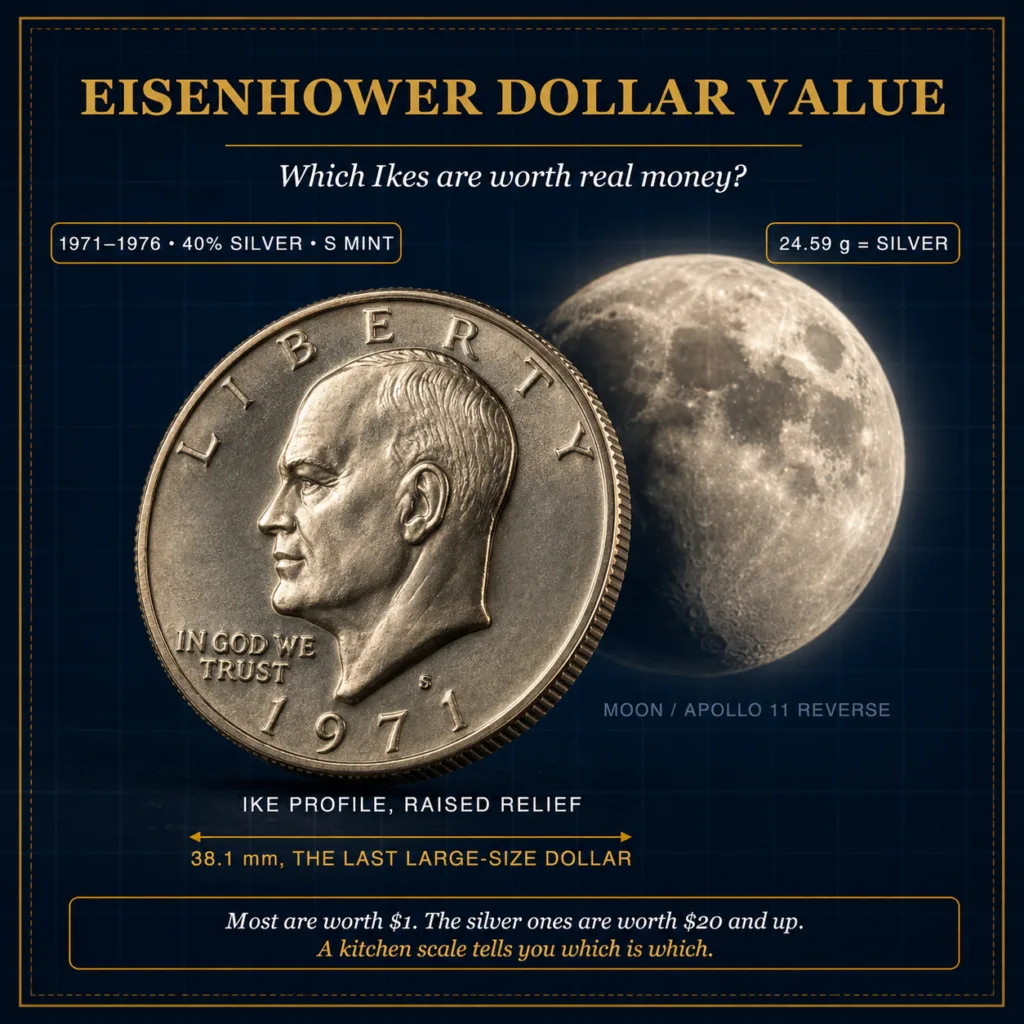
You found a huge, heavy dollar coin with Dwight Eisenhower on the front, and you want to know the same thing everyone does: is it worth anything? Here is the honest answer about Eisenhower dollar value, up front: most of these coins are worth exactly one dollar. The exceptions are the 40% silver versions struck in San Francisco between 1971 and 1976, which melt for a little over $20 each with silver trading near $65 an ounce, and a short list of varieties that collectors pay hundreds for. Telling them apart takes a kitchen scale, decent light, and about two minutes.
That gap between one dollar and twenty is the whole story. Two Ikes from 1976 can look nearly identical side by side, yet one spent that year in a casino bucket and the other left the Mint in a sealed blue envelope. One buys a candy bar today. The other buys lunch for two. So before you spend, sell, or donate a jar of these things, it pays to know exactly which is which.
The last big dollar America ever made
The Eisenhower dollar exists because two things happened within a few months of each other in 1969: Dwight Eisenhower died in March, and Apollo 11 landed on the moon in July. Congress rolled both events into one coin, and the Mint’s chief engraver, Frank Gasparro, designed both sides. The front is Ike’s profile. The back is the Apollo 11 mission insignia, an eagle landing on the lunar surface with an olive branch in its talons. First struck in 1971, it was the first dollar coin the United States had made since the Peace dollar series ended in 1935.
It is also a physically enormous coin, 38.1 mm across, the same size as the Morgan and Peace dollars of the silver era. That size turned out to be its undoing. Nobody wanted to carry them. They wore holes in pockets, jammed in vending machines, and mostly circulated in Nevada casinos, which is why so many surviving Ikes have the dull, scuffed look of a coin that spent a decade on a craps table. The Mint gave up after 1978 and replaced the Ike with the small Susan B. Anthony dollar, which people hated for the opposite reason. The Eisenhower dollar was the last full-size dollar coin America ever struck for circulation, and it still turns up in inherited coin jars constantly.
Which Eisenhower dollars actually contain silver
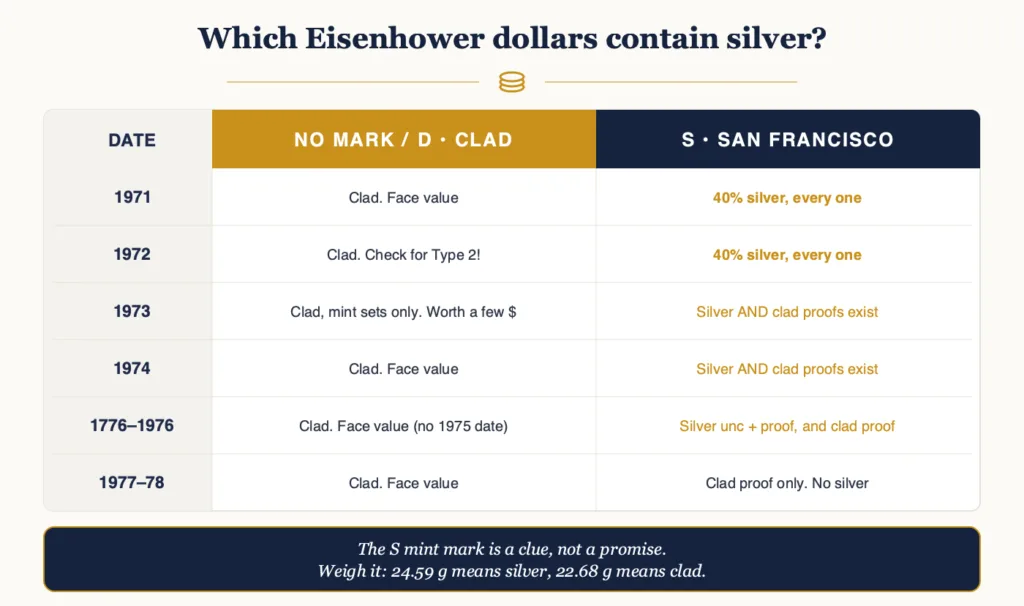
By 1971 the government had already pulled silver out of everyday money, a story told in the changeover of 1965, when the US stopped making silver coins. So every Eisenhower dollar you could get at a bank came in the same copper-nickel clad sandwich as a quarter: no silver at all. Philadelphia and Denver struck those by the hundreds of millions.
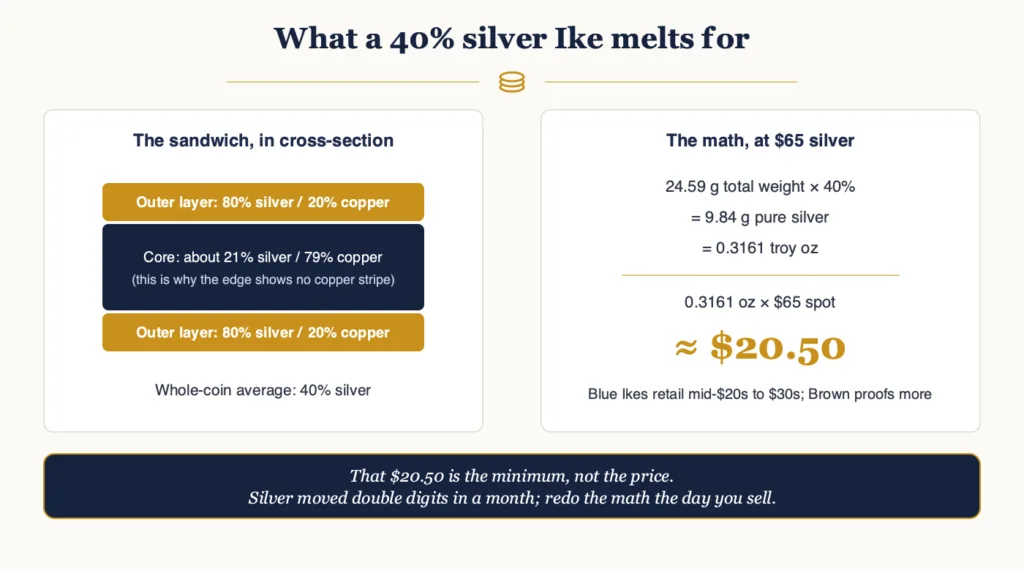
But the Mint knew collectors would want something better, so San Francisco struck a parallel series in 40% silver and sold it directly to the public at a premium. From 1971 through 1976, those special Ikes came two ways. Uncirculated coins arrived in a blue envelope, and collectors still call them Blue Ikes. Proof coins arrived in a brown wood-grain box, the Brown Ikes. The composition is a sandwich too, outer layers of 80% silver bonded to a mostly copper core, and it works out to 0.3161 troy ounces of pure silver per coin, per the specifications in Stack’s Bowers’ silver Eisenhower type guide.
The packaging matters a little, too. A Blue Ike still sealed in its cellophane with the small blue token, or a Brown Ike in an intact wood-grain box, sells a few dollars better than the same coin loose, because collectors building original sets want the whole presentation. A torn envelope does nothing to the silver inside it, so do not agonize over one, but if the packaging survives, keep it with the coin instead of tossing it.
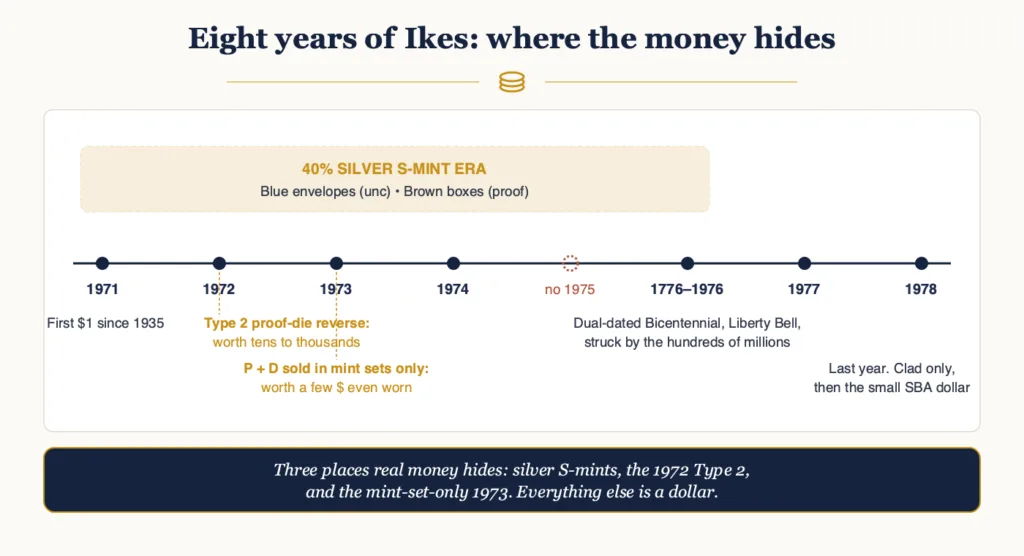
Here is the part that trips people up: the S mint mark is a clue, not a promise. Every 1971-S and 1972-S dollar is silver. But 1973-S and 1974-S coins exist in both silver and clad proof versions, and 1976-S coins come three ways: silver uncirculated, silver proof, and clad proof. Then the rule flips entirely. The 1977-S and 1978-S dollars are clad proofs only. Not one 1977 or 1978 Ike contains any silver, S mint mark or not. And no Eisenhower dollar is dated 1975 at all, because the Mint spent that year striking Bicentennial coins dual-dated 1776-1976.
Eisenhower dollar value today: the 40% silver math
Start with the floor, which is melt value. Each silver Ike carries 0.3161 troy ounces of silver, and with spot silver around $65 in mid-August 2026, per Trading Economics price data, that puts the metal alone at roughly $20.50 per coin, the same figure Coinflation’s live Ike melt calculator lands on today. Silver has been on a run strong enough that this floor moved up by double digits in a single month, so the math is worth redoing on the day you act. The arithmetic itself is simple, and the same method in our guide to calculating the melt value of silver coins works for any of them: total weight, times purity, times spot.
Retail prices sit above that floor. Common-date Blue Ikes in their original packaging typically sell in the mid-$20s to $30s, Brown Ike proofs a bit higher, and the scarcer issues climb from there. Condition drives the top end hard. Price guides like Greysheet’s Eisenhower dollar tables show ordinary silver Ikes in ordinary grades trading within a few dollars of melt, while the same coins in top-population uncirculated grades have brought four figures at auction. That is the collector market doing what it always does, paying for the best-preserved handful out of millions.
One warning that saves people money: a 40% silver Ike is bullion-adjacent, not rare. Dealers buy common ones by the melt formula, the same way they buy 90% junk silver coins, usually at a small discount to spot because 40% material costs more to refine per ounce of silver recovered. If a buyer quotes you far below the melt math, walk. If a seller asks triple melt for a common Blue Ike “because it’s silver,” walk the other way.
The clad Ikes that still bring money
A few copper-nickel Ikes are worth more than the silver ones, which surprises everybody.
The famous one is the 1972 Philadelphia Type 2. Gasparro’s earth-and-eagle reverse went through three die versions in 1972, and the Type 2, identifiable by a funnel-shaped Florida and Caribbean islands flattened almost to nothing, came from a proof die that was pressed into circulation service by mistake. PCGS’s guide to the three 1972 die types walks through how to spot each one. A worn 1972 Type 2 brings tens of dollars; choice uncirculated examples run into the hundreds and beyond. Checking the reverse of every 1972 Ike with no mint mark takes ten seconds and is the closest thing to a lottery ticket in this series.
The sleeper is the 1973. Philadelphia and Denver struck 1973 dollars only for annual mint sets, about two million from each mint, and never released them to circulation. Even a mishandled one is worth several dollars, and crisp examples bring more. That one is worth an extra beat of attention, because a 1973 looks exactly like every other clad Ike. Nobody checks the date, which is precisely why they keep turning up in casino buckets and bank rolls decades later.
The 1776-1976 Bicentennial coins are the opposite case. The Mint held a public design competition for the celebration, and a 21-year-old art student named Dennis R. Williams won the dollar with his Liberty Bell superimposed on the moon, making him the youngest person ever to design a circulating US coin. Charming story, enormous mintage: struck through both 1975 and 1976, Bicentennial dollars exist in such quantities that a circulated one is worth exactly a dollar. The exception is at the margins, where the Type 1 variety with thick, blocky reverse lettering carries a modest premium in fully uncirculated condition. Certification data at NGC’s Eisenhower dollar census shows how sharply value concentrates in the top grades across all of these.
How to check your Ikes in two minutes
You need a kitchen scale that reads grams and decent light. First look at the date and mint mark, above the date on the front. Anything from Philadelphia (no mark) or Denver (D) is clad, worth face value with the exceptions above. For an S coin dated 1971 through 1976, weigh it. A silver Ike weighs 24.59 grams; a clad one weighs 22.68. Nearly two full grams is a gap any working scale can see. Then look at the edge. A clad coin shows an obvious copper-brown stripe through the middle, like a quarter. The silver version’s edge is a quieter, more uniform silver tone.
Two habits protect whatever value you find. Never clean a coin, ever. A shiny scrubbed Ike is worth less than a naturally toned one to every dealer and collector on earth, and the damage cannot be undone. And if you think you have a 1972 Type 2 or a high-grade silver piece, resist the urge to prove it with a polishing cloth. That is a job for professional grading at NGC or PCGS, where authentication and a sealed holder turn a maybe into a market price.
Where Ikes fit if you care about silver
I have a soft spot for these coins. They are the cheapest way to hold a big, historic, genuinely American silver dollar, struck to the same dimensions as a Morgan but priced like a bullion product. A stack of common Blue Ikes near melt gets you real silver plus a moon landing on every reverse, and there is nothing wrong with that trade.
But be clear-eyed about which game each coin is playing. The silver S-mints track the silver price, and at $65 silver they have already done more for their owners in the past month than most collectibles do in a decade. The clad rarities play the collector game, where condition and variety are everything and the price of silver is irrelevant. The worst outcome is mixing the games up: spending a 1973 at face value, cleaning a Type 2, or paying collector money for a casino-worn clad coin. Sort the jar first. The two minutes with a scale are the best-paid two minutes in coin collecting.