
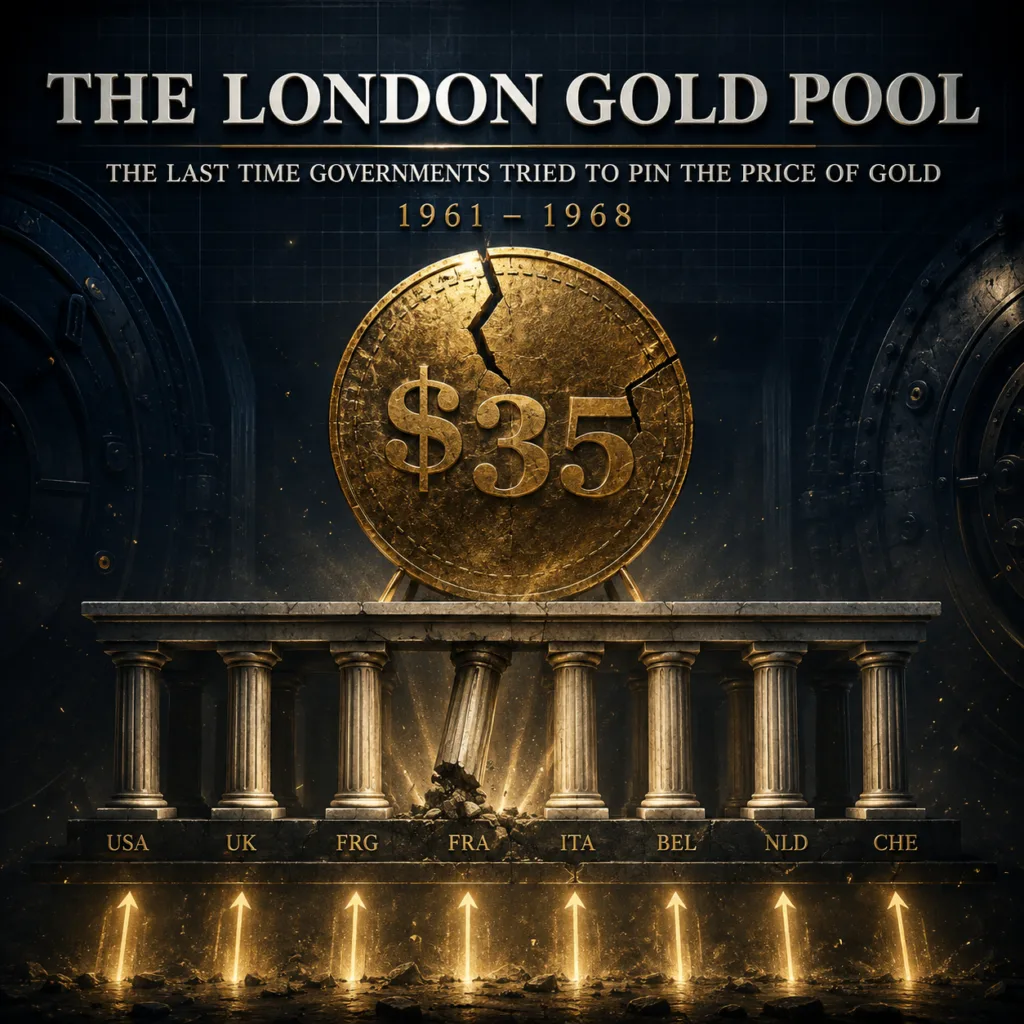
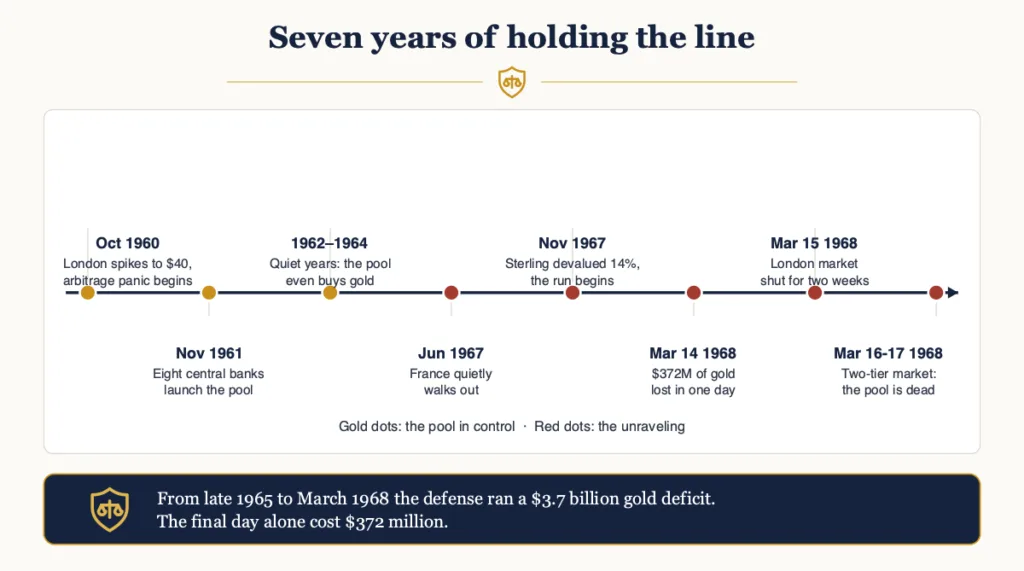
For seven years, the price of gold was not really a price. From November 1961 to March 1968, eight of the richest central banks on earth ran a joint operation called the London Gold Pool, quietly selling and buying whatever it took to hold gold at $35 an ounce. It worked, for a while. Then, in March 1968, the market called the bluff, the pool bled $372 million of gold on its final day alone, and the whole arrangement died over a single weekend. The free market took over, and gold never traded at $35 again.
The story matters for more than trivia night. It is the cleanest experiment ever run on a question people still argue about today: can governments hold the gold price where they want it? They had the world’s reserves, coordination, and secrecy on their side. They still lost.
Why eight central banks went to war with a number
The number was $35, and it was the keystone of the entire postwar money system. Under Bretton Woods, every major currency was pegged to the dollar, and the dollar was pegged to gold at $35 an ounce, a rate set back in 1934. Foreign governments could show up at the Treasury window and swap dollars for metal at that price. The system only held together if everyone believed the swap would always be honored.
By 1960 that belief was wobbling. The United States had been running payments deficits for years, which meant dollars were piling up abroad faster than the gold backing them. In October 1960, speculators pushed the London market price to around $40, a 14 percent premium over the official rate. That gap was an arbitrage machine: buy from the Treasury at $35, sell in London at $40. Left alone, it would drain Fort Knox on autopilot.
So the central banks did something that had never been tried at this scale. In November 1961, the United States, Britain, West Germany, France, Italy, Belgium, the Netherlands, and Switzerland formed a syndicate to manage the London price directly. The design is laid out in a National Bureau of Economic Research study by Bordo, Monnet, and Naef: each member pledged a quota of gold, the United States covering half, and the Bank of England worked the market as the pool’s agent, selling into rallies and buying on dips to keep the price glued to $35. The public was not told the details. Traders just noticed that gold had stopped moving.
The quotas tell you who was really underwriting the peg. America put up 50 percent. West Germany carried about 11 percent, Britain, France, and Italy roughly 9 percent apiece, and Belgium, the Netherlands, and Switzerland split the remainder. None of it rested on a treaty. The whole apparatus was a gentlemen’s agreement among eight institutions, coordinated through regular meetings at the Bank for International Settlements in Basel and executed by a trading desk in London that outsiders were never supposed to notice.
Twice a day, at the London fixing, the Bank of England knew exactly how much metal it would take to hold the line, and the pool supplied it. When the price sagged, the pool bought instead, restocking quietly. As market management goes, it was elegant. It was also, in hindsight, a slow-motion transfer of official gold into private hands at a fixed discount.
The quiet years, when the trick actually worked
Here is the part that surprises people: for its first few years the pool was a genuine success. From 1962 through 1964, calm markets and fresh Soviet and South African supply meant the pool bought more gold than it sold and split the surplus among its members. By the end of 1965 the syndicate was sitting on a cumulative surplus of roughly $1.4 billion in gold, according to the same NBER study of the pool’s records. Holding the price looked easy. It always does, right up until it isn’t.
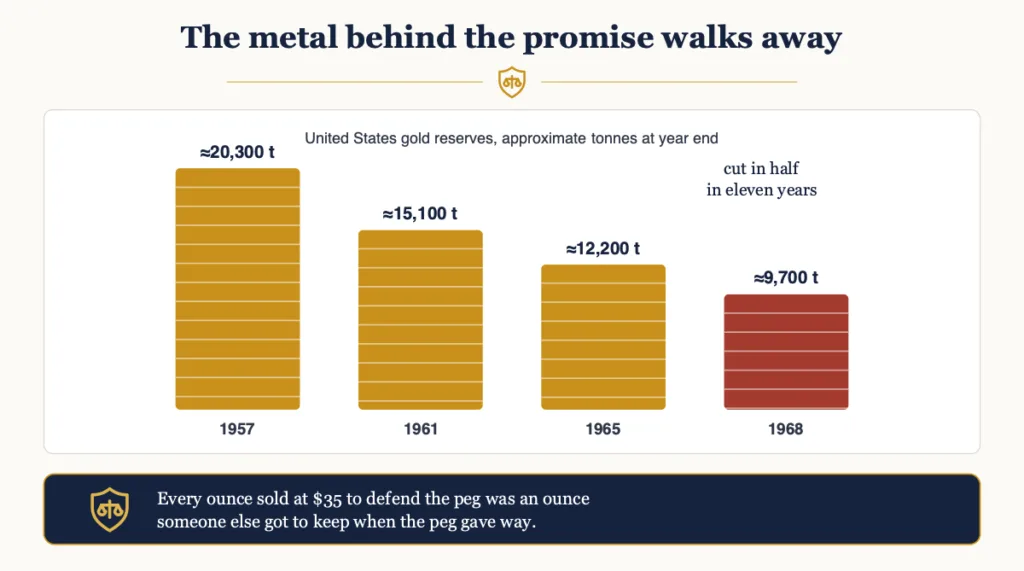
The trouble was that the pool treated a symptom. The London price kept wanting to rise because the world was slowly losing faith in the dollar’s gold backing, and no amount of coordinated selling could fix that. America’s gold stock had peaked near 20,000 tonnes in the late 1950s and was sliding year after year as foreign governments quietly exercised their right to convert. The pool could hide the fever. It could not cure the infection.
France walks out, then the pound breaks
The first crack was political. Charles de Gaulle had spent years attacking the dollar’s reserve status, the “exorbitant privilege” in his finance minister’s famous phrase, and France backed the talk with metal, converting dollars and shipping gold home by the tonne. In June 1967, France quietly stopped contributing to the pool altogether. The remaining members, chiefly the United States, absorbed its share and kept the secret. The market found out anyway.
The second crack was fatal. In November 1967, Britain devalued the pound by 14 percent, from $2.80 to $2.40. The devaluation of the world’s second reserve currency put an obvious question in every trader’s head: if sterling’s peg could break, why not the dollar’s? Gold buying turned from a trickle into a run. The pool sold and sold, and the Bank of England’s ledgers record the losses compounding through the winter.
Eight days in March
The endgame was stunningly fast. Between late 1965 and March 1968 the pool ran a cumulative deficit of about $3.7 billion in gold, and by the second week of March the losses had gone vertical. Buyers were no longer speculating on a small revaluation; they were front-running the collapse of the system itself, and against that kind of demand the pool’s quotas were a rounding error. On March 14 alone the defense cost $372 million in metal. That night, presidential adviser Walt Rostow put the arithmetic to Lyndon Johnson in a memo preserved in the State Department archives: close the market now, or “avoid losing perhaps $1 billion in gold tomorrow.”
Washington took the advice and pulled the plug. At the request of the United States, Britain declared a bank holiday and shut the London gold market on Friday, March 15. The decision came together so late that Chancellor Roy Jenkins announced it at one in the morning and the Queen approved the proclamation at a hastily convened Privy Council meeting at Buckingham Palace, a detail that tells you how close to the edge the system was running. London stayed dark for two weeks, and while it did, gold changed hands in Paris and Zurich at prices well above the official rate, which settled the argument about what the metal was actually worth.
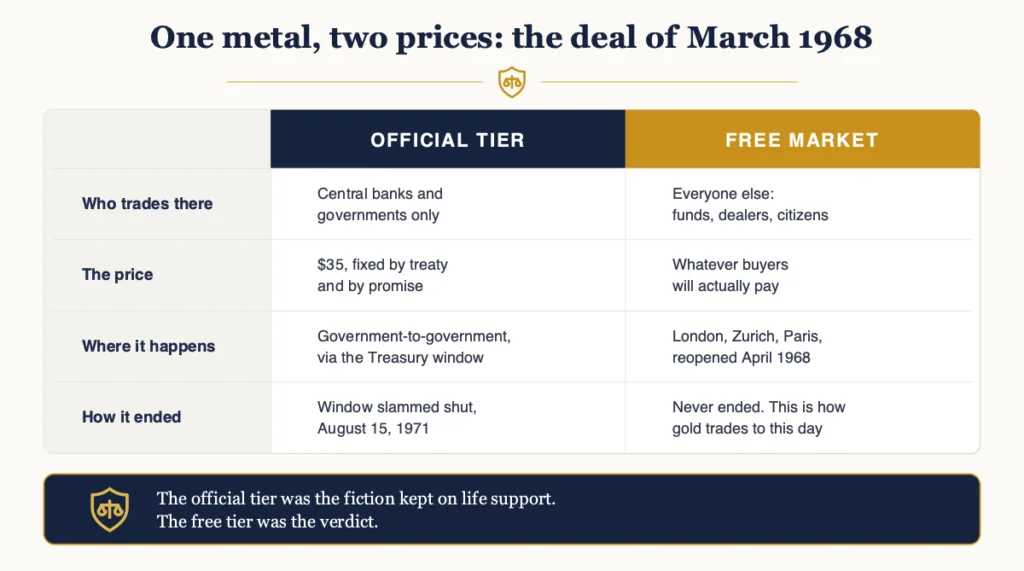
That weekend, central bank governors met in Washington and announced the pool was finished. Their communique created what came to be called the two-tier market: central banks would keep settling with each other at $35, and everyone else could pay whatever the free market demanded. The fiction had been split in half to save the official piece of it.
What happened once the price was free
When London reopened in April 1968, the free price settled in the high $30s and pushed past $40 the following spring. Then it did something the gold-suppression crowd rarely mentions: in early 1970 it sagged back to roughly $35 on its own, briefly dipping below the official price. Markets are like that. Freed from the peg, gold did not rocket in a straight line; it wandered, and for one strange stretch the “suppressed” price and the free price agreed.
The agreement did not last. The dollar’s underlying problem, too many claims against too little metal, kept grinding forward until August 15, 1971, when President Nixon suspended dollar-to-gold convertibility entirely, the event covered in our piece on the Nixon Shock. The two-tier system was formally abandoned in 1973, and by 1974 gold averaged about $160 for the year and brushed $200 near year end, a price history documented in the USGS metal price archives. Everyone who bought from the pool’s dying hands in March 1968 roughly quintupled their money in six years. The institutions that sold to them were, in effect, the last sellers of $35 gold in human history.
What the London Gold Pool proves, and what it doesn’t
The London Gold Pool is the strongest card in the deck for anyone who claims gold’s price can be managed, because it really happened: for seven years, a cartel of central banks set the price of gold in the world’s largest market. But read the ending honestly and the lesson cuts the other way. The pool worked only while the market half-believed the official story, and the moment belief cracked, no vault on earth was deep enough to defend the number. Suppression did not prevent repricing. It postponed it, concentrated it, and handed cheap metal to everyone standing on the other side of the trade.
It is worth noticing who stood where. In 1968, central banks were the sellers of last resort, shoveling reserves out the door to defend a currency arrangement. Today the same institutions are the market’s most relentless buyers, adding more than 1,000 tonnes a year since 2022 by the World Gold Council’s count, a reversal we unpack in our look at central bank gold buying. The people who once fought the price now accumulate the metal. Draw your own conclusion about what they learned.
And if you ever hear that some committee, somewhere, is holding gold down for good, remember how the last attempt ended: with the lights off in the London market, a hasty weekend communique, and a price that has never looked back at $35. Governments can pin a price to the wall. History’s verdict is that the wall gives out. How that price gets discovered now, across futures exchanges and the London bullion market, is a story we cover in our guide to COMEX and LBMA pricing. The mechanism changed. The lesson didn’t.