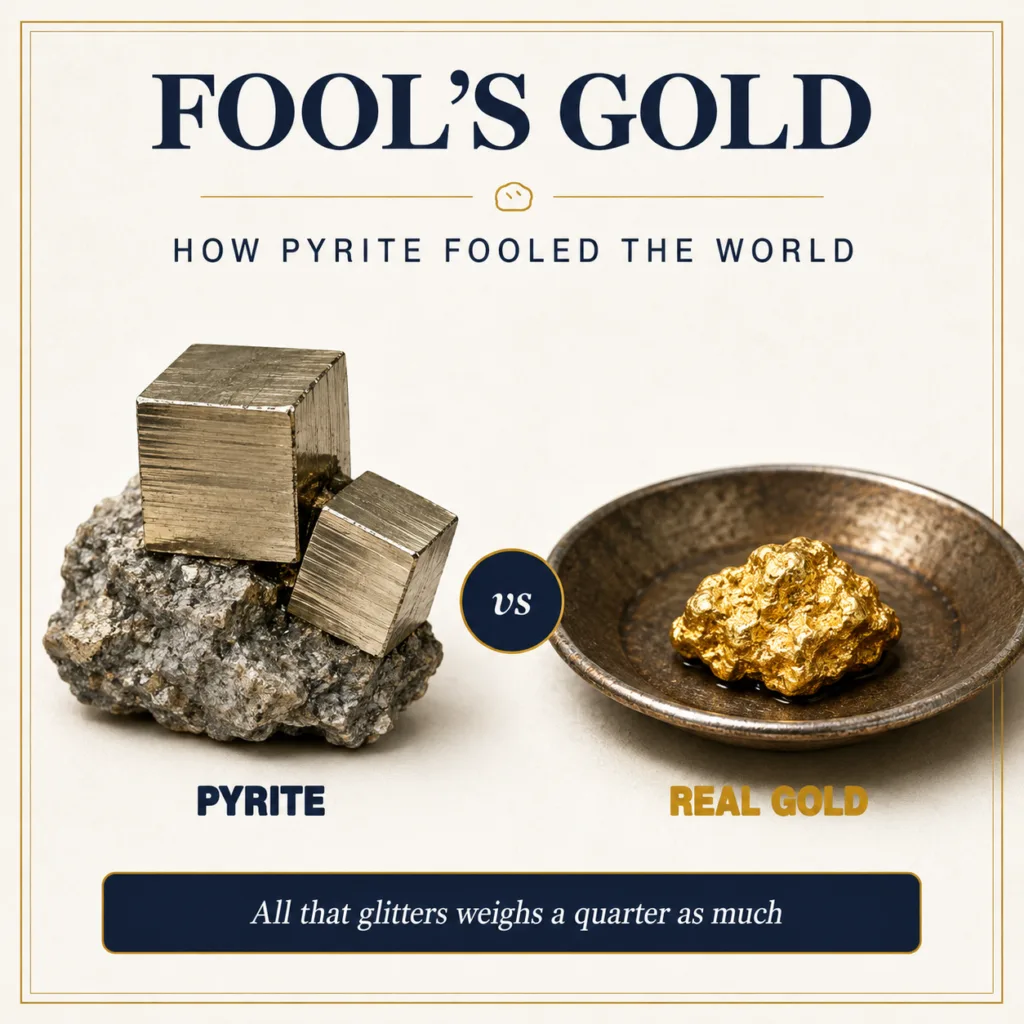
Every so often someone walks into a coin shop with a jar of glittering flakes from a riverbed, or a chunk of sparkling rock from an inherited box, convinced they are holding real gold. Most of the time they are holding fool’s gold: iron pyrite, the mineral that has been breaking hearts since before the California Gold Rush. The good news is that you do not need a lab to tell the difference. Pyrite and gold barely resemble each other once you know the five quick checks in this guide, and every one of them can be done at a kitchen table. The strange twist, which we will get to, is that modern refiners now pull real gold out of the fake stuff.
What fool’s gold actually is
Pyrite is iron sulfide, FeS2, the most abundant sulfide mineral in the Earth’s crust. It forms shiny, brass-yellow crystals that catch the light, which is the entire con. In a dark stream bed, wet pyrite glitters harder than gold does, and to an untrained eye that sparkle reads as treasure. The name comes from the Greek word for fire, because striking pyrite against steel throws sparks. Miners have called it fool’s gold for centuries because it shows up in exactly the places people hunt for the real thing: quartz veins, stream gravels, and sulfide-rich rock.
Here is the detail that surprises people: real gold and pyrite are found together constantly. Gold forms in many of the same hydrothermal settings that produce sulfide minerals, so a rock laced with pyrite is not proof of gold, but it is not proof of its absence either. That geological overlap is why the mistake has always been so easy to make, and why it has fooled people far more sophisticated than weekend panners. If you want the deeper story of where the real metal comes from, our piece on how gold is formed traces it back to colliding neutron stars.
The most expensive mistake in mining history
The prospectors of 1849 get the reputation, but the grandest fool’s gold failure came almost three centuries earlier and involved the English crown. In 1576, the explorer Martin Frobisher returned from the Canadian Arctic with a black stone. Britannica’s account of the voyages records that three testers called it worthless iron sulfide, but a fourth swore it contained gold. That single opinion was enough. According to the Royal Museums Greenwich account of the voyages, Frobisher sailed back in 1577 with royal backing and returned with roughly 200 tons of ore. A third expedition in 1578, this time a small armada, hauled home more than a thousand tons.
Smelters at specially built furnaces in Dartford spent five years trying to coax gold out of the rock before everyone admitted the truth: it was iron pyrite, essentially worthless. The investment company behind the voyages went bankrupt, and some of the ore ended up as ballast and paving for the streets of London. Over a thousand tons of rock, shipped across the North Atlantic in wooden ships, to pave streets. Every seller who has ever been embarrassed at a dealer’s counter can take comfort in that story. The Elizabethan court fell for the same mineral, at fleet scale.
The forty-niners had it easier, because by then the tests were folk knowledge. A panner could bite a flake, press it with a knife, or simply feel the weight. Gold stayed in the pan; pyrite washed out. The California Gold Rush still produced plenty of disappointment, but the physics of a gold pan did most of the sorting automatically, for a reason the next section makes obvious.
Five tests that settle it in minutes
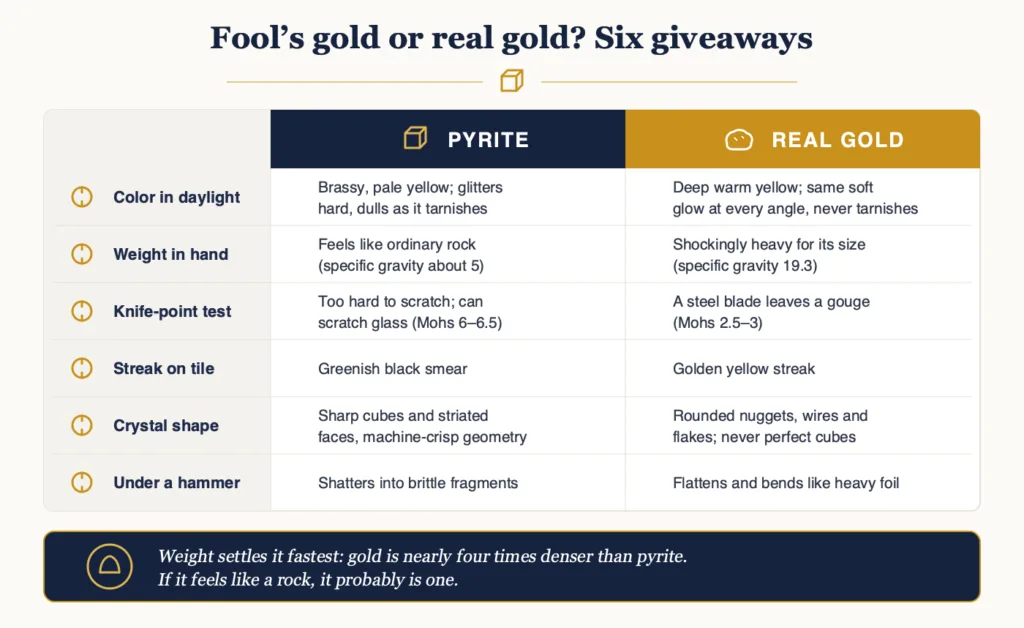
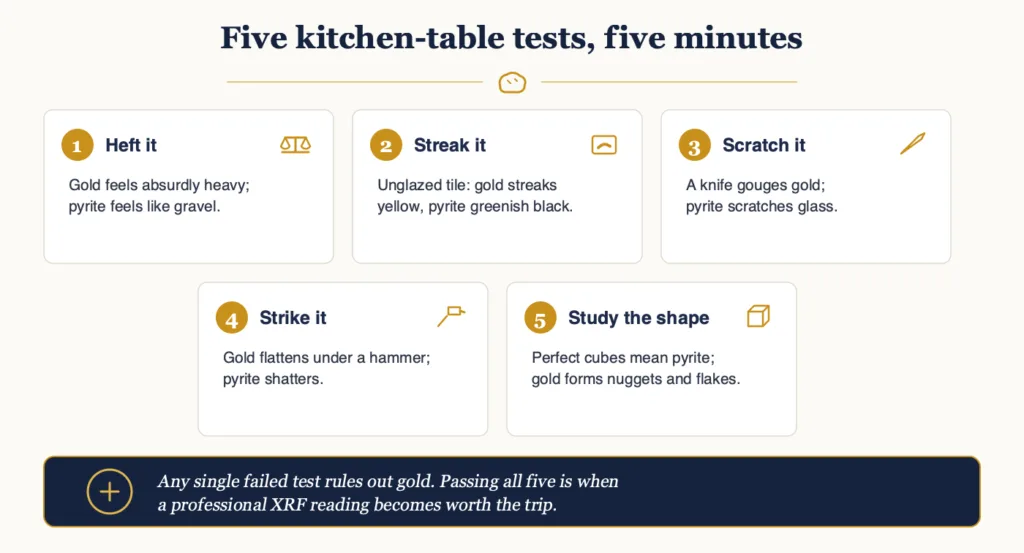
Weight is the first and best test. According to the identification guide at Geology.com, gold has a specific gravity of about 19.3, meaning a piece of pure gold weighs over nineteen times as much as the same volume of water, while pyrite comes in around 5. That is not a subtle gap, and you can feel it: a nugget-sized piece of gold sits in the hand like nothing else in nature, while pyrite feels like ordinary rock. This is exactly why panning works. Swirl gravel in water and gold sinks to the bottom of the pan while lighter minerals, pyrite included, wash over the rim.
Second, the streak test. Drag the specimen firmly across the unglazed back of a ceramic tile, the kind sold at any hardware store. Gold leaves a golden-yellow streak. Pyrite leaves a greenish-black one, and the first time you see that dark smear come off a bright brassy rock, the illusion dies instantly. This one test is close to conclusive on its own, and it costs about a dollar.
Third, hardness. On the Mohs scale gold sits at roughly 2.5 to 3, soft enough to scratch with a pocket knife or, as the old-timers demonstrated, dent with your teeth. Pyrite measures 6 to 6.5, hard enough to scratch glass. Press a steel blade into the specimen: if the blade leaves a gouge, gold is possible. If the specimen shrugs it off, or scratches a glass bottle, you are holding pyrite.
Fourth, watch how it breaks. Gold is malleable. Hit it with a hammer and it flattens, bends, and spreads like heavy foil. Pyrite is brittle, and the same hammer blow shatters it into sharp fragments. On a smaller scale, a flake of gold pressed under a pin point will dent; a flake of pyrite will crack or crumble.
Fifth, look at the shape. Pyrite loves geometry. It grows in sharp cubes, twelve-sided crystals, and faces with fine parallel striations, forms so crisp they look machine-made. Natural gold almost never does that. It turns up as rounded nuggets, wires, flattened flakes, and irregular sponge-like masses. If your specimen has perfect right angles and mirror-flat faces, nature is telling you what it is. Sunlight helps too: gold keeps its warm color in shade and stays untarnished for centuries, while pyrite is brassier, glitters hardest at certain angles, and often shows a dull or darkened surface where it has begun to oxidize.
The twist: refiners now mine fool’s gold on purpose
Here is where the story turns on itself. For most of history, pyrite was the worthless imposter. Today, a meaningful share of the world’s gold is extracted from it.
Geologists have long known about so-called invisible gold: real gold atoms locked inside the crystal structure of pyrite, in particles too small to see under an ordinary microscope. In deposits of this type, most famously the Carlin-type deposits of Nevada that anchor American gold mining, there is often no visible gold at all. The metal rides inside arsenic-rich pyrite as particles measured in nanometers. A 2021 study in the journal Geology identified yet another hiding place: gold trapped along microscopic defects, called dislocations, inside deformed pyrite crystals. The mineral that fooled Frobisher turns out to be one of nature’s favorite gold vaults.
Getting it out is genuinely hard, which is why the industry calls these refractory ores. The gold cannot be dissolved out directly because the pyrite armor shields it, so processors first break the sulfide down with pressure oxidation or roasting, then leach the freed gold. It is expensive, energy-hungry work that only makes sense at industrial scale, and it is a big part of why no dealer will ever pay you for a bucket of pyrite. The gold inside ordinary pyrite exists in parts per million at best. At today’s prices, with gold trading around $4,500 an ounce in late August 2026, those parts per million justify a hundred-million-dollar autoclave. They will never justify anything at kitchen-table scale.
So the childhood disappointment and the mining engineer are both right. Your sparkling rock is not gold. And yet, somewhere in Nevada, a very similar rock is being pressure-cooked precisely because it secretly is.
Why this still costs sellers money in 2026
You might assume fool’s gold stopped fooling anyone around the time electric light replaced the campfire. Dealers see otherwise, and the modern versions of the mistake run in both directions.
The first version walks in with inherited boxes. A parent collected minerals, or kept a jar of flakes from a long-ago panning trip, and the family assumes the glitter is money. The reverse happens too, and it is sadder: families toss dull, heavy lumps that turn out to be genuine nuggets because real gold, in the rough, is far less flashy than the movies suggest. Weight is the tiebreaker every time. When the estate might contain real metal, it is worth working out what the metal content would actually be worth; our guide to calculating melt value shows the arithmetic before anyone visits a buyer.
The second version is the online specimen market. Listings for “natural gold nuggets” at too-good prices are sometimes pyrite, sometimes brass, and occasionally lead with gold plating. The five tests above catch pyrite easily, but plated fakes defeat surface checks, which is why anything bought as an investment should get the full workup in our fake gold and silver detection guide, and why serious buyers insist on an XRF reading from a dealer before money changes hands.
And a note of respect for the imposter: pyrite specimens have a legitimate market of their own. A crisp cluster of cubic crystals from a famous locality can sell for more than its weight would fetch as scrap brass, because mineral collectors prize the geometry. Nobody is retiring on pyrite, but a beautiful specimen is not garbage either. It is simply a rock, priced like a rock, not like a metal.
Let the rock tell you what it is
Four and a half centuries after a thousand tons of Arctic pyrite paved English roads, the mineral is still running the same con, glittering in the same rivers, and turning up on the same counters. The defense has not changed either. Feel the weight. Drag it across a tile. Press a knife into it. Look for cubes. Any one of those tests would have saved Queen Elizabeth’s investors a fortune, and together they take less time than reading this article did.
The deeper lesson applies to more than rocks. Glitter is a marketing department; density is an audit. Whether you are judging a sparkling stone, a too-cheap online nugget, or a deal that shines a little too hard, the move is the same: ignore what catches the light and measure what actually has weight. Gold has been passing that test for as long as people have looked for it. Pyrite never has.