
Reviewed by Isaac Kahan, Owner ·
A practical guide to casting grain for small jewelers, jewelry manufacturers and casting studios.
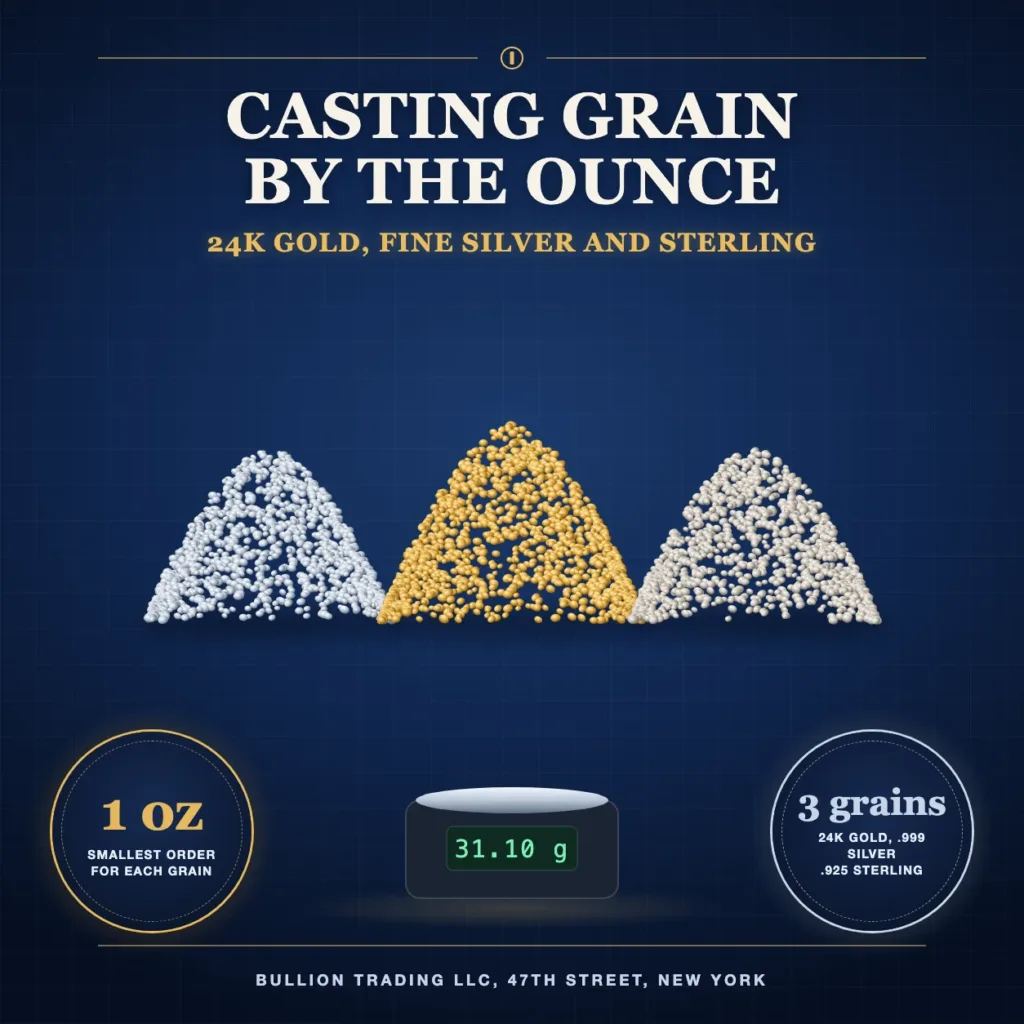
Small jewelers can buy casting grain from precious-metals dealers that supply jewelry manufacturers, and some of them sell it by the single troy ounce. Bullion Trading LLC, on West 47th Street in New York’s Diamond District, sells 24K gold casting grain, .999 fine silver grain and one .925 sterling silver grain at published prices that follow the spot price, and you can buy as little as one troy ounce of each. You lock in your price, pay, and the order usually ships within one to two business days after payment clears, subject to availability. At today’s prices (7 November 2026), 24K grain is 0.9% over the gold Ask, the lowest premium of any gold product we have in stock. Current products and prices are on the casting grain page.
| Key finding | Result |
|---|---|
| Smallest order | One troy ounce (31.1 g) of each grain |
| 24K gold grain today | $4,138.31 an ounce by check or wire, 0.9% over the gold Ask |
| Silver grain today | Fine $60.97 an ounce, 16.4% over the Ask; sterling $56.74, 17.0% over the Ask on its silver |
| Paying | Check or wire from $1,000; card or PayPal 5% more, up to $7,500 |
| Leftover grain | Not bought back as standard |
Why small jewelers sometimes struggle to buy casting grain
A large manufacturer buys metal every week in bulk; an independent jeweler may need an ounce or two for one custom ring. Some small buyers run into wholesale-account rules, high premiums, thin stock or slow shipping. In an April 2025 post on Reddit’s r/jewelers, a hobby jeweler who helps run a maker-space casting studio wrote that without a full-time jewelry business they had no access to wholesale prices, and that grain premiums kept frustrating them. A December 2022 post in the same forum asked where small jewelers were now getting gold casting grain. Posts like these show the problem exists; they don’t show how common it is.
For a small order the useful question is narrow: can you get the right metal, in the amount you need, at a price you can see before you pay?
What is pure 24K gold casting grain?
Gold casting grain, also called shot, is gold in small granules that can be weighed to the gram and melted, and pure 24K grain is the unalloyed form. Our 24K grain is listed at .9999 purity on its product page. It is a starting material for casters who make their own alloys: 18K gold is 75% gold by weight, and the other quarter is alloying metal that sets the color, hardness and how the metal flows. Shops want different yellows, roses and whites, so no single premixed alloy suits everyone. Federal guidance ties the karat mark to the gold in the alloy; misrepresenting a piece’s karat fineness counts as deceptive under the FTC’s Jewelry Guides.
Bullion Trading carries pure gold grain, not a shelf of premixed 14K and 18K colored alloys. If you need ready-to-cast karat grain, buy it from a supplier whose formula suits your process. If you mix your own, our guide to 24K gold casting grain shows how many grams of fine gold each karat takes.
How much does gold casting grain cost?
Casting grain is priced as spot plus a premium per troy ounce. Today (7 November 2026) our check or wire price for one ounce of 24K grain is $4,138.31, with the gold Ask on our site at $4,099.96. The premium changes, so check the live price before you order.
Ask any supplier what its price is measured against. Bullion Trading’s prices are spot-based: they move with the market through the day, and your price is locked when you confirm the order. Other suppliers price against a daily benchmark such as the LBMA Gold Price PM, set by an electronic auction at 15:00 London time, normally 10 a.m. in New York, according to its administrator, ICE Benchmark Administration. A benchmark is fixed for the day, so at any moment it and a live spot quote can differ.
On a small order the payment method can change the price too. Under our terms, orders under $1,000 are paid by card or PayPal, and bank wire and check payments start at $1,000. Card and PayPal cost 5% more and are capped at $7,500 an order, according to the premiums page. One ounce of gold grain clears the $1,000 line on its own. An ounce of silver grain doesn’t, so a small silver order is paid at the card price.
| Order | Check or wire price | Payment that applies | Metal price you pay |
|---|---|---|---|
| 1 oz 24K gold grain | $4,138.31 | Check or wire, or card or PayPal at 5% more | $4,138.31 |
| 2 oz 24K gold grain | $8,276.62 | Check or wire (over the $7,500 card limit) | $8,276.62 |
| 1 oz .999 fine silver grain | $60.97 | Card or PayPal (order under $1,000) | $64.02 |
| 5 oz .999 fine silver grain (one 5 oz pack) | $303.54 | Card or PayPal | $318.72 |
| 1 oz .925 sterling silver grain | $56.74 | Card or PayPal | $59.58 |
Fine silver versus sterling silver casting grain
Fine silver grain is .999 silver. Sterling must be at least 925 parts per thousand silver to be called sterling under the FTC’s Jewelry Guides; the other 7.5% is base metal that hardens it. The difference shows in hardness and in how the metal behaves at the bench. Fine silver suits work that calls for high-purity silver; sterling is the usual choice for durable everyday jewelry. The metals in that last 7.5% vary from one sterling to another, so ask your supplier for the composition.
Pure gold and silver each melt at one temperature; sterling melts over a range that moves with its alloy. Legor’s 925 casting alloy, with 3% zinc, is solid to 850°C and liquid at 895°C, according to its technical datasheet.
| 24K gold grain | .999 fine silver grain | .925 sterling silver grain | |
|---|---|---|---|
| Purity | .9999 gold | .999 silver | .925 silver |
| Sold by | Troy ounce | Troy ounce, or a 5 oz pack | Troy ounce |
| Melting point | 1,064°C (1,948°F) | 962°C (1,763°F) | Over a range, 810°C to 893°C (1,490°F to 1,639°F) |
| Premium over the Ask today | 0.9% | 16.4% (1 oz), 15.9% (5 oz) | 17.0% (on its 0.925 oz of silver) |
The casting grain page also lists two platinum grains alloyed with ruthenium. Check any grain’s specification against your own casting process before you buy.
Why turnaround matters on a custom order
An independent jeweler often needs metal quickly to finish a customer’s piece. Orders usually ship within one to two business days after payment clears. A check has to clear first, which can take up to 10 business days under our terms, so on an order of $1,000 or more a wire is the faster way to pay. You can also collect a wire or check order at our 47th Street counter.
Can I buy just one ounce of casting grain?
Yes. You can buy as little as one troy ounce of 24K gold, fine silver or sterling grain, so you don’t tie up money in metal for jobs that haven’t come in; a troy ounce is 31.1 grams. One exception: online orders of grain can’t be delivered to California.
Buy the amount you will use. Our buy desk doesn’t take back grain as standard, because it is hard to verify that loose grain hasn’t been mixed with other metal; for a larger lot, we can melt it into one bar, assay it and pay on the assay. That drawback matters far more to an investor than to a caster who melts leftovers into the next job, as our piece on why casting grain is hard to sell back explains.
Pure 24K gold or ready-to-cast 14K and 18K grain?
Choose by how you work. A caster who formulates alloys may want pure gold for control over composition and color. A jeweler who needs one particular karat and color, cast the same way every time, may be better served by premixed casting grain. Pure 24K isn’t a direct substitute for a ready-to-cast 14K or 18K alloy: it has to be alloyed first, with a tested formula and your own quality checks, before it goes in a flask.
What should I ask a casting grain supplier?
Before you order, ask about:
- Purity and composition, and whether product documentation comes with the grain.
- The price relative to spot, what it is measured against (a live spot price or a daily benchmark), and whether it differs by payment method.
- Any minimum order, and whether you need an account or business verification.
- Stock on hand, and how long an order takes to leave after payment.
- Whether they buy back leftover grain or scrap, and on what terms.
If a casting house is doing the casting for you, ask whether it accepts customer-supplied metal before you buy any.
Frequently asked questions
Where can I buy one ounce of 24K gold casting grain?
Bullion Trading LLC in New York sells 24K gold casting grain from one troy ounce, at a published price that follows spot. Current pricing and stock are on its 24K casting grain page.
Does gold casting grain cost more than spot?
Yes. Suppliers charge a premium over spot for handling and their own costs. At today’s prices (7 November 2026), Bullion Trading’s 24K grain is 0.9% over the gold Ask, the lowest premium among the gold products it has in stock.
Do I need a wholesale account to buy casting grain?
Policies vary by supplier. Bullion Trading sells grain without a wholesale account, from one troy ounce.
Where can I buy sterling silver casting grain?
Jewelry supply houses and precious-metals dealers, including Bullion Trading. Check the composition and stock before you buy.
Is fine silver the same as sterling silver?
No. Fine silver is .999 silver. Sterling is at least 92.5% silver, with base metal making up the rest.
Can I make 14K or 18K jewelry from pure gold grain?
Yes, with the right alloying metals, a tested formula and experience.
How quickly does Bullion Trading ship casting grain?
Usually within one to two business days after payment clears, subject to availability.
Is shipping included in the price?
No. At Bullion Trading, shipping is added at checkout.
Can I supply my own metal to a casting house?
Some casting houses accept customer-supplied metal and some don’t. Ask the caster before you buy.
A source for small amounts of casting grain
Not every jeweler needs metal by the kilo. Bullion Trading LLC sells pure gold, fine silver and sterling grain from one troy ounce at published prices that follow spot, and orders usually ship within one to two business days after payment clears. Products and current terms are on the casting grain page.
Sources
- ICE Benchmark Administration, LBMA Gold Price.
- FTC Jewelry Guides, 16 CFR §23.3 and §23.5: gold and silver content.
- BIPM, Guide to the Realization of the ITS-90: gold 1,064.18°C, silver 961.78°C.
- Legor, AG115MA technical datasheet.
- Bullion Trading LLC product pages, premiums page and terms: prices, premiums, purity and payment rules.