
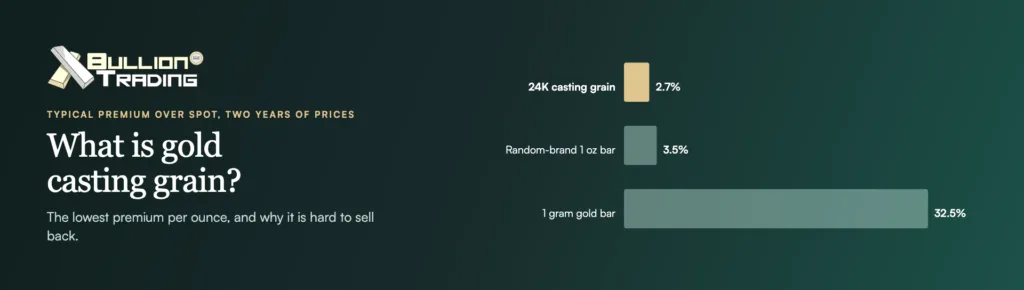
Casting grain is refined metal in small granules that jewelers weigh out and melt to cast rings, chains and other pieces; gold grain is usually 24 karat, 999.9 fine. In Bullion Trading LLC's price records since 27 October 2024, 24K gold grain cost a median 1.9% over the Ask, less than a random-brand 1 oz bar (2.7%) and far less than a 1 g bar (31.6%). The catch comes when you sell: grain carries no refiner’s stamp, serial number or assay card, and Bullion Trading LLC sells it but does not buy it back.
Jewelry is a third of the gold market: jewelers used 1,638 tonnes in 2025 out of 5,002 tonnes of total demand, the World Gold Council reported on 29 January 2026. A “grain of gold” can also mean the old unit of weight, 64.8 milligrams, worth $8.29 at today’s gold Ask. This guide explains both, then tests the investor’s question against two years of prices.
| Key finding | Result |
|---|---|
| What it is | Refined metal in small granules, sold by weight to jewelers and casters; 24K gold grain is 999.9 fine |
| Median premium over the Ask since 27 October 2024 | 24K grain 1.9%; random-brand 1 oz bar 2.7%; 1 g bar 31.6% |
| Grain cost less per ounce than the 1 oz bar | 392 of 506 trading days |
| Grain cost less than the 1 kilo bar | 167 of 506 trading days |
| Smallest amount of gold grain sold | 1 troy ounce (31.1 g) |
| Bought back by Bullion Trading LLC | No: the buy desk takes coins, bars and rounds only |
| A grain of gold, the unit of weight | 64.8 mg, $8.29 at today's Ask |
What is casting grain?
Casting grain, also sold as shot, granules or pellets, is pure metal or a ready-made alloy in pieces a few millimeters across, priced by weight. Refiners make it by pouring molten metal into water, where it breaks into droplets that freeze as grains; the goldsmith’s textbook by Erhard Brepohl calls them shot. Swiss refiner Valcambi sells gold grain at 999.99, 999.9 and 995.0 fineness to jewelry makers, and there is fine silver, sterling and platinum grain too.
Casters prefer grain to bars because it melts quickly and evenly and can be weighed to the gram for each job, with no sawing. In lost-wax casting, molten metal takes the place of a wax model that has been melted or burned out of a mold, as the Getty art vocabulary defines it.
Myth: casting grain is impure gold, maybe 90% to 95%. Fact: 24K grain is refined to 999.9, purer than a 22-karat American Eagle; grain made for 14K or 18K casting is alloyed on purpose and sold by its karat. The real drawback is proof: nothing on a loose grain says which one you have.
What is a grain of gold worth?
It depends which grain you mean. As a unit, a grain is exactly 64.79891 milligrams: 480 make a troy ounce and 24 make a pennyweight, the unit many jewelers still price in, under NIST Handbook 44. At today's gold Ask of $3,979.90 an ounce, one grain of gold comes to $8.29, a pennyweight $199.00 and a gram $127.96.
| Unit | Pure gold at the Ask |
|---|---|
| 1 grain (64.79891 mg) | $8.29 |
| 1 pennyweight (dwt) = 24 grains = 1.555 g | $199.00 |
| 1 gram = 15.43 grains | $127.96 |
| 1 troy ounce = 480 grains = 31.1035 g | $3,979.90 |
In nature, “grains” are the particles of gold that streams carry along with dust, flakes and nuggets, in the words of the U.S. Geological Survey. Natural gold is alloyed with silver and other metals; the USGS example nugget is 885 parts gold per thousand. Casting grain is the refined, measured version.
Why do jewelers buy 24K grain instead of ready-made alloy?
Because starting from pure gold lets a caster make exactly the alloy a piece needs. Karat counts parts of gold in 24: 18K is 75% gold and 14K is 58.3%, hallmarked 750 and 585 under the British Hallmarking Council‘s standards. The rest is a master alloy that sets color and hardness: copper gives a reddish tint, silver a greenish one, and nickel or palladium bleach gold white (Cretu and van der Lingen, Gold Bulletin, 1999).
Pure gold is too soft for most rings, so 24K grain is almost always alloyed before casting. Ready-alloyed grain ties a caster to one supplier’s formula and color. The guide to buying 24K casting grain has a calculator for the gold and alloy each karat takes.
Is casting grain cheaper than gold bars?
Per ounce, usually. Grain cost less per ounce than the random-brand 1 oz bar on 392 of 506 trading days and less than the 1 kilo bar on 167 of 506. At today's prices grain is 1.2% over the Ask, below both the 1 oz bar's 3.2% and the 1 kilo bar's 2.7%.
At those median premiums and today's Ask, a gram of gold costs about $130.43 as grain, $131.45 in a 1 oz bar and $168.37 as a 1 g bar. The saving only works from one ounce up: gold grain is sold by the troy ounce, so 10 grams of grain means buying 31.1.
What are the disadvantages of casting grain for investors?
Four, and they all show up when you sell.
- No proof attached. A bar carries its refiner’s name, weight, fineness and usually a serial number, often sealed in an assay card. Grain comes loose; its fineness rests on the seller’s word until someone assays it.
- Fewer buyers. Dealers price recognized bars and coins from spot in minutes. Bullion Trading LLC buys coins, bars and rounds only, so grain, including its own, is not bought back. Grain usually goes to a refiner, which melts the lot, pulls samples and fire-assays them (United Precious Metal Refining), then pays for the recoverable gold with its charges taken out of the metal.
- Purity risk from unknown sellers. Nothing about loose metal shows whether it is 999.9 or 990; only a melt and an assay to ISO 11426, the fire-assay standard, does.
- Tax treatment can differ. Bullion exemptions are written for investment metal, not raw material (below).
Is casting grain taxed like bullion?
Not always. New York exempts precious metal bullion, defined as bars, ingots or coins, when more than $1,000 is sold and the buyer keeps it in the same form, and it excludes metal “manufactured, processed, assembled, fabricated or used for an industrial, professional, esthetic or artistic purpose” (Tax Law §1115(a)(27)). Grain is none of those forms, and melting it into jewelry is the use the law excludes. California works differently: refined gold valued for its metal content is exempt when a single sale reaches $2,000 (CDTFA Regulation 1599).
A jeweler who melts grain into goods for sale can usually buy it without tax on a resale certificate; New York’s regulation gives that exact example for a manufacturer (20 NYCRR 528.29). Other states are in the bullion sales tax guide.
Who should buy casting grain, and who should buy bars?
Grain is the right buy when the metal is going into a melt. Tick what applies:
- You cast or alloy metal yourself, or send it to a caster.
- You need gold by weight, in whole troy ounces or more.
- You don’t plan to sell the metal back to a dealer.
- You can store loose metal so none of it goes missing.
For everyone else, a recognized bar or coin costs a little more per ounce and is far easier to sell. These are the random-brand bars in the comparison:
Random-brand gold bars
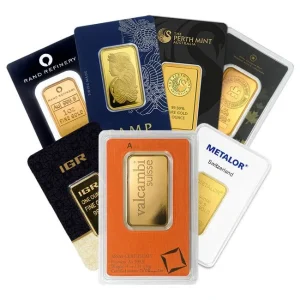
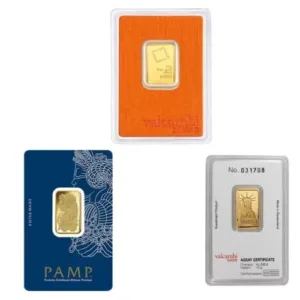

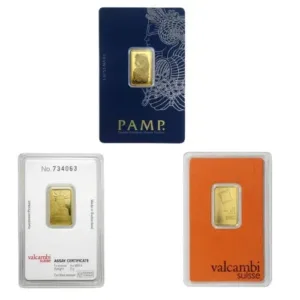
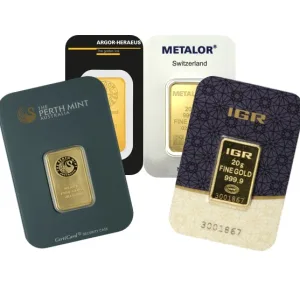

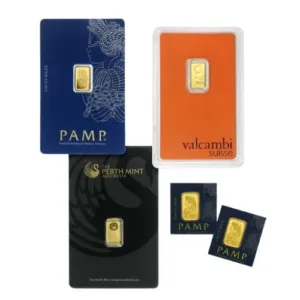

The large price is the check/wire price; the card/PayPal price is listed under it. Prices follow the live spot price.
How we did the research
We took the check/wire price Bullion Trading LLC recorded for 24K casting grain (sold per troy ounce) and for the store’s random-brand gold bar of each size, about four times a day, used each day’s median and divided it by the value of the product’s fine gold at that day’s spot close: the LBMA Gold Price PM, and after 28 September 2026 the 5 pm New York close. The grain series covers 506 trading days from 28 October 2024 to 3 November 2026. Grain “cost less” on a day when its price per fine ounce was at least 50 cents below the bar’s.
Limits: these are one dealer’s prices (card and PayPal are 5% higher); the 2.5 g, 20 g and 5 oz bars were listed later; a daily median against one fixing adds noise, which medians absorb. What a refiner would pay for grain is not in the data. Monthly medians by product: CSV download.
The bottom line on casting grain
Casting grain is the jeweler’s form of gold: pure, easy to weigh and priced like the largest bars; over two years it cost a median 1.9% over the Ask, against 2.7% for a 1 oz bar. For an investor that saving is small next to the cost of selling metal no dealer can price at a glance. Buy grain to melt it; buy bars or coins to keep.
Frequently asked questions
Is casting grain real gold?
Yes. 24K grain is 999.9 fine gold, but its purity rests on the seller’s word until a refiner assays it.
Can you sell gold casting grain?
Yes, usually to a refiner or a jeweler, after an assay and less charges. Bullion Trading LLC sells grain but does not buy it back.
How many grains are in an ounce of gold?
480 in a troy ounce, the ounce used for gold; an ordinary (avoirdupois) ounce has 437.5.
Sources
- NIST, Handbook 44 (2026), Appendix C: grain, pennyweight and troy ounce.
- World Gold Council, Gold Demand Trends Full Year 2025: jewelry and total demand.
- Erhard Brepohl, The Theory and Practice of Goldsmithing (excerpt), and Valcambi, Grain: how grain is made and sold.
- Getty Research Institute, AAT: lost-wax process.
- British Hallmarking Council, Hallmarking Guidance Notes: fineness standards.
- Cretu and van der Lingen, Coloured gold alloys, Gold Bulletin 32 (1999): alloy colors.
- USGS, Gold: natural gold grains.
- United Precious Metal Refining, High grade process, and ISO, ISO 11426:2021: how refiners assay and pay.
- New York Tax Law §1115 and 20 NYCRR 528.29; CDTFA Regulation 1599: sales tax.
- Bullion Trading LLC price records and current prices: every premium and price here.