
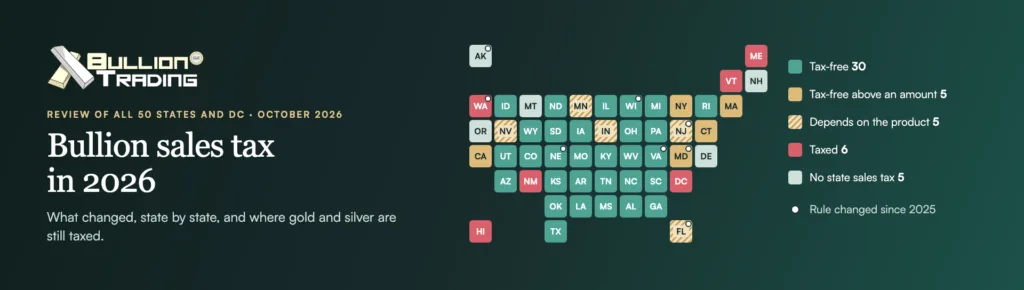
In 2026, six states changed how they tax gold and silver, and only one made bullion more expensive: since 1 January, Washington charges sales tax on all bullion and coins, after ESSB 5794 repealed the exemption it had kept since 1985. Bullion Trading LLC's review of the rules in all 50 states and DC, read from statutes, session laws and revenue-department guidance on 19 October 2026, counts 30 states where investment gold and silver are tax-free at any order size, 5 where they are tax-free above a dollar amount, 5 where it depends on the product, five states plus DC that tax them, and 5 with no state sales tax.
The newest are Florida’s coin exemption (1 July 2026) and Alaska’s limit on local taxes (28 August 2026); Connecticut’s follows on 1 July 2027.
| Key finding | Result |
|---|---|
| Tax-free at any order size | 30 states |
| Tax-free above a dollar amount | 5: California ($2,000 or more); Connecticut and Massachusetts ($1,000 or more); Maryland and New York (over $1,000) |
| Depends on the product | 5: Florida, Indiana, Minnesota, Nevada and New Jersey |
| Taxed like other goods | 5 states plus DC: Hawaii, Maine, New Mexico, Vermont and Washington |
| No state sales tax | 5: Alaska, Delaware, Montana, New Hampshire and Oregon |
| Rule changes in force in 2026 | 6 states; only Washington's raised the tax |
| Next scheduled change | Connecticut, 1 July 2027: no minimum, platinum and palladium added |
| States that also exempt the profit | Missouri, Alabama, Idaho, Nebraska; Utah, Arizona and Arkansas in part |
How many states tax gold and silver in 2026?
Five states plus DC tax investment bullion outright, and ten more tax some orders or products; the other 35 don't. The totals have barely moved since the end of 2024, but four states changed places: Florida (from a dollar minimum to product by product), Nebraska (from product by product to tax-free), New Jersey (from taxable to product by product) and Washington (from tax-free to taxable).
Which states changed their bullion tax rules?
Eleven changes in nine states took effect, or will, between January 2025 and July 2027; each name links to the state’s full rule.
| Date | State | What changed |
|---|---|---|
| 1 Jan 2025 | New Jersey | Exemption begins; a coin must be worth $1,000 or more (P.L.2024, c.64) |
| 1 Jan 2025 | Nebraska | Exemption widened to coins (LB 1317) |
| 1 Jul 2025 | Maryland | Exemption limited to sales at the Baltimore Convention Center (Ch. 604) |
| 1 Aug 2025 | Florida | Bars tax-free at any price; $500 minimum ends (HB 7031) |
| 1 Jan 2026 | Washington | Exemption repealed; bullion and coins taxed (ESSB 5794) |
| March 2026 | Wisconsin | Exemption certificate no longer needed (Act 124) |
| 1 Jul 2026 | Maryland | Statewide exemption over $1,000 restored (Ch. 729) |
| 1 Jul 2026 | Florida | 99.5% gold and 99.9% silver coins exempt (TIP 26A01-08) |
| 1 Jul 2026 | Virginia | Exemption extended through 1 July 2028 (HB 30) |
| 28 Aug 2026 | Alaska | Local tax barred from the metal value of coins and stamped bullion (HB 1) |
| 1 Jul 2027 | Connecticut | Scheduled: $1,000 minimum ends; platinum and palladium added (PA 25-168) |
Why does Washington tax bullion now?
Because ESSB 5794, a 2025 law revising several tax preferences, repealed RCW 82.04.062, the 1985 exclusion for precious-metal bullion and coins, from 1 January 2026. The Department of Revenue told sellers in September 2025 that those sales would owe retail sales tax. Two 2026 bills to restore the exemption, HB 2115 and SB 5894, never left committee.
The state rate is 6.5%, plus local tax where the buyer receives the metal. At Washington's average combined rate of 9.51%, that adds $95.10 to a $1,000 order and $475.50 to a $5,000 one. If the seller doesn’t collect it, the buyer owes use tax instead.
What changed in Florida and Maryland?
Florida loosened its rules twice. HB 7031 made gold, silver and platinum bars tax-free at any price from 1 August 2025; before, a sale had to exceed $500. From 1 July 2026, stamped gold coins and rounds of at least 99.5% purity and silver of at least 99.9% are exempt too (TIP 26A01-08). U.S. legal-tender coins were already exempt. Palladium bars are taxed, and so are coins meeting neither test, such as the Krugerrand (91.67% gold), unless more than $500 of them are bought at once.
Maryland took its exemption away for a year, then gave it back. The 2025 budget act limited the exemption for sales over $1,000 to the Baltimore Convention Center from 1 July 2025, so almost every other sale paid 6% through June 2026 (fiscal note). Chapter 729 of 2026 removed that condition from 1 July 2026. The $1,000 line stayed, and it is strict: a $1,000.00 sale is taxed.
Myth: Maryland dropped its $1,000 minimum in 2026, and Connecticut dropped its own in 2025. Fact: amendments kept Maryland’s minimum; Connecticut’s repeal starts on 1 July 2027.
What changed in Alaska, Virginia, Wisconsin and New Jersey?
Smaller changes, all in the buyer’s favor:
- Alaska has no state sales tax, but about 100 cities and boroughs levy their own. Since 28 August 2026, HB 1 bars them from taxing the gold or silver value of coins and stamped bullion; Juneau still taxes the premium over spot.
- Virginia has exempted gold, silver and platinum bullion and legal-tender coins with no minimum since July 2022; the 2026 budget moved the sunset to 1 July 2028 (Virginia Tax). Palladium bars stay taxable.
- Wisconsin‘s 2024 exemption required an exemption certificate; 2025 Act 124, signed in March 2026, dropped it.
- New Jersey has exempted bars at any price since January 2025, but a coin only if that coin is worth at least $1,000, says the Division of Taxation, so a 1 oz silver coin is taxed.
Which bills to change bullion tax failed?
Four legislatures considered changes that did not pass:
- Maine: LD 372, an exemption, died between the chambers in June 2025 after a 68-72 House vote.
- Vermont: H.711, a similar exemption, died in committee in 2026.
- Washington: the two restore bills above.
- New York: S7875 and A8511 would have limited the exemption to central banks and governments; A10670 would have removed the $1,000 floor. None passed.
Is a $1,000 order taxed? A worked case
Take 1 oz American Silver Eagles, U.S. legal tender priced on their metal, at two order sizes. The $1,000.00 order is taxed in six of these nine states; at $2,000.00 only Minnesota, New Jersey and Washington still tax it.
| State | $1,000.00 order | $2,000.00 order | Why |
|---|---|---|---|
| California | $89.90 | Tax-free | Tax-free from $2,000 |
| Connecticut | Tax-free | Tax-free | Tax-free from $1,000 |
| Florida | Tax-free | Tax-free | U.S. legal-tender coins exempt |
| Maryland | $60.00 | Tax-free | Tax-free only over $1,000 |
| Massachusetts | Tax-free | Tax-free | Tax-free from $1,000 |
| Minnesota | $81.40 | $162.80 | Coins taxed; 99.9% bars exempt |
| New Jersey | $66.00 | $132.00 | Each coin must be worth $1,000 |
| New York | $85.40 | Tax-free | Tax-free only over $1,000 |
| Washington | $95.10 | $190.20 | Exemption repealed 1 January 2026 |
Two lessons. Read the comparison word: Maryland and New York want more than $1,000, Connecticut and Massachusetts $1,000 or more. New Jersey tests each coin, not the order. Gold clears these lines easily: at the 3 November 2026 gold Ask of $3,963, one 1 oz coin passes every threshold above, while a 1/4 oz coin holds about $991 of gold, short of New Jersey's per-coin test. In Washington the gold in a 1 oz coin carries about $377 of tax.
Do states tax the profit when you sell?
Selling to a dealer isn’t a retail sale, so no sales tax applies. The IRS taxes long-term gains on bullion as collectibles, at up to 28% (Topic 409; see the collectibles tax explained). Most states add income tax, but four now exclude bullion gains:
- Missouri: no tax on individuals’ capital gains from 2025, plus a gold and silver subtraction from 2026 (RSMo 143.121).
- Alabama: gains on precious-metal coins, bars and rounds excluded from 2025 (SB 297).
- Idaho: bullion and coin gains excluded from 2025 (H0040).
- Nebraska: gold and silver gains subtracted from 2025 (77-2716).
Utah’s credit cancels its tax on gains from U.S.-minted gold and silver coins, Arizona exempts gains on precious-metal coins but not bars, and Arkansas excludes half of most gains. Washington goes the other way: it taxes long-term gains at 7% above a yearly deduction, plus 2.9% over $1 million, with no exception for metals (Washington DOR).
What could change next, and what can’t a state count tell you?
Connecticut drops its minimum on 1 July 2027 and adds platinum and palladium, but requires 90% purity for gold and silver bullion (PA 25-168). Virginia’s exemption lapses after 1 July 2028 unless a budget extends it. Maryland’s 2025 restriction came in a budget bill: any session can change these rules.
A count also hides detail. Palladium is taxed in several “tax-free” states, including Virginia, Georgia and Illinois; Colorado’s roughly 70 home-rule cities aren’t bound by the state exemption. The status shown is how each law reads, checked on 19 October 2026.
How we did the research
Reviewers read each state’s statute, session laws and revenue-department guidance on official sites and recorded the status, threshold wording, metals covered and every dated change with its source. Each of the 50 states and DC then falls into one of five groups. Counts at past dates undo each dated change; rates are Tax Foundation averages for 1 January 2026. Limits: a few official sites were unreachable, so Wisconsin’s Act 124 and the Massachusetts statute rest on official summaries and secondary copies. Every state’s data: CSV download.
The bottom line
In 2026 sales tax on bullion fell in Florida, Maryland and Alaska, Virginia extended its exemption, and Washington began taxing it. The rule that decides most bills is still a threshold or a product test, so check both before an order lands near $1,000.
Frequently asked questions
Is gold taxed in Washington state?
Yes. Since 1 January 2026 bullion and coins pay the 6.5% state rate plus local tax; bills to restore the exemption failed in 2026.
Do you pay sales tax on gold under $1,000?
Only where an exemption has a minimum: California ($2,000 or more); Connecticut and Massachusetts ($1,000 or more); Maryland and New York (over $1,000). Most states exempt bullion at any amount, and New Jersey tests each coin.
Is silver taxed the same as gold?
Usually. In New Jersey a 1 oz silver coin is taxed and a 1 oz gold coin isn’t; Minnesota taxes all coins but exempts 99.9% bars.
Sources
- Washington Legislature, ESSB 5794, section 105, and the Department of Revenue notice: the repeal.
- Florida Legislature, Chapter 2025-208 (HB 7031) and Florida DOR, TIP 26A01-08: bars and coins.
- Maryland General Assembly, Chapter 729 of 2026 and its fiscal note: the Convention Center rule.
- Alaska Legislature, HB 1 (Chapter 6, SLA 2026): local tax on coins and bullion.
- Virginia General Assembly, 2026 budget, item 3-5.22: the extension.
- Wisconsin Legislative Council, Act 124 memo: the certificate.
- Connecticut General Assembly, Public Act 25-168, section 444: the 2027 change.
- New York Senate, A10670 and S7875: failed bills.
- Tax Foundation, State and local sales tax rates, 2026: combined rates.
- IRS, Topic 409, and the state statutes linked above: gains.