
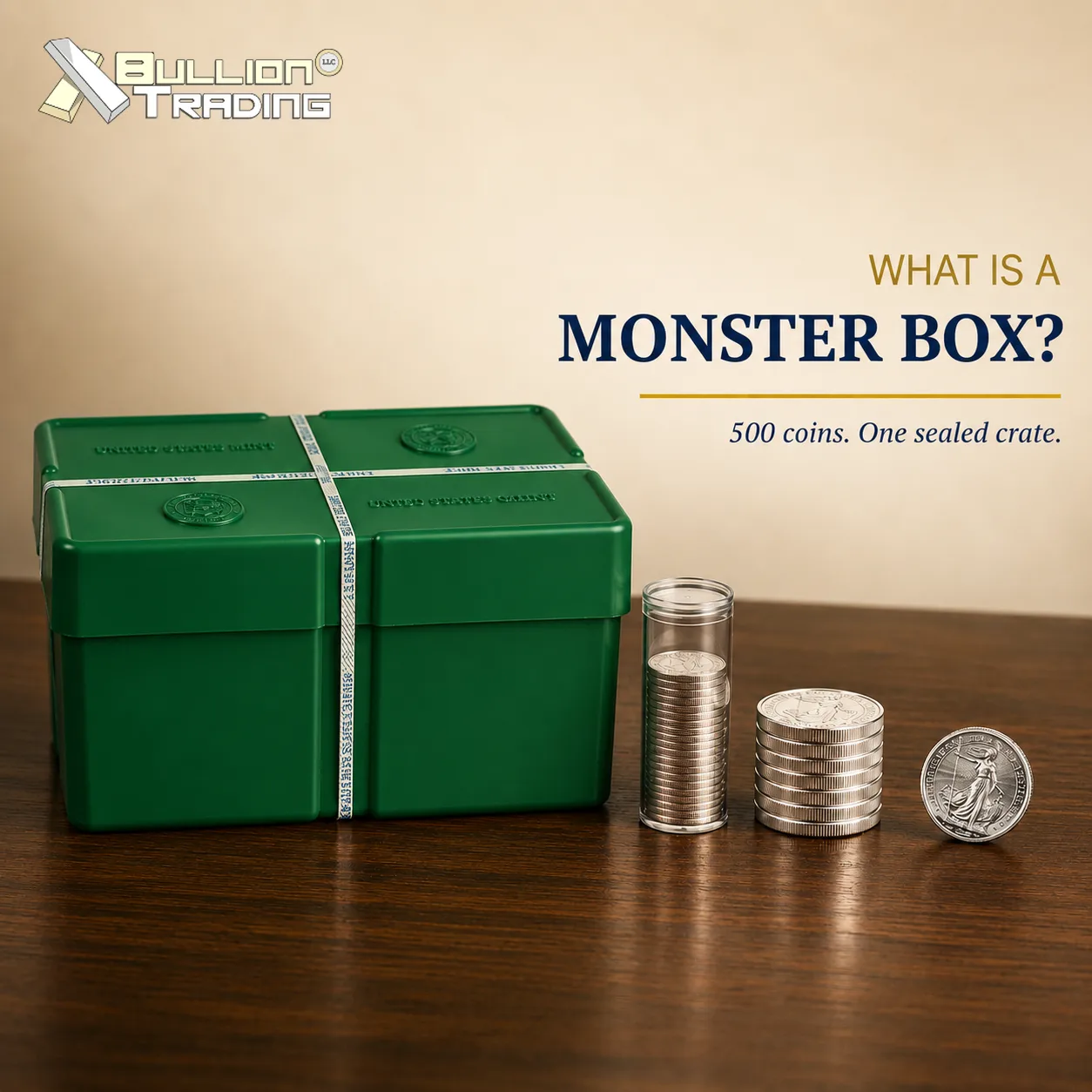

Walk up to a typical dealer counter for one Silver Eagle this week and you will pay about $70. Ask instead for five hundred of them in the mint’s original sealed box and the price drops to roughly $63 a coin, for exactly the same silver. That box is called a monster box: 500 one-ounce bullion coins in plastic tubes, packed and sealed at a government mint, 500 troy ounces of metal weighing 34 pounds. The gap between those two prices, multiplied across 500 coins, is why the monster box is the unit serious silver buyers think in. This guide covers what is inside one, how the boxes differ from mint to mint, and when buying one actually makes sense.
Where the box comes from, and why you can’t buy one at the mint
The name is dealer slang that stuck. Nobody at a mint sat down and christened it, but the boxes are heavy, they land on a loading dock in stacks, and somewhere along the way “monster box” beat every official term the industry tried. Even the mints have given in; you will now find the phrase in dealer catalogs worldwide.
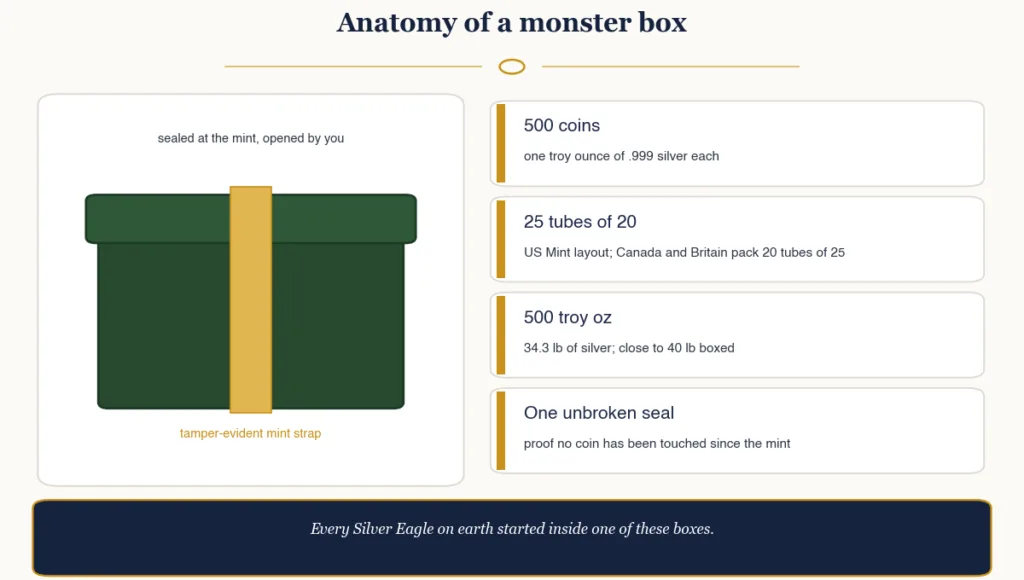
Here is the part most first-time buyers do not realize. The United States Mint does not sell bullion coins to the public. It strikes Silver Eagles, packs them into green boxes of 500, seals each box with a security strap, and sells them only to a small network of Authorized Purchasers at spot price plus a flat per-coin surcharge. Those wholesalers sell to dealers, and dealers sell to you. Every Silver Eagle in every display case anywhere on earth started its life inside one of these green boxes. When you buy a full sealed one, you are simply stepping one link up a supply chain that normally ends with the coins loose in a tray.
The economics follow from that. Every time a box is opened, sorted, tubed, and re-sold coin by coin, someone adds handling cost and margin. Buy the box intact and you skip all of it, which is why the per-coin price drops the closer your purchase gets to the original sealed crate.
Monster boxes by mint: not all boxes are 500 coins
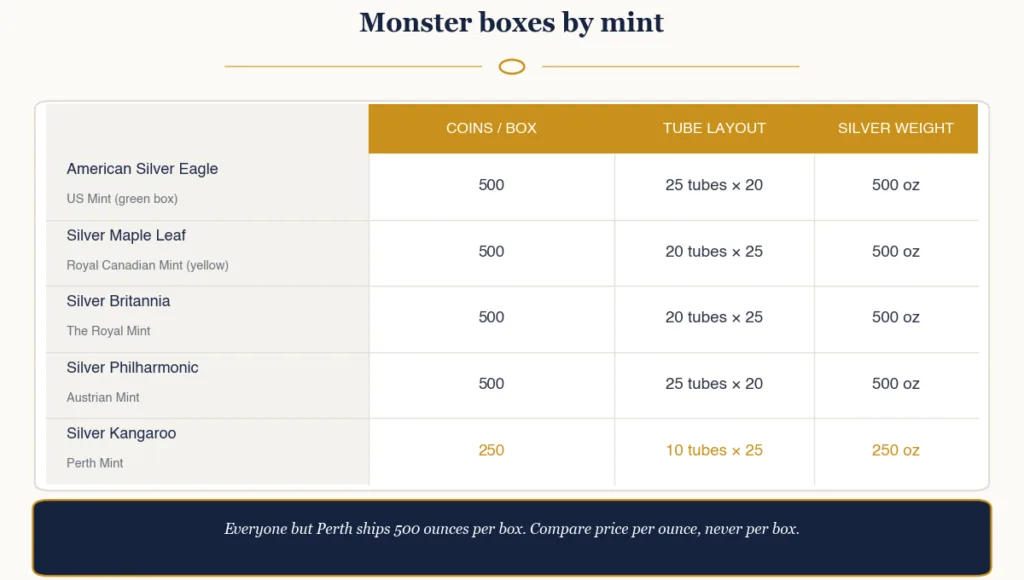
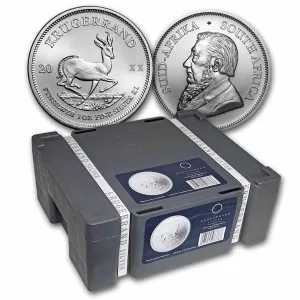
Each major mint has its own version, and the differences matter when you compare prices. The US Mint’s green box holds 500 Silver Eagles in 25 tubes of 20 coins. The Royal Canadian Mint ships Silver Maple Leafs in a yellow box of 500, but arranged as 20 tubes of 25. The Royal Mint’s Britannia box matches the Canadian layout at 500 coins in 20 tubes, and the Austrian Mint packs 500 Philharmonics the American way, 25 tubes of 20. The outlier is Australia: Perth Mint monster boxes hold 250 coins in 10 tubes of 25, so an Australian “box price” covers half the silver of everyone else’s. A tube count that seems like trivia becomes very practical the day you sell two tubes to raise cash and want the rest to stay full.
The boxes themselves are more thoughtfully engineered than they look. The tubes sit in molded slots so 34 pounds of coins cannot shift in transit, the lids stack, and the strap or shrink seal is tamper-evident. Mints did this for armored-car logistics, not for collectors, but the result is the best storage container silver coins ever get. Plenty of long-term stackers never remove the coins at all, partly because the box protects the coins’ surfaces from the handling that causes wear, and partly because sealed boxes are simply easier to sell, a point worth its own section.
And gold? The term barely exists there, for a simple reason of arithmetic. Gold bullion travels from mints to wholesalers in much smaller sealed units, because 500 ounces of gold at mid-2026 prices is more than two million dollars in a single lift. The monster box is a silver phenomenon: silver is cheap enough per ounce that moving it in half-thousand-ounce crates makes sense, and that accident of value density is why the box became the unit serious silver buyers think in.
The premium math: what a monster box actually saves you
Silver coins never sell at the spot price you see on a chart; there is always a premium on top, and the premium shrinks as quantity grows. That gap between the screen price and the physical price is a subject on its own, and our piece on the spot price versus the physical price explains why it exists at every quantity. What the monster box does is shrink it to its practical minimum.
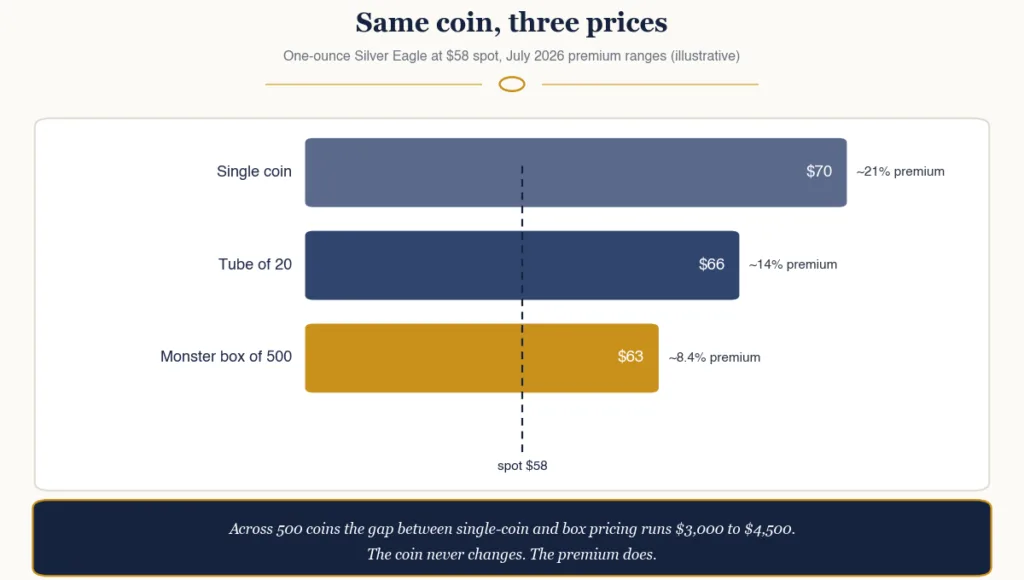
Put real numbers on it. Silver traded at $56.92 an ounce on July 20, 2026, according to Fortune’s price tracking, and has hovered in the high $50s all month. Premium tracking site FindBullionPrices, which polls dealer prices daily, put Silver Eagle monster box premiums between 7.6 and 9.2 percent in July 2026, averaging about 8.4 percent. The same coin bought one at a time commonly carries a premium of 20 percent or more. At a $58 spot price, that is roughly $63 a coin by the box against $70 or more for singles. Across 500 coins, the identical metal, the difference lands somewhere between $3,000 and $4,500.
The box does not make silver cheaper. It makes the packaging, handling, and retail margin cheaper, and on 500 coins that is real money.
Two honest caveats belong next to that math. First, a monster box is a five-figure purchase now; at mid-2026 prices a sealed Eagle box runs above $30,000, which is concentration risk in a single metal on a single day. If that number is most of your budget, spreading purchases over time may serve you better, and the case for that approach is laid out in our guide to dollar cost averaging into gold and silver. Second, premiums are not static. In March 2026 the same box briefly commanded a 22.5 percent premium before touching a record low of 6.69 percent just two months later. Patient buyers watch the premium as closely as the spot price, a discipline familiar to anyone who has read our piece on the premium trap on the gold side.
Why the factory seal is worth money
Counterfeiting is the quiet tax on the silver market. Fake coins exist, fake tubes exist, and every buyer of secondhand silver has to price in the cost of checking. A mint-sealed monster box shortcuts the whole problem: an unbroken US Mint strap means the coins inside have not been touched since they left the mint. Dealers trust the seal, which is why a sealed box sells faster and often at a better bid than 500 loose coins of the same date, and why the strap on a genuine sealed box should never be cut casually. Break it to admire your coins and you have converted a sealed box into “500 loose Eagles and an empty box,” which a future buyer must verify coin by coin.
The seal also protects you from subtler value leaks. Fingerprints, drops, and careless stacking all show up on soft .999 silver, and surface condition affects what a dealer will pay even for bullion coins. The one thing the box cannot prevent is milk spots, the white haze that can appear on silver coins years after minting regardless of storage; our guide to milk spots on silver coins covers why they happen inside sealed tubes too. Worth knowing before you blame your storage room.
One more resale note. Under the dealer reporting rules that govern precious metals buybacks, sales of American Silver Eagles are exempt from Form 1099-B reporting in any quantity, so selling a full monster box of Eagles does not trigger a dealer filing the way 1,000 ounces of bars would. Your capital gains obligations are a separate matter entirely, but the transaction itself stays paperwork-light.
What to check before you buy one
Compare the all-in price per ounce, not the box price, since a Perth box holds half the silver of an American one. Confirm whether the box is factory sealed or a dealer-assembled box of mixed years; both are legitimate products, but sealed commands more at resale and should be described as sealed, with the strap intact in photos. Ask how the box ships and insure the full value in transit, because 37 pounds of registered silver is not a padded-envelope item. And buy from a dealer who will quote you a buyback price on the same product, which tells you more about the fairness of their sell price than any slogan will.
Think about where the box will live, too, before it arrives. At roughly 15 by 8.5 by 4.5 inches, a monster box will not fit in most bank safe-deposit boxes, and at nearly 40 pounds boxed it tests the shelf of many home safes, so check your safe’s rated capacity and interior dimensions against the box, not against a stack of tubes. Homeowners insurance is the other surprise: standard policies cap coverage for bullion at a few hundred to a few thousand dollars, a fraction of what one sealed box is worth, so a rider or a vault arrangement belongs in the budget alongside the coins.
None of this is a reason not to buy. It is a reason to have the storage answer ready before the courier does. If this is your first large purchase, the pre-purchase homework in our first-time precious metals buyer’s checklist applies double at this size.
Silver Monster Boxes In Stock
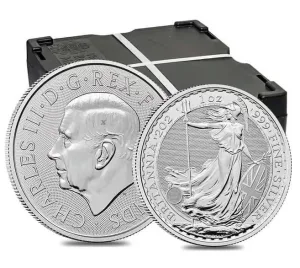
Monster Box of 500 - Great Britain 1 oz Silver Britannia Coins BU (Random Years)
Who the monster box is actually for
A monster box makes sense for a specific buyer: someone who has decided on a meaningful silver position, wants government-minted coins rather than bars, and would rather pay the lowest available premium once than a retail premium five hundred times. It rewards patience on the way in, since premiums swing, and discipline on the way out, since the seal is part of the value. It is the wrong first purchase for almost everyone, and the right five-hundredth ounce for a lot of people. If you are still weighing coins against bars, or silver against gold, settle that question first. The box will still be there, green or yellow, 34 pounds and utterly indifferent, when you are ready for it.
