
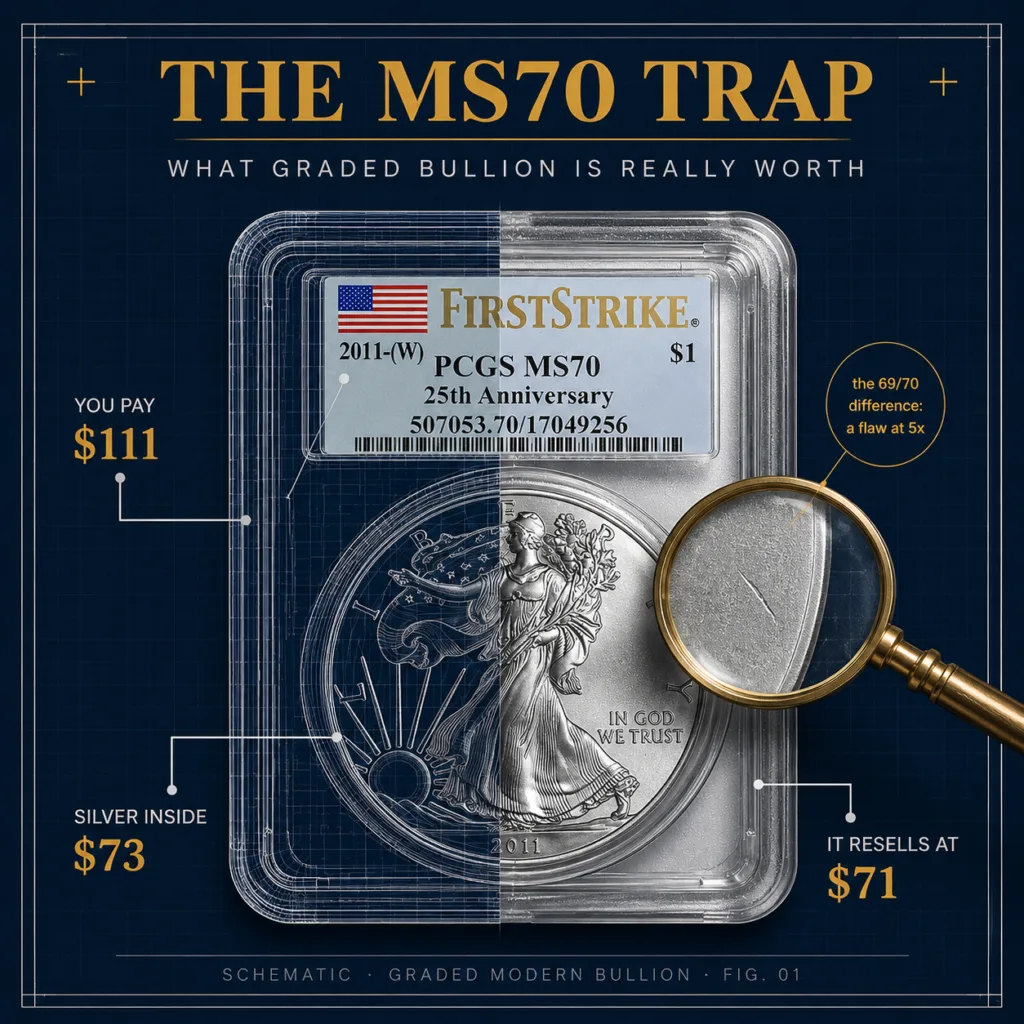
Walk into any coin shop or scroll any bullion site and you will see the same pairing: a plain American Silver Eagle for a few dollars over spot, and right beside it the identical coin in a plastic slab stamped MS70, priced 50 percent higher. Are MS70 graded Silver Eagles worth that premium? For modern bullion coins, the honest answer is usually no. The metal is the same, the design is the same, and the thing you are paying extra for, a perfection score and sometimes a “First Strike” sticker, tends to evaporate the day you try to sell. Understanding why takes about ten minutes, and it can save you thousands over a stacking career.
None of this means grading is a scam. For rare dates and genuinely scarce coins, third-party grading is one of the best things that ever happened to the hobby. The trap is specific: paying collectible prices for perfection labels on coins that were made by the tens of millions, most of them nearly perfect straight out of the press.
What MS70 actually means
Coin condition in the United States runs on the Sheldon scale, from 1 to 70. The two big grading services define the top of that scale precisely. NGC defines a Mint State 70 as a coin with no post-production imperfections at 5x magnification, and PCGS grading standards describe a 70 as fully struck, lustrous, and free of visual marks. MS69, in NGC’s own words, is a fully struck coin with nearly imperceptible imperfections, a microscopic contact mark or a faint hairline that a trained grader found under magnification.
Read those definitions again, because the entire price gap lives inside them. The difference between a $100 coin and an $85 coin is a flaw you need a loupe and professional training to find. Nobody at a dinner party, and no future buyer holding the coin in hand, will ever see it. If you want the deeper background on how the services authenticate and encapsulate coins, our guide to NGC and PCGS coin grading covers the machinery. The short version is that grading answers two questions: is it real, and what condition is it in. Both answers matter enormously for an 1893 Morgan dollar. For a coin the U.S. Mint struck last month with modern quality control, the second answer is close to a formality.
Perfection used to be rare. It is now the default
The Sheldon scale was built for a world of 19th-century coins that circulated in pockets and bank bags, where a genuinely mark-free survivor was a small miracle. Modern bullion manufacturing does not live in that world. Silver Eagles are struck on modern presses, handled by machine, and shipped in sealed tubes and monster boxes. They do not circulate. The result is that the overwhelming majority of freshly minted Eagles arrive at the grading services in gem condition, and MS70 populations for recent dates run into the tens of thousands in the PCGS population report.
Think about what that does to the word “perfect.” A perfect 1996 Eagle is a scarce thing, because 1996 coins were made before the services graded moderns in bulk and before mint handling improved. A perfect 2026 Eagle is closer to a coin that did not get unlucky. Dealers know this. Large submitters send the Mint’s sealed boxes to the grading services by the pallet, and a healthy fraction of every box comes back MS70. The slab did not find a needle in a haystack. It confirmed that a mass-produced product met its factory spec.
The price ladder: same coin, four prices
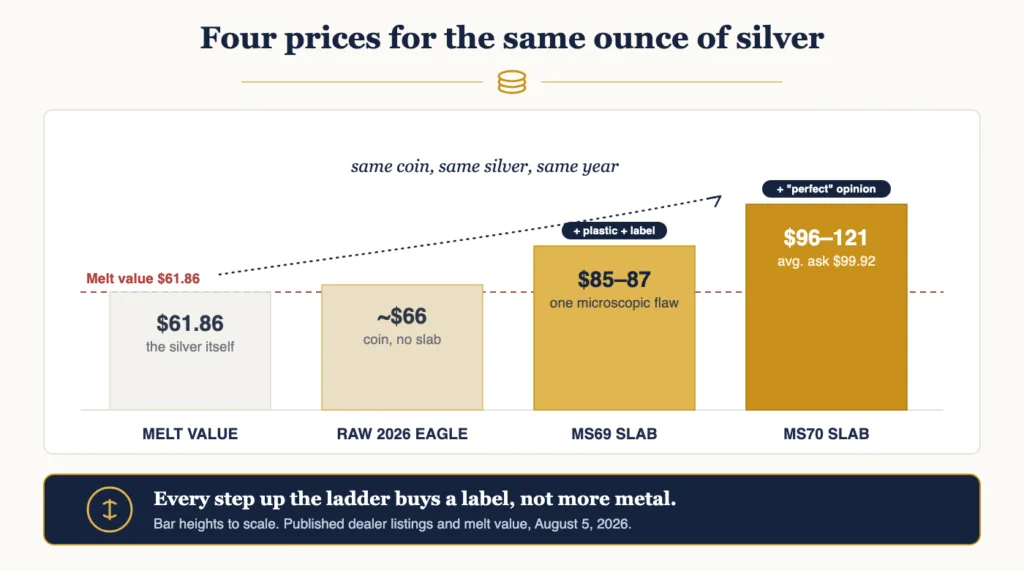
Put real numbers on it, all from public listings on August 5, 2026. With silver spot at $61.86, the melt value of the silver in one Eagle is $61.86. A raw, ungraded 2026 Eagle sells for as little as $65.67 across the dealers tracked by FindBullionPrices, which on the same day shows the 2026 PCGS MS70 version averaging $99.92 across five dealers, a premium of roughly 60 percent over the metal. Slabbed retail listings elsewhere run about $85 to $87 for MS69 and $96 to $121 for MS70.
So the ladder for one identical ounce of silver reads: about $62 in metal, about $66 raw, mid 80s in an MS69 slab, and $96 to $121 in an MS70 slab. Every rung above the raw coin is paying for plastic and a two-digit opinion. That would be defensible if the market later honored the opinion. Which brings us to the part the sales page never shows you.
The sell-side test: what the premium is worth on the way out
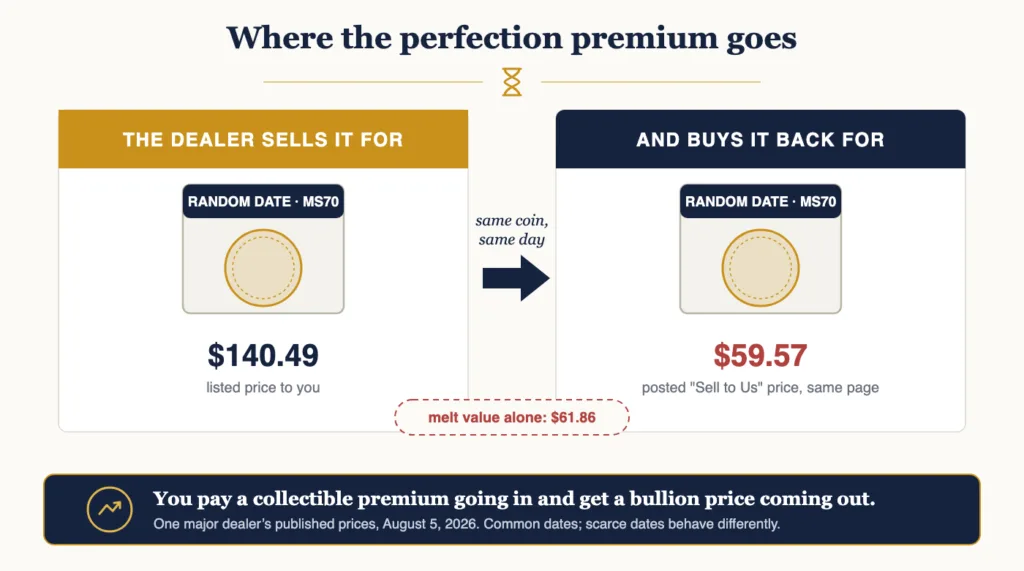
The cleanest way to test any premium is to check both sides of the same dealer’s counter. One major online dealer’s product page for a random-date MS70 Silver Eagle tells the whole story in two numbers, posted side by side on August 5, 2026. Buy the coin from them: $140.49. Sell the identical coin to them: $59.57. That buyback is not a typo. It sits below the $61.86 melt value of the silver inside, which means the dealer will pay you slightly less for a certified perfect Eagle than the raw metal is worth. Walk the full round trip and you surrender 58 percent of your money to the same counter that sold you perfection.
This is the trap in one sentence: you pay a collectible premium going in and receive a bullion price coming out. Dealers who buy back graded modern Eagles generally pay their ordinary bullion rate, because that is what the wholesale market gives them. The slab does not hurt you, but on a common date it does not pay you either. The pattern rhymes with the one we documented in our piece on the gold premium trap: the price you pay and the value you hold are two different numbers, and marketing lives in the gap between them.
“First Strike” does not mean what you think it means
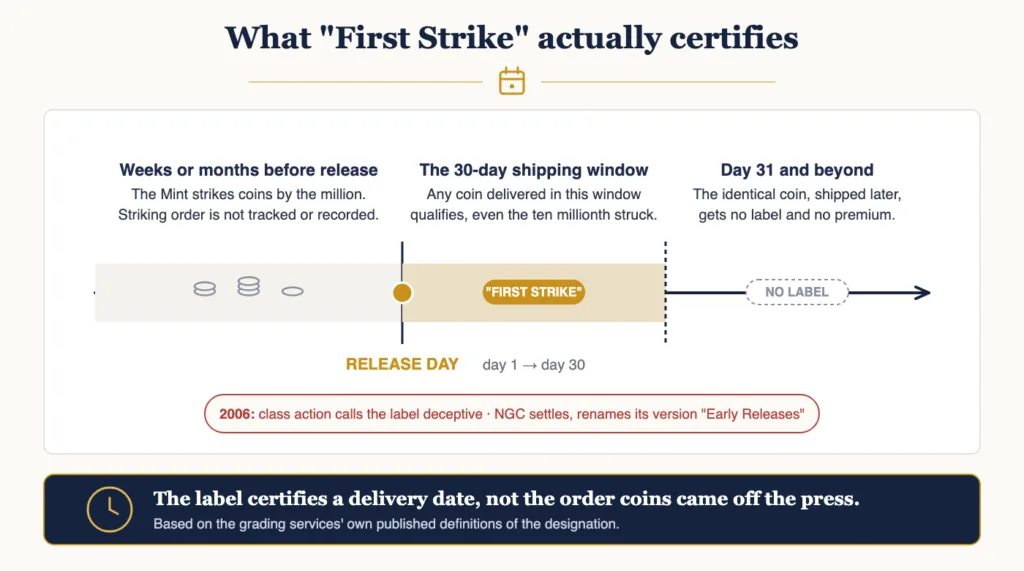
Now for the sticker. Slabbed modern coins often carry an extra designation, “First Strike” at PCGS or “Early Releases” at NGC, usually with a flag or special label, always with a higher price. The natural reading is that these were the first coins off the press, struck from fresh dies, sharper and more special than the rest. That is not what the label means.
By PCGS’s own definition, First Strike designates coins issued in the first 30 days of the Mint’s release, submitted with a qualifying postmark or in the Mint’s unopened shipping box. It is a shipping-window designation, and it costs an extra $18 per coin on top of the grading fee. The Mint often strikes coins for weeks before release day, and the U.S. Mint itself has stated it cannot track when individual coins were produced. A “First Strike” coin might have been the ten millionth Eagle struck. It simply traveled early.
This is not a pedantic quibble. In 2006 a class action was filed against both major grading services, alleging the First Strike label was deceptive precisely because buyers believed they were getting the first coins struck; the same coverage records the Mint’s admission that it cannot track production order. NGC reached settlement terms in 2007, directing $447,500 to the American Numismatic Association for consumer education, and shifted its wording to “Early Releases.” The labels survive today with careful fine print, and they still command premiums from buyers who never read that fine print. When a label’s own legal history includes a deceptive-marketing lawsuit, the burden of proof for its premium should sit with the seller, not with you.
When grading genuinely earns its fee
Here is the nuance the extremes miss. Grading costs real money, $24 to $42 per coin at current PCGS service levels before shipping and any label upcharges, and for the right coin it is money brilliantly spent. Older Silver Eagle dates with small surviving MS70 populations carry premiums that have held for decades. Classic coins, Morgans, Saint-Gaudens, anything where authenticity and condition are genuine questions, benefit enormously from a slab, both in value and in ease of sale. The whole category of coins whose worth floats far above their metal is real, and we have written about why collectible coins are worth more than their weight.
Registry collectors are the other honest use case. PCGS and NGC run set-registry competitions where only their top-graded coins score points, and for those collectors an MS70 is the point of the exercise. If that is your hobby, buy the 70 with open eyes and enjoy it. The trap is not that MS70 coins exist. The trap is a stacker who wants ounces of silver being sold a competition entry instead, at 40 percent over the metal.
One more distinction worth keeping sharp: none of this applies to proof coins, which are a different product made a different way for a deliberately higher price. If you are weighing a shiny cameo proof against a standard coin, that comparison has its own rules, which we walk through in our guide to proof versus bullion coins.
The question that deflates the label
The salesman’s pitch for a graded modern Eagle leans on words: perfect, certified, first, limited. Your defense is one number. Before paying for any slabbed modern bullion coin, ask what the same coin costs raw, and what the dealer would pay you for the slabbed one today. If the answers are “$66” and “around spot,” then the $100 sticker is not a coin price, it is a story price. Sometimes a story is worth paying for. A perfect coin from a birth year, a milestone issue that means something to your family, a set you are building for the joy of it, those are fine reasons, and they have nothing to do with investment.
But if the pitch is that the MS70 label or the First Strike flag makes the coin a better investment than the raw Eagle next to it, the market has already voted, and the ballot is that $59.57 buyback quote. High-pressure sellers of overpriced “collectible” versions of ordinary bullion are one of the oldest recurring problems in this industry, and when they collapse, as we saw in the Rosland Capital bankruptcy, it is the label buyers who are left holding coins worth half what they paid. Buy the metal, or knowingly buy the story. Just never confuse the two prices, because the person selling the slab never does.