
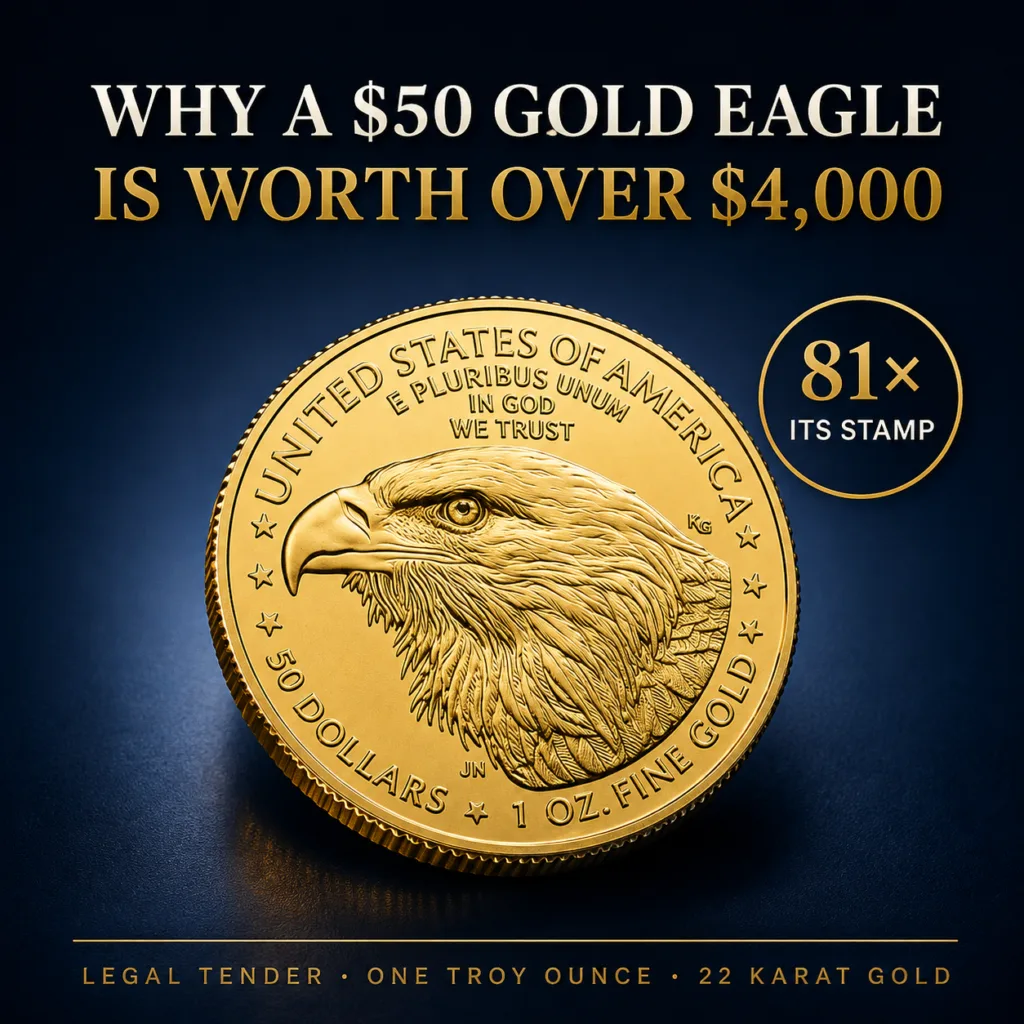
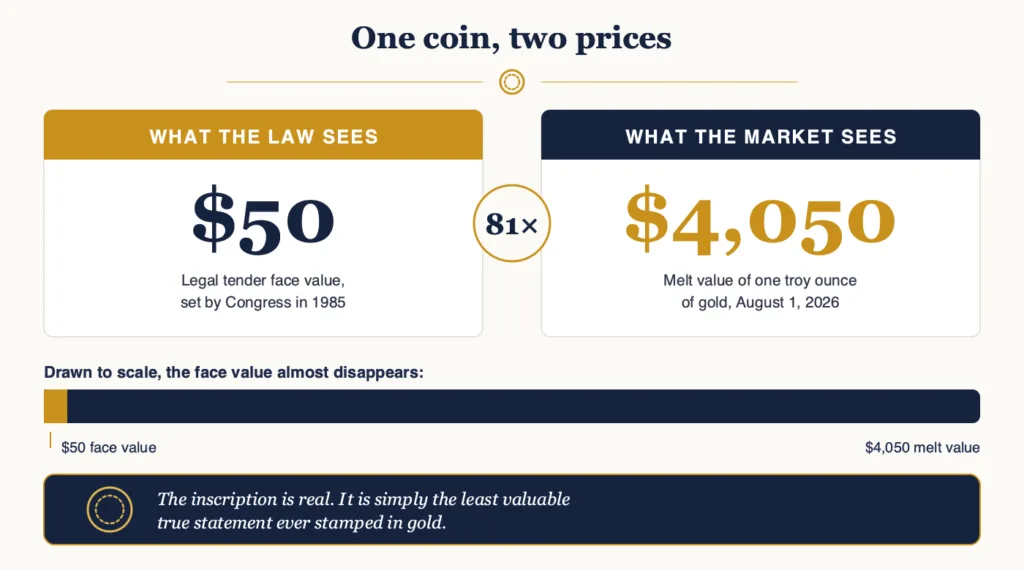
Flip over a one ounce American Gold Eagle and you will find, stamped right into the metal, the words FIFTY DOLLARS. The coin holding that inscription contains a full troy ounce of gold, which traded at about $4,050 on August 1, 2026. So the gold eagle face value understates what the coin is worth by a factor of roughly 81. You could, in theory, walk into a diner, order a sandwich, and settle the bill with a coin carrying four thousand dollars of gold. The law would be perfectly satisfied. Your accountant would need a drink.
Why would the United States government stamp a number that wrong onto its own coin? The answer runs through two centuries of monetary history, one very strange statute, a Las Vegas businessman who bet his freedom on that little inscription, and a 221 pound Canadian coin that thieves wheeled out of a Berlin museum on a skateboard. It is a better story than a two word inscription has any right to carry.
What legal tender actually means (it is less than you think)
Start with the phrase everyone uses and almost nobody defines. The Gold Eagle is legal tender because Congress said so: 31 U.S.C. § 5112 authorizes the coin and assigns its denomination, and 31 U.S.C. § 5103 declares that United States coins are “legal tender for all debts, public charges, taxes, and dues.”
Notice what that sentence covers: debts. If you already owe someone money, they must accept your Gold Eagle at $50 toward the balance. What the law does not do is force anyone to take it as payment in an ordinary purchase. The Federal Reserve is refreshingly blunt about this in its own FAQ: no federal statute requires a private business to accept cash at all. A coffee shop can refuse your hundred dollar bill, and it can refuse your Gold Eagle. Legal tender status is a narrower, duller power than the grand phrase suggests.
Which raises the obvious question. If the $50 barely functions as money, why put a denomination on the coin at all? The Krugerrand, the coin that invented the modern bullion market, carries no face value whatsoever and has sold tens of millions of ounces without one. We covered that contrast in our Krugerrand vs Gold Eagle comparison. South Africa never bothered with a denomination. Congress did. The reasons turn out to be part history, part law, and part marketing.
Where the gold eagle face value came from
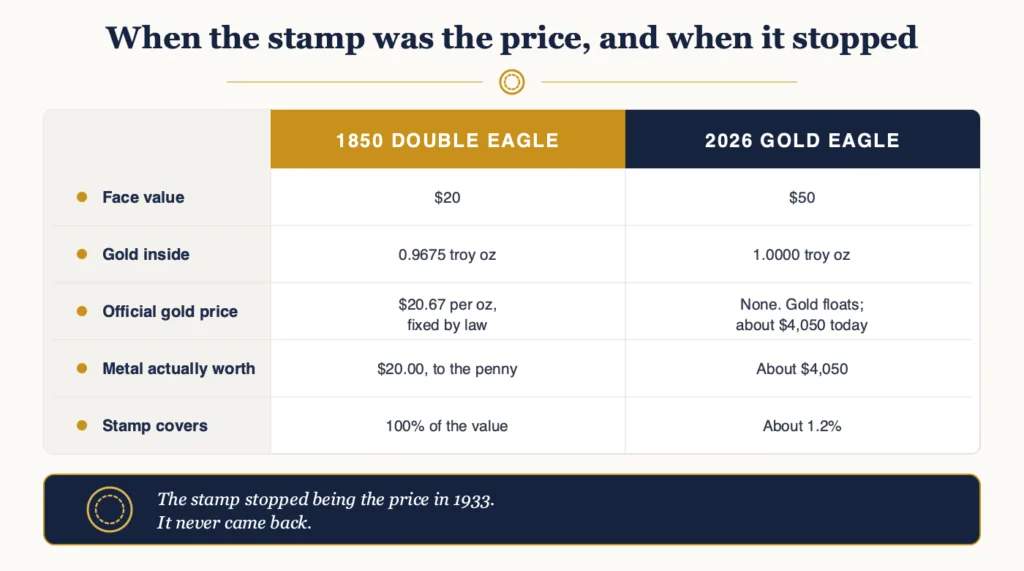
The number is not random, but it is not principled either. When Congress passed the Gold Bullion Coin Act of 1985 and the Mint struck the first Eagles in late 1986, America already had a long tradition of gold coins with denominations, and those older denominations had actually meant something. From the nineteenth century until 1933, the official price of gold in the United States was fixed at $20.67 per troy ounce. The $20 Double Eagle of that era contained 0.9675 ounces of gold, which at the official price works out to $20.00 on the nose. The face value was not a label. It was the gold, weighed and priced. A Double Eagle was twenty dollars in the same way that four five dollar bills were.
That identity between the stamp and the metal died in stages: gold ownership banned in 1933 under Executive Order 6102, the last official link between the dollar and gold cut in 1971. By the time the Eagle arrived in 1986, gold floated near $400 an ounce, so a proportionally honest one ounce coin would have needed a face value that changed daily. Congress instead picked a deliberately low round number: $50, comfortably below any conceivable market price. The denomination was never meant to price the coin. It was meant to make the coin officially money, with everything that status drags along behind it.
Other mints made the same choice with different arithmetic. Canada stamps $50 on its Maple Leaf. Austria puts 100 euros on the Philharmonic. And in 2007 the Royal Canadian Mint took the idea to its logical extreme with the Big Maple Leaf, a 100 kilogram coin bearing a face value of one million Canadian dollars while containing several times that in gold.
One of only six ever made sat in Berlin’s Bode Museum until March 2017, when thieves broke into the second floor and escaped with it. Investigators concluded the 221 pound coin was wheeled out on a skateboard and melted down soon after. The face value said one million. The metal said more than four million. The thieves, you will notice, priced it like bullion.
The quarter ounce coin that breaks the pattern
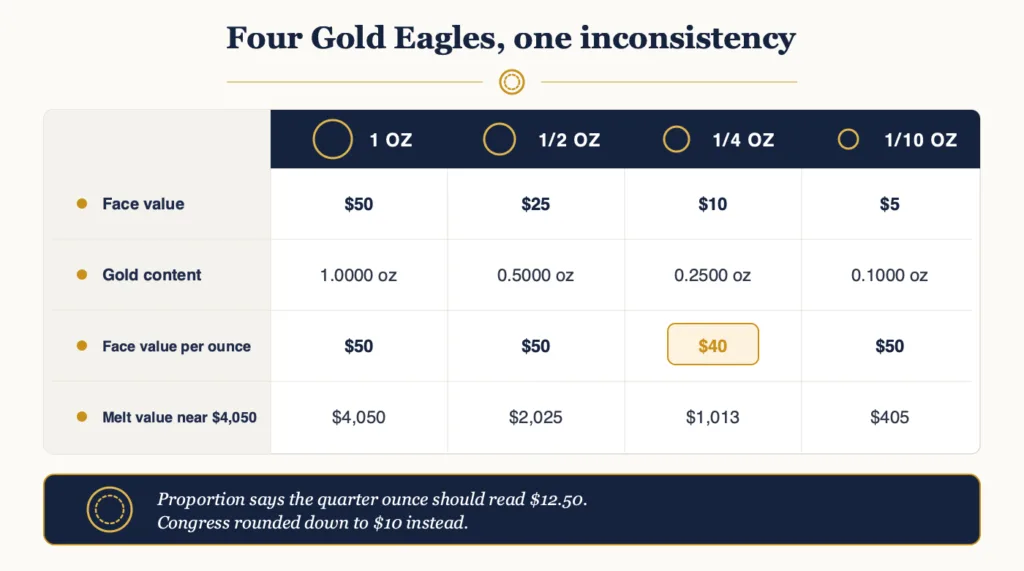
Here is a detail that catches even experienced stackers off guard. The Eagle comes in four sizes, and the face values do not scale. The one ounce coin is $50 and the half ounce is $25, which tracks. Then the tenth ounce carries $5, still fifty dollars per ounce. But the quarter ounce Eagle is stamped $10, when proportion demands $12.50. Congress apparently could not bring itself to put a fraction on a coin, so the quarter ounce Eagle walks around with a face value of just $40 per ounce of gold while its three siblings all say $50. It changes nothing in practice. It is simply a reminder, struck in 22 karat gold, that the denomination was always a legal costume rather than a measurement.
None of this stops the face value from doing quiet, useful work. Because the Eagle is statutory United States coinage, faking one is counterfeiting federal money, prosecuted under the counterfeiting statutes rather than as mere fraud. The denomination also gives the coin an absolute price floor. If gold somehow fell to zero tomorrow, the Treasury would still owe you fifty dollars for the coin. That floor sits about 99 percent below the market, so nobody buys Eagles for it, but no Krugerrand can make the same promise. And the weight and purity behind that denomination are guaranteed by the United States government under § 5112, which is a real part of why Eagles command stronger premiums than generic rounds of identical gold content.
The man who bet fifteen years on the inscription
Every gap between two official numbers eventually attracts someone who tries to arbitrage it. The gap between the gold eagle face value and its market value found Robert Kahre.
Kahre ran construction related businesses in Las Vegas, and for years he paid workers in gold and silver Eagles, booking the wages at face value. A worker might receive coins worth a full week’s pay at market prices, while the payroll ledger recorded something like $50, far below the thresholds that trigger tax withholding and W-2 reporting. On paper, almost nobody earned enough to owe taxes, and the government’s own legal tender statute seemed to bless the arithmetic. If the United States says this coin is fifty dollars, went the argument, who is the IRS to disagree?
The IRS disagreed. A federal jury convicted Kahre in 2009 on 57 felony counts, including failing to collect employment taxes, tax evasion, and wire fraud, in a scheme prosecutors said concealed $120 million in income, and he was sentenced to 15 years in federal prison. The Ninth Circuit upheld the convictions in language that closes the loophole for good: coins are taxable as property when their market value exceeds their face value, and it is “immaterial that such coins may be legal tender at their face value.”
The logic cuts cleanly: the $50 governs what the coin can legally settle, not what the coin is worth. The same principle runs through the tax code generally. When you sell Eagles at a profit, the IRS taxes the real gain, at rates we broke down in our guide to the 28 percent collectibles tax, and it has never once cared what the inscription says.
So could you actually spend one?
Legally, yes. At any business willing to take it, a one ounce Eagle settles exactly fifty dollars. People have done it, usually by accident, and the stories are uniformly painful: inherited coins hauled to a bank and deposited at face value, a $5 tenth ounce Eagle dropped in a charity kettle, estate coins spent by relatives who saw the number and not the metal. The bank is not obligated to flag it. The register will not stop you. The law regards a transaction that vaporizes 98.8 percent of a coin’s value as entirely proper.
The silver version of this trap is quietly worse. The American Silver Eagle carries a face value of one dollar over a full ounce of silver, and silver traded near $57.60 on the same August day. Deposit an inherited tube of twenty Silver Eagles at the bank and the teller will credit your account exactly twenty dollars for more than eleven hundred dollars of metal. Nothing about the transaction is illegal, improper, or reversible. The teller followed the law. The law followed the inscription.
This is precisely why coins like the 1933 Double Eagle could sell for millions while wearing a $20 inscription, and why nobody at that auction blinked at the contradiction. In American law, a coin’s denomination and a coin’s value divorced in 1933 and never remarried. The stamp became a legal formality, the metal became the money, and the two numbers have been drifting apart ever since. At $400 gold in 1986, the Eagle was worth 8 times its face value. At $2,000, it was 40 times. At $4,050, it is 81 times, and every dollar gold climbs stretches the absurdity a little further.
So read the inscription on an Eagle the way you would read a cornerstone date on a building: official, permanent, and telling you almost nothing about what the thing is worth today. The fifty dollars is real. It is simply the least valuable true statement ever stamped in gold.