
Here is how bullion coins are made, in short. A flat metal disc called a blank is softened in a furnace, washed, and given a raised rim. Then it gets squeezed once between two hardened steel dies, while a ring called a collar shapes the edge in the same instant. The finished coins are inspected, counted into plastic tubes and packed into 500-coin boxes for the authorized dealers who sell them on. The U.S. Mint walks through each machine on its coin production page.
What surprises people is where the trip starts. The Mint makes its own blanks for nickels, dimes, quarters, half dollars and dollar coins, but “for collectible pennies, numismatic coins, and bullion coins, the Mint buys blanks”. The Silver Eagle in your safe began life in a private factory before the government ever touched it, which helps explain why Silver Eagles have spent years on allocation even when silver itself was easy to find. Here is the full route, using the one-ounce Silver Eagle as the example and noting where the gold coin differs.
The metal arrives with a legal paper trail
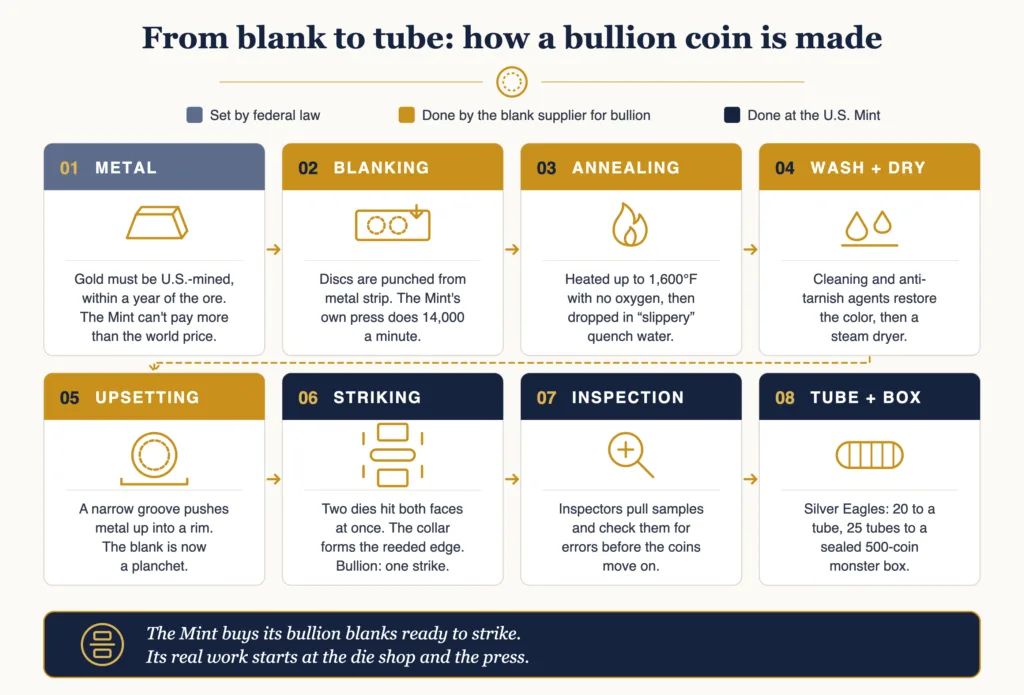
Before anyone cuts a blank, Congress has already decided where the metal can come from. For Gold Eagles, the Treasury must buy “gold mined from natural deposits in the United States, or in a territory or possession”, within one year after the month the ore was mined, and pay “not more than the average world price”, under 31 U.S.C. 5116. If no such gold is available at that price, the Mint can fall back on gold from the government’s own reserves.
Silver Eagles started from a different pile. The same statute told the Mint to buy their silver from the government’s strategic materials stockpile, and a 2002 amendment spelled out what happens after that: once the stockpile was used up, the Mint would buy newly mined American silver, and if that wasn’t economically feasible, silver “from other available sources”. The last sentence of the rule is the one that bites in a tight market. The Treasury “shall not pay more than the average world price for silver under any circumstances”. When blank makers are swamped, the Mint cannot simply outbid everyone else for their output.
The gold coin also gets an alloy. A one-ounce Gold Eagle is 91.67% gold, 3% silver and the balance copper, and it weighs 33.931 grams so that it still carries a full troy ounce of pure gold, according to the Mint’s bullion coin specifications. The Mint says the alloy makes “harder coins that resist scratching and marring”. The silver coin skips the alloy: it is .999 fine silver, 31.103 grams and 40.60 millimeters across.
Blanking: the step the Mint hands to contractors
When the Mint makes blanks itself, it starts with coils of metal 1,500 feet long, made to the correct specification for each denomination. A machine straightens the strip and feeds it into a blanking press that “punches out the blanks like a cookie cutter at a rate of 14,000 blanks per minute”. The perforated skeleton left behind, called webbing, is shredded and recycled. Bullion blanks are made the same basic way in somebody else’s plant, and most reach the Mint as finished planchets ready for the press. Inspectors check each shipment against the specifications before it goes anywhere near a coin press.
For Silver Eagles, the best-documented supplier is Sunshine Minting of Coeur d’Alene, Idaho. Coin World reported in 2015 that Sunshine was “the primary supplier of 1-ounce silver planchets” to the Mint, with its Idaho plant and a Las Vegas facility running around the clock, seven days a week. Its owner, Tom Power, summed up that year’s shortage in a few words: “There is no physical shortage of the metal. It’s fabrication”. He also noted that the Mint “doesn’t get 100 percent of our capacity”. Sunshine supplies other world mints and sells its own bars and rounds as well.
That bottleneck has never fully cleared. As of October 2026, the Mint’s page for firms hoping to become authorized purchasers still says “American Eagle silver bullion remains on allocation”, and the application process for new silver distributors stays suspended. If you have wondered why Silver Eagle premiums run above other one-ounce coins, look at the blank stage first. It is a little absurd that the coin the Mint calls the world’s leading choice among silver bullion coins depends on outside fabricators, but that is how the program is built.
Annealing, washing and the raised rim
A freshly punched blank is too hard to take a crisp design, so it gets annealed. For bullion, the planchet supplier usually handles this and the next two steps before delivery, but the Mint’s own line shows how they work. The Mint’s furnace heats blanks to as much as 1,600 degrees Fahrenheit in an oxygen-free atmosphere, because oxygen would tarnish them. Then it drops them into a quench tank of what the Mint calls “slippery” water, a mix of water, citric acid powder and lubricants that keeps the hot discs from sticking together. Philadelphia lifts them out with a slowly turning cylinder called a whirlaway, and Denver uses a large scoop called a skip basket. After that come a wash in cleaning and anti-tarnish agents and a pass through a steam dryer.
The last preparation step is upsetting. The upsetting mill rolls each blank through a groove slightly narrower than its diameter, which pushes metal up around the edge into a rim. The rim protects the design from wear and lets coins stack. Once a blank has that rim, the Mint calls it a planchet.
Processing is also one suspect behind milk spots, the white blotches that appear on silver bullion months or years after it is struck. The Royal Canadian Mint spent four years studying them and found “there is no single cause”, with silver reacting to contaminants “in processing, handling and storage”, as it explained on its own blog. Its fix was a proprietary surface treatment called MINTSHIELD, applied to every Silver Maple Leaf bullion coin dated 2018 and later, which it says significantly reduces the spots rather than ending them. Our guide to milk spots on silver coins covers what they do to resale value.
The dies come from a family tree of steel
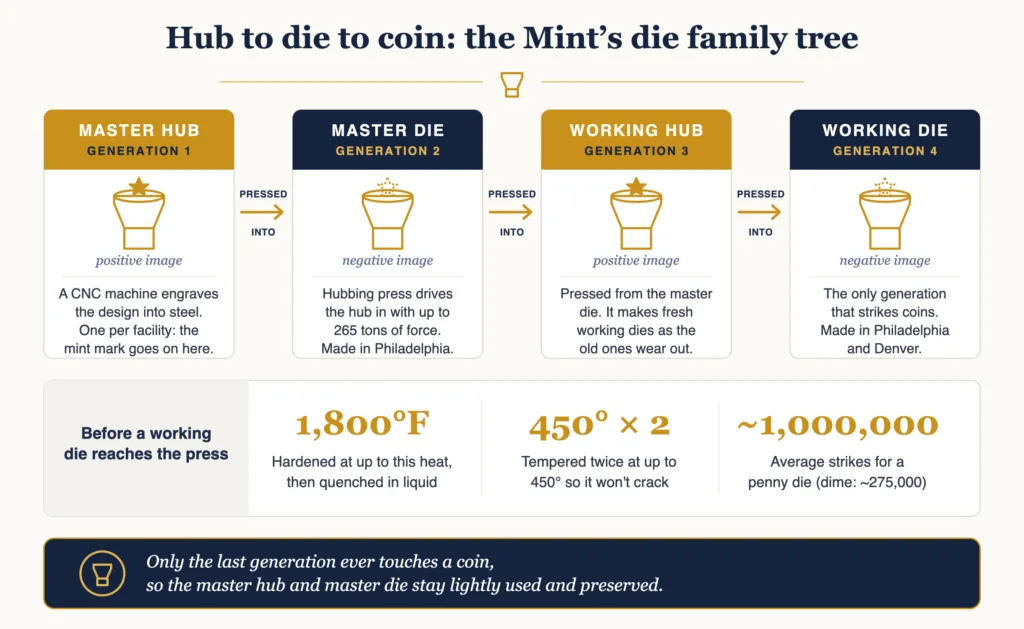
While blanks are being prepared, the die shop is making the tools that will strike them. A computer-controlled milling machine engraves the approved design onto a steel master hub, which carries the image in positive relief, as the Mint’s die-making page describes. The Mint makes a separate master hub for each facility that will strike the coin, because “it’s at this stage that the machine adds the mint mark”.
From there the design passes down the generations. A hubbing press drives the master hub into a fresh die blank with up to 265 tons of force, depending on the denomination, to make a master die. Master dies make working hubs, and working hubs make the working dies that actually strike coins. The whole point of the chain is preservation: working dies wear out and get replaced from the working hubs, while the master hub and master die stay lightly used. Philadelphia makes the master hubs and dies for nearly every Mint coin, and Philadelphia and Denver supply working dies to San Francisco and West Point.
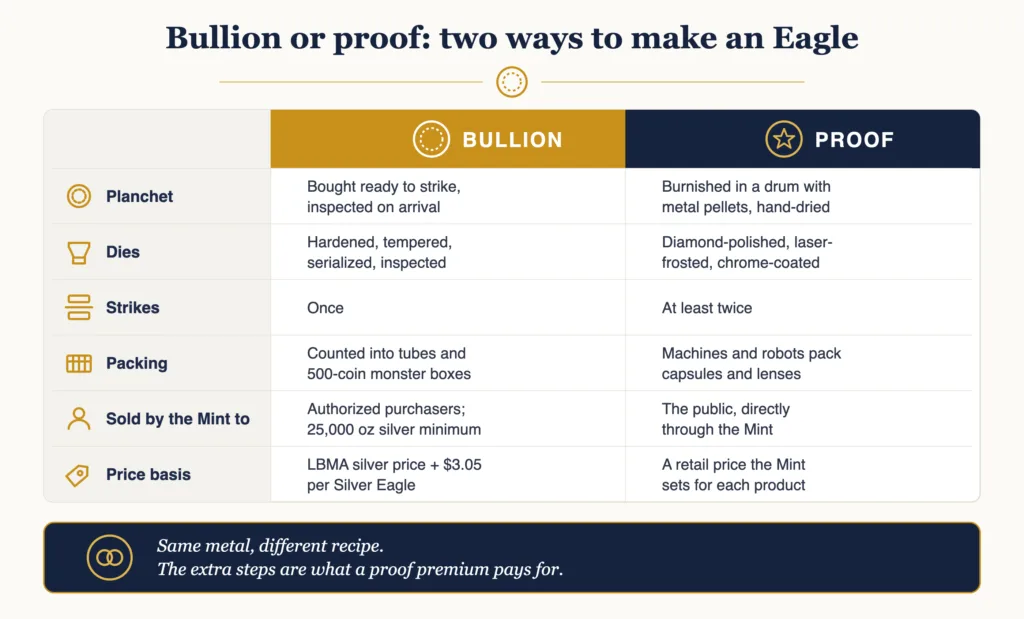
Working dies are then hardened in a furnace at up to 1,800 degrees Fahrenheit and quenched. That makes the steel hard but brittle, so they are tempered twice at up to 450 degrees to keep them from cracking under the press. Each die gets a laser-engraved serial number so the Mint can track its life, which depends on the coin. A penny die averages about a million strikes and a dime die about 275,000. The page gives no figure for bullion dies. Bullion and circulating dies are ready at this point, while proof dies go on to be polished with diamond paste, laser-frosted and coated with chrome by vapor deposition, the extra work our comparison of proof and bullion coins breaks down.
One strike does all the work
Striking is the moment the coin’s design comes into existence. The press forces the obverse and reverse dies together against the planchet and strikes both sides at once, and the metal flows up into the recesses of the design. A ring called the collar surrounds the planchet so the metal can’t spread too far, and the collar forms the edge. That is how a Silver Eagle gets its reeding in the same instant as its faces, and our explainer on why coins have ridges covers why the reeds are there at all.
The Mint says its circulating presses use 35 to 100 metric tons of force, depending on the denomination, and other presses strike with up to 540 tons for the five-ounce America the Beautiful silver coins. It does not give a figure for the one-ounce Eagles. What it does state plainly is that “circulating, uncirculated, and bullion coins are struck once. Proof coins are struck at least twice”. Its circulating presses run at 750 coins a minute, faster than the presses it uses for bullion.
The collar now carries a security feature too. In 2021 the Mint gave the American Eagles new reverse designs and “introduced anti-counterfeiting features, including a reeded edge variation on the one-ounce bullion coins”, according to its press release. Coin World described the visible part as a notch in the reeding at the 6 o’clock position when the coin sits obverse up, and reported that the Mint also uses covert features it will not identify.
Inspection, tubes and the 500-coin box
After striking, coins drop into a bin or tray and an inspector examines samples for errors. Circulating coins that fail go to a machine the Mint calls a waffler, which bends them into wavy shapes before they are recycled. Bullion that passes is counted and packed. In the Mint’s words, “bullion coins are packaged in 500-coin monster boxes to ship to authorized dealers”. For Silver Eagles that sealed green box holds 25 plastic tubes of 20 coins, a layout our piece on what a monster box is compares with the Canadian, British and Australian versions.
The Mint never sells those boxes to you. It sells to a small network of authorized purchasers, who must order at least 25,000 ounces of Silver Eagles or 1,000 ounces of Gold Eagles at a time. They pay the LBMA silver price plus $3.05 per Silver Eagle, or the LBMA gold price plus 3% for a one-ounce Gold Eagle, a premium the Mint says covers “minting, distribution, and marketing costs”. That $3.05 is, in effect, the price tag on everything described above beyond the metal itself: making the blank, the dies, the press time, the inspection and the tube. Every markup you pay further down the chain sits on top of it.
Minted bars travel a similar road. They are cut from rolled strip and struck between dies instead of being poured into molds, which is the main dividing line in our guide to cast and minted gold bars.
How bullion coins are made, and what it means when you buy
Knowing the process changes how you read the coins in your hand. Bullion is struck once at production speed and packed 500 coins to a box, so small contact marks and the occasional milk spot come with the product. They are not signs of mishandling, and they are certainly not signs of a fake. A proof costs more because it follows a slower manufacturing route, with burnished planchets, polished dies and two or more strikes. The metal inside is the same.
The process explains the shortages as well. When Silver Eagles go on allocation, the constraint usually sits at the blank stage in contractors’ plants, not in the vaults. And the collar hands you a free check every time you buy: a one-ounce Eagle with the 2021 reverse should show that notch in its reeding at 6 o’clock. If it doesn’t, slow down and test the coin properly before any money changes hands.