
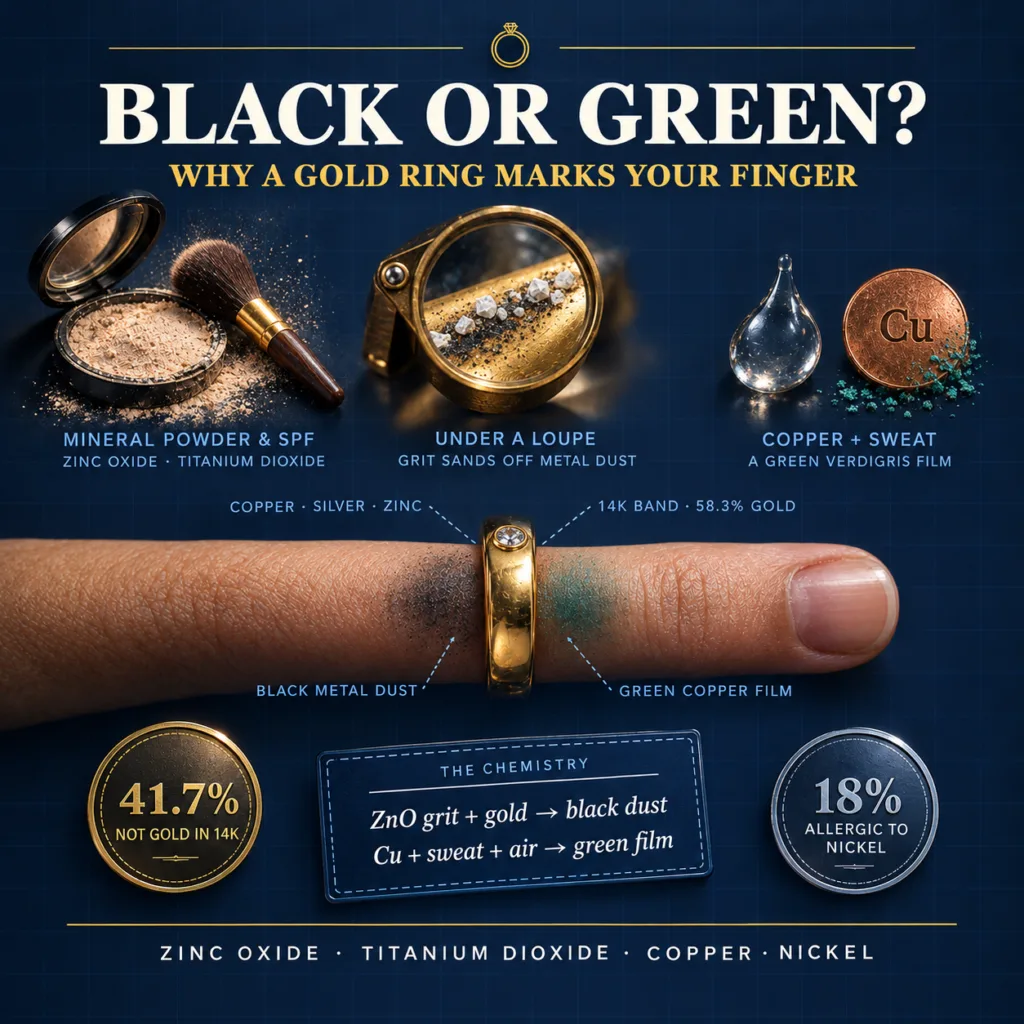
If you are asking “why does my gold ring turn my finger black?”, the short answer is that the mark almost never means the gold is fake, and it is almost certainly harmless. A black smudge is usually metal dust. Something on your skin that is harder than the ring, most often zinc oxide or titanium dioxide from cosmetics such as face powder, sands microscopic particles off the band, and particles that small look black. A green ring around the finger is a different reaction: copper in the alloy meets sweat, salt and pollution and forms a thin green film that rubs off onto you.
On its own, neither mark tells you much about the gold. A 14 karat ring is 41.7% other metals, and a 10 karat ring is 58.3%, so there is plenty of copper, silver and sometimes nickel sitting against your skin all day. The mark that deserves more attention is the itchy, red, bumpy kind. That is often an allergy to nickel, though soap or lotion trapped under the band can irritate the skin too.
Why does a gold ring turn my finger black?
Dermatologists have a name for it: black dermographism, literally “black writing on the skin”. A 2017 case report in JAMA Dermatology notes that the phenomenon was reported as early as 1879, so this is not a new problem.
The leading explanation is nearly a century old. In 1943 two University of Pennsylvania dermatologists, Erich Urbach and Donald Pillsbury, described the phenomenon in JAMA, citing a 1925 proposal by Emdin and Kusmenko that the black line is particles of metal rubbed off by friction and left on the skin, a physical process rather than a chemical one. In that view, your finger is not reacting to the gold. It is wearing a fine coat of the ring’s own alloy.
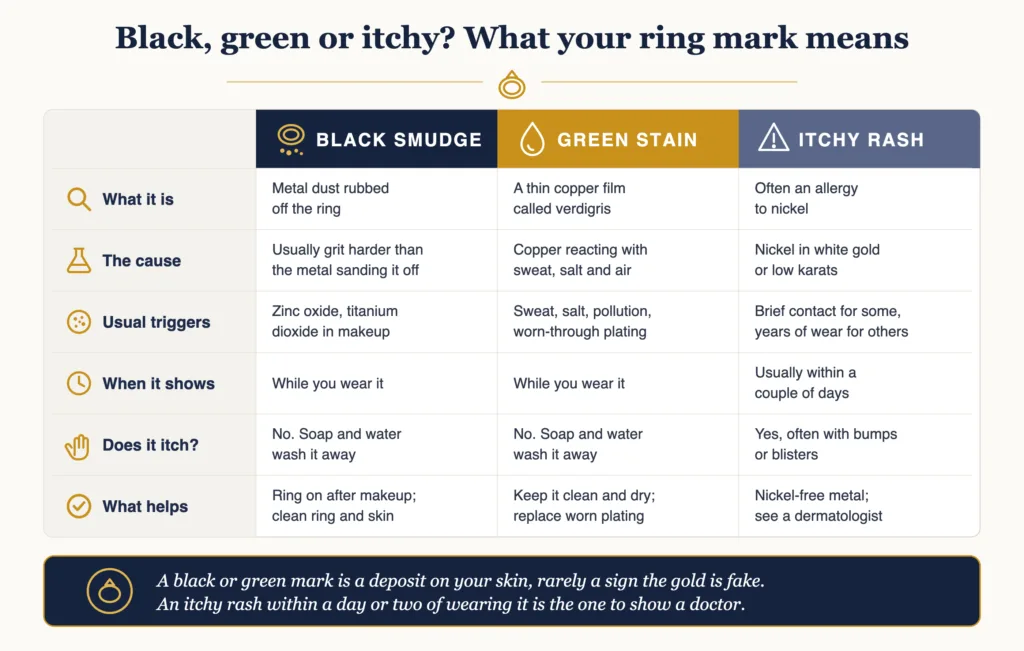
What does the rubbing? Usually something you put on your hands or face. Jewelers of America, a national trade association based in New York, said in a 1993 Deseret News article that cosmetics are the most common cause, specifically compounds harder than jewelry metal: zinc oxide, titanium dioxide, ferric oxide and calamine. Left on the skin, those particles “act like fine sandpaper”, and the metal they scrape off looks black because the particles are too small to reflect light. A 1973 dermatology reference indexed by the EPA’s HERO database went further and called zinc oxide probably the most common cause of black dermographism from jewelry.
The same association named two chemical causes as well. Rings made with copper and silver alloys can leave a black smudge when there is enough salt on your hands, even from salted nuts or popcorn, and some people have sulfur in their sweat that leaves a greenish-black stain on any metal jewelry. So a black mark is usually abrasion, and less often it is corrosion.
Neither source mentions sunscreen, but the same two minerals are the active ingredients in mineral sunscreen. In 2021 zinc oxide and titanium dioxide were the only sunscreen ingredients the FDA proposed as generally recognized as safe and effective, and the agency’s page still describes that order as a proposal. Both are also common in mineral foundation and setting powder. If your ring started leaving marks around the time you switched to a zinc oxide or titanium dioxide sunscreen, keep it off your ring hand for a week and see whether the marks stop.
Occasionally the mark shows up no matter what. The 40-year-old woman in that 2017 JAMA Dermatology report could reproduce it with rings from 10 to 24 karat, whatever cosmetics or medication she used, and even straight out of the shower with nothing on her skin. Her smudge was painless, came and went, and faded on its own within 10 to 15 minutes, and the authors note that several causes have been proposed over the years. If your marks behave like hers, the mark itself is harmless, and a dermatologist can rule out anything else.
Why gold turns some fingers green
Green is chemistry, not abrasion, and the culprit is copper. As the Royal Society of Chemistry explains, copper on its own darkens as it reacts with oxygen, but with sulfur from air pollution, with salt water and with the sweat on your skin it forms compounds that range from blue to green. Together they make a thin patina called verdigris. It is so thin that it brushes off, and the place it brushes off onto is your finger.
The best-known example stands in New York Harbor. The Statue of Liberty was a dark coppery red when it was finished in 1886, and the RSC notes that salt water and pollution from New York City slowly turned it green. A Royal Society of Chemistry video on the same page puts the change at about 20 years. Your ring is doing the same thing in miniature, with sweat standing in for the harbor.
Yellow gold below 24 karat is usually alloyed with copper and silver, and rose gold gets its color from extra copper, so a low karat rose or yellow band is the most likely solid gold ring to leave a green line. Sterling silver is in the same boat, since the 7.5% that is not silver is usually copper, as our guide to sterling silver 925 explains.
Plated jewelry is often the bigger offender. Under the FTC’s jewelry guides, a piece can be sold as gold plated or gold electroplate with a coating of at least 10 karat gold equivalent to as little as 0.175 microns of fine gold, about seven millionths of an inch, so long as it is of “reasonable durability”. The inside of a ring takes constant friction, so that skin can wear through and expose the brass or copper underneath. If a ring that never marked you suddenly starts turning your finger green after months of wear, worn plating is the first thing to suspect. Our comparison of gold vermeil, gold-filled, gold-plated and solid gold covers how much gold each one actually carries.
How much of a 10k or 14k ring isn’t gold
Karats are 24ths. Pure gold is 24 karat, 18 karat is 18 parts in 24, or 75%, 14 karat is 58.3%, and 10 karat is 41.7%. The rest is other metals, chosen for hardness and color. The FTC’s jewelry guides call it deceptive to misrepresent karat fineness, and they list calling an alloy “gold” without its karat as a marking that may mislead. Our explainer on karats, purity marks and hallmarks walks through the stamps you will find inside a band.
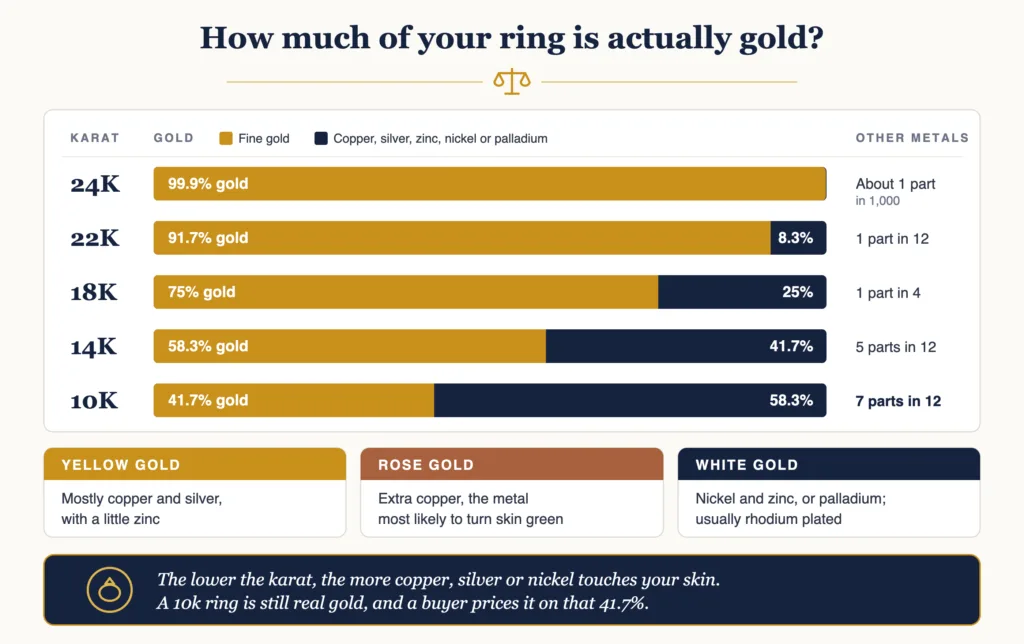
Which metals fill that gap depends on the color. Yellow gold leans on copper and silver with a little zinc. White gold, according to the U.S. Geological Survey, is usually about 75% gold and 25% nickel and zinc. Some white gold is whitened with palladium instead, and much of it is plated with rhodium, a thin coat that hides the alloy until it wears off the underside of the band.
So the lower the karat, the more copper, silver or nickel is pressed against your skin, which matters most for green stains and nickel rashes. Karat says little about black smudges, though. Jewelers of America put more than 99% of smudging down to something other than gold quality, and the JAMA patient marked herself with 24 karat.
Itchy, red or blistered is a skin reaction, not a stain
A rash under your ring is a different animal. Nickel is one of the most common causes of allergic contact dermatitis, and the American Academy of Dermatology says it is estimated that more than 18% of people in North America are allergic to it, including 11 million children in the United States. DermNet says solid gold of 12 carat or more should be safe, but warns that nine carat gold and white gold contain nickel. Nickel-free white gold does exist, so ask before you buy.
The giveaways are timing and feel. According to the Mayo Clinic, a nickel reaction usually begins within a couple of days of contact and brings a rash or bumps, severe itching, color changes and sometimes blisters. A black or green deposit, by contrast, shows up while you are wearing the ring, does not itch, and washes off with soap. Jewelers of America also noted that soap, detergent or cosmetic cream built up under a ring can cause irritation with burning and redness.
Both the AAD and Mayo point allergic wearers toward 18, 22 or 24 karat yellow gold. The AAD also lists platinum, and Mayo lists nickel-free white gold. DermNet describes a simple home test with dimethylglyoxime: if a cotton bud rubbed on the metal turns pink, the piece contains nickel. If the rash keeps coming back, a dermatologist can confirm it with a patch test.
Does a mark mean your gold ring is fake?
Almost never, and this is where a lot of online advice goes wrong. The old “skin test”, where a ring that leaves a mark is supposed to be fake, proves very little on its own. Jewelers of America said smudging comes from something other than the quality of the gold “more than 99 percent of the time”. A genuine 14 karat band can leave a black line every day of the week, and a gold-plated brass ring can go weeks or months without a trace until the plating wears through.
If you want to know what a ring is, test the metal, not your skin. Acid testing, XRF and density checks all measure the ring itself, and our guide to spotting fake gold and silver explains what each one can and cannot tell you. And if the stain has you thinking about selling the ring, the smudge does not touch its value. A buyer pays for weight and karat, which you can estimate yourself with our walkthrough on calculating the melt value of gold jewelry.
How to stop a gold ring from marking your finger
Most of the fixes are boring, which is good news, because boring fixes work. Start with cleaning. Jewelers of America said the deposits come off the skin with soap and water, and it recommended cleaning rings often. Use warm water, a drop of mild dish soap and a soft brush on the inside of the band, then dry it completely, because a damp ring traps sweat against the skin.
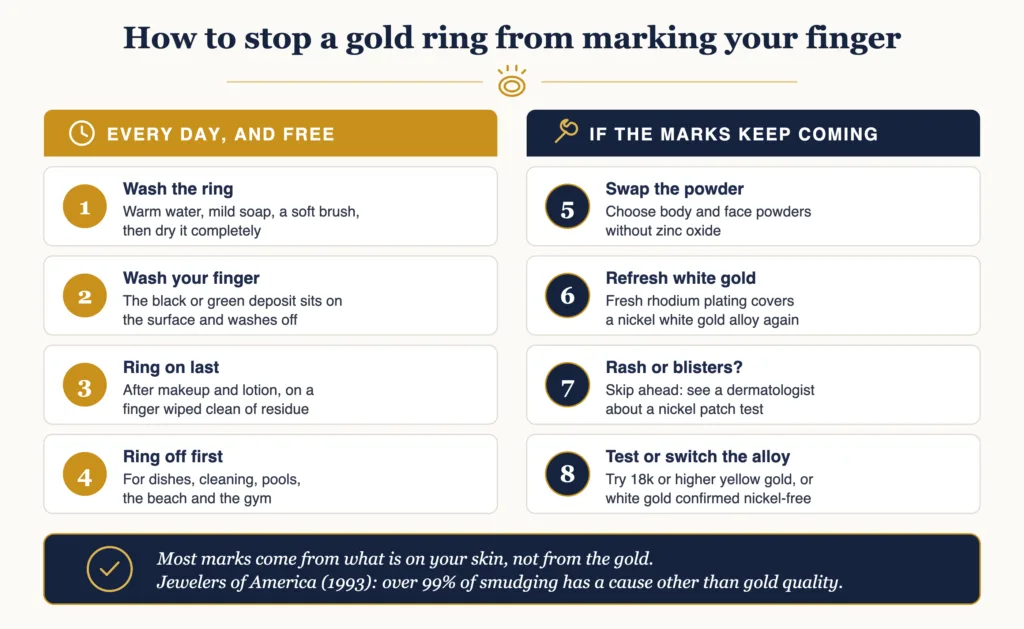
Then change the order you get ready in. Put your ring on last, after makeup, sunscreen and hand cream, and wipe your ring finger clean first so no mineral residue sits under the band. Take it off first before washing dishes, cleaning, swimming in a pool or the ocean, or lifting weights. For people whose sweat seems to darken any metal they wear, Jewelers of America suggested taking rings off often and using an absorbent powder without zinc oxide. Clear nail polish inside the band is a stopgap at best. The Mayo Clinic suggests clear barriers for snaps and clasps, but DermNet advises against coating jewelry with nail varnish because it soon chips off.
For white gold, ask a jeweler about fresh rhodium plating, and while you are there, ask whether the alloy is whitened with nickel or palladium. If marks keep appearing after all of that, the alloy itself is the problem. As Jewelers of America put it, most reactions are to the alloy, and switching to a different alloy can solve it. In practice that means 18 karat or higher yellow gold, or a white gold confirmed to be nickel-free.
The mark says more about the alloy than the gold
A black line or a green ring under a gold band is one of those problems that looks alarming and turns out to be mundane. It is usually metal dust from makeup, or a copper film from sweat, and both wash away. On its own it is not proof that someone sold you fake gold, although a green mark from a ring sold as solid gold that only started after months of wear is worth having tested. If the skin under your ring itches, blisters or flares within a day or two of wearing it, take that seriously and see a dermatologist. Otherwise, wash the ring, wash your hand, put the ring on last, and keep wearing it.