
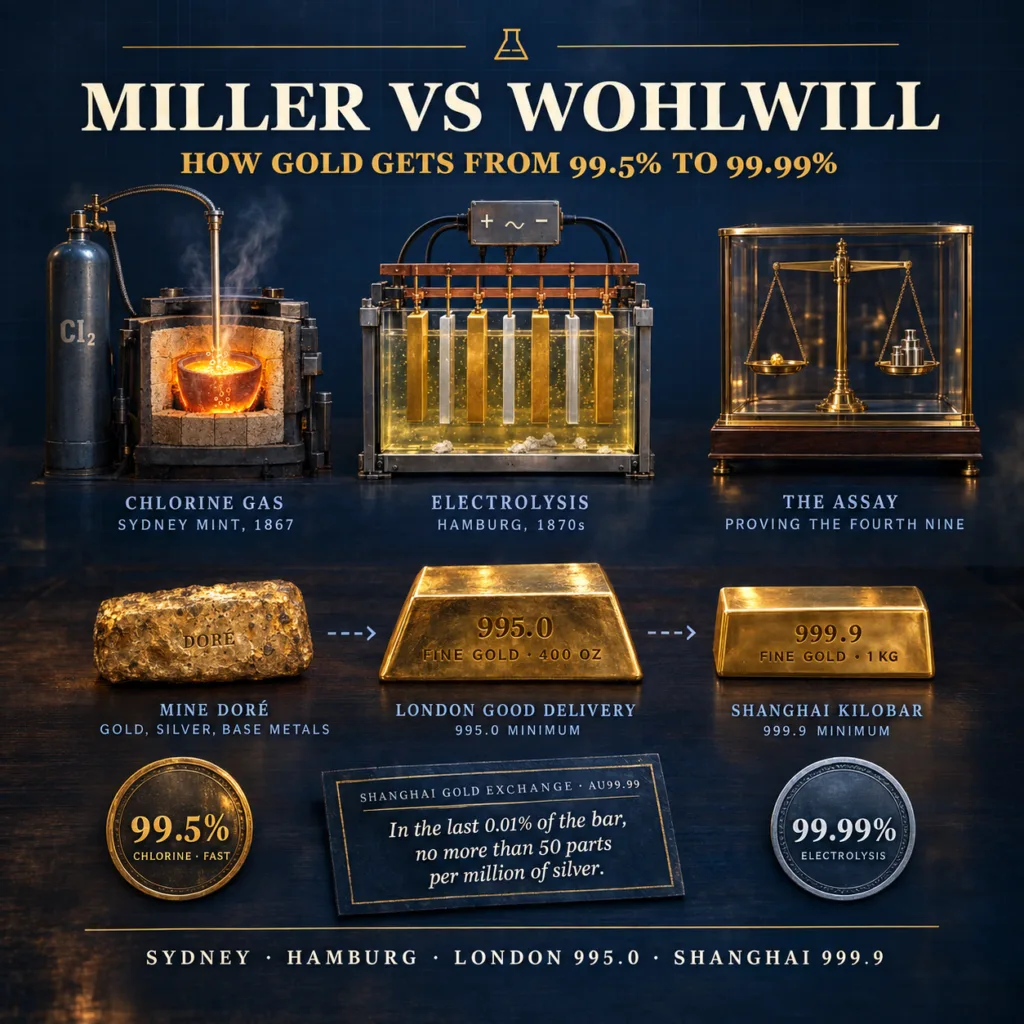
The purity stamp on a gold bar is the last line of a chemistry lesson most buyers never see, and that lesson usually comes down to Miller vs Wohlwill. Gold reaches a refinery as doré, a rough mine bar that Canada’s mint puts at around 70% gold. The Miller process blows chlorine gas through the molten metal and gets it to about 99.5% in a single fast melt. The Wohlwill process dissolves that gold with electricity and plates it back out at 99.99% or better, more slowly, with a small fortune in gold sitting in its tanks while it works.
The two are less rivals than relay partners, and many big refiners still run chlorine first and electrolysis second. The gap between their two numbers looks trivial. It often decides whether gold ends up as a 400-ounce London bar or a Shanghai kilobar, and it is where one government-owned mint got itself into trouble over the last hundredth of a percent.
How the Miller process cleans gold with chlorine
Francis Bowyer Miller was an assayer at the Sydney branch of Britain’s Royal Mint, and his big idea was to refine and toughen gold with chlorine gas. He patented the process in London in June 1867, and mints and refiners adopted it quickly. The LBMA’s history of the method notes that in 1995 the German refiner Degussa estimated two-thirds of all the gold ever refined had been through it, which makes it the most important refining method most investors have never heard of.
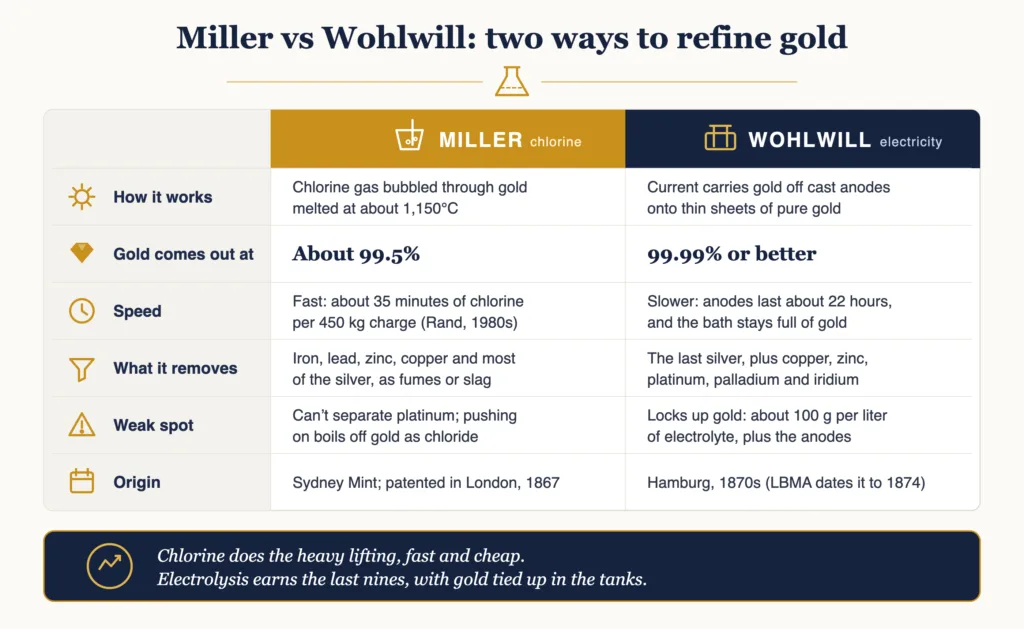
In a mid-1980s account of South Africa’s Rand Refinery, each 450 kg charge melted under a borax, silica and salt flux in 45 minutes, and then two graphite tubes fed chlorine into the melt for about 35 more. The gas picks off impurities in order. Iron goes first, then lead and zinc, all leaving as gaseous chlorides that the exhaust system has to catch. Only then do copper and silver react, forming chlorides that stay liquid at the roughly 1,150°C working temperature and float up as a slag to be bailed off and refined separately.
The operator stops when the gold itself starts to react. The fumes begin to turn reddish-brown as gold chloride forms, a sample is pulled through the slag, and once silver tests below about 0.35%, the melt counts as refined. Push on and you are boiling off gold, which is why the same account calls for elaborate fume collection. At Rand, precipitators drawing fumes from across the refinery recovered some 350 kg of gold a year.
The LBMA lists the method’s two weaknesses: chlorine cannot separate platinum, whose chloride behaves too much like gold’s, and it cannot efficiently produce high-purity gold. What comes out is gold of 995 or 996 fineness, which the LBMA notes can go straight into large London Good Delivery bars with no further refining. Rand still describes its chlorine step as upgrading bullion to 99.50% purity.
How the Wohlwill process gets gold to 99.99%
Electrolysis attacks the problem from the other side. Instead of burning impurities out of molten gold, it moves the gold itself and leaves the impurities behind. The method carries the name of Emil Wohlwill, a pioneer of electrolytic refining at Norddeutsche Affinerie in Hamburg, the company now called Aurubis. The LBMA dates its introduction to 1874, and Aurubis lists Wohlwill as the company’s senior chemist from 1877 to 1900.
In a Wohlwill cell, chlorine-refined gold is cast into anode plates that hang in a warm bath of hydrochloric acid already loaded with dissolved gold, facing thin cathode sheets rolled from pure gold. At Rand in the mid-1980s, the anodes started at 99.6% gold and the bath held 80 to 100 grams of gold per liter at 60°C. When current flows, gold leaves the anode and plates out on the cathode. Copper, zinc, platinum and palladium dissolve too, but they don’t plate, so they pile up in the electrolyte until it has to be replaced. Iridium, osmium, ruthenium and most of the silver, as silver chloride, settle to the bottom as sludge.
Silver is the troublemaker, because silver chloride can crust over the anode and choke the current. A patent filed in 1909 by his son, Heinrich Wohlwill, explains that once silver passed about six percent, operators had to periodically remove that deposit from the anodes by mechanical means. Heinrich’s fix was to layer an alternating current over the direct current, which, his patent says, worked on gold carrying 20% silver and on alloys richer still. The reward for all this fuss is gold of 99.99% or better. Canada’s mint runs gold through electrolysis twice to reach 99.999%, a purity its refinery first achieved in 1998.
Miller vs Wohlwill: why refiners run both
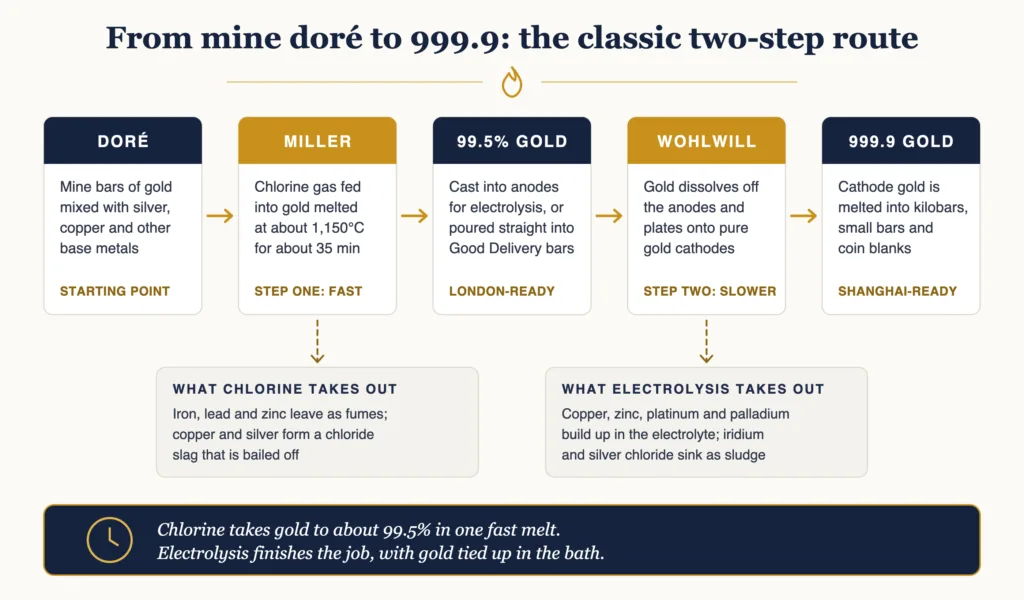
Each process is strong exactly where the other is weak. Chlorine is fast and cheap, but refiners stop it around 99.5% because pushing on boils off gold, and it leaves the platinum in. Electrolysis reaches four nines and pulls the platinum metals out, but it hates silver and costs real money to run. Feed the cell Miller gold, with silver already down to a few tenths of a percent, and the silver problem mostly goes away. Rand describes exactly this sequence: chlorine to 99.50%, then electrolysis to more than 99.99% for bars, granules and coins. The Perth Mint lists Miller chlorination, electrolytic refining and aqua regia among its methods.
A big part of the cost is gold that isn’t earning anything. A 1997 paper by Mintek researchers calls the Wohlwill lock-up substantial: about 100 grams of gold per liter of electrolyte, anodes that last roughly 22 hours before the leftover quarter or so is recycled, and up to 30% of the gold looping back through the slimes. At early October 2026 prices, a single tonne of gold is worth about $134 million, and every gram sitting in a tank is money the refinery has to finance.
History has swung back and forth on that trade-off. Canada’s mint started with Wohlwill electrolysis, then installed a more productive Miller chlorine plant in 1913 as Ontario’s gold output grew. Plenty of refiners swapped their electrolytic tanks for Miller furnaces, until demand for 999.9 gold, especially in East Asia, made electrolysis important again in the second half of the 20th century. Today it has competition. Some refiners dissolve gold in aqua regia and precipitate it selectively with sulphur dioxide or ferrous sulphate, and Mintek’s solvent extraction route can produce 99.99% or 99.999% gold, with the gold spending under 24 hours in the circuit when the plant runs continuously. If you have sold scrap jewelry, the melt and assay that set your price came first, and our guide to how gold refining works covers that side.
Who actually needs 99.99% gold
The world’s biggest gold bars don’t need the second step. London’s rules for a Good Delivery bar set the minimum at 995.0 parts per thousand, and COMEX lets 995 fineness gold settle its 100-ounce futures. London’s 400-ounce bars are what central banks and big gold ETFs hold: heavy, plain, and perfectly acceptable at 99.5%. Smaller bars are another matter, and the same LBMA guide sets a 999.9 minimum for kilobars. Our explainer on COMEX and LBMA gold pricing shows how those bars anchor the benchmark price.
Shanghai is where the fourth nine earns its keep. The Shanghai Gold Exchange’s Au99.99 contract delivers 1 kg ingots of at least 99.99%, and its 100 g and 50 g bars carry the same floor. Kilobars are what Chinese jewelers and banks buy there, and our piece on the Shanghai gold premium explains why that gold often costs more than it does in London. When Asian buying runs hot, London’s big bars make the trip. In 2014 Rhona O’Connell of Thomson Reuters GFMS said bars leaving the ETFs “would have been going through refineries, predominantly in Switzerland, for conversion into kilobars” on their way east.
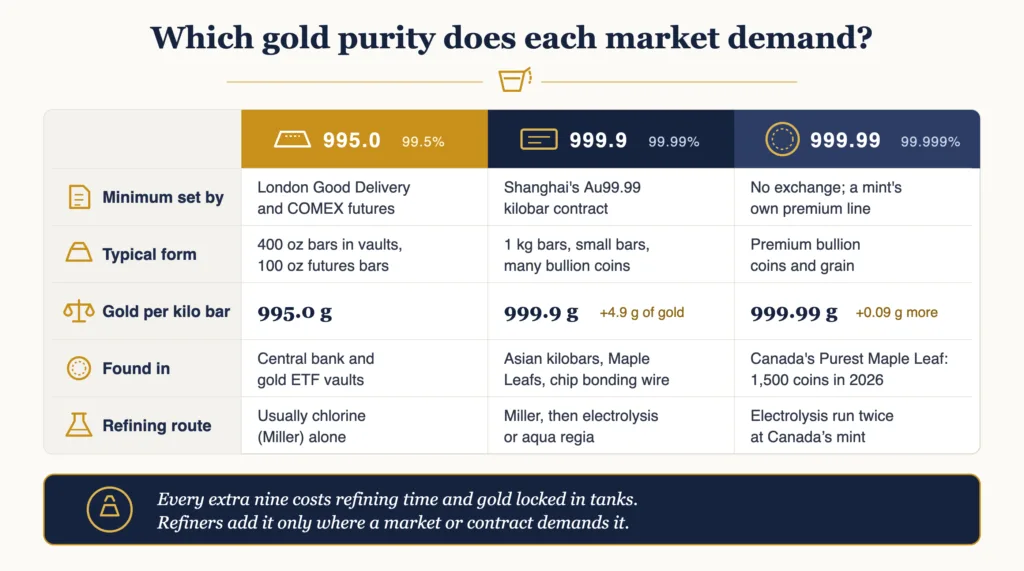
Coins took the same road. The Royal Canadian Mint introduced the first 99.99% gold bullion coin in 1982, and its 2026 99.999% Maple Leaf was limited to 1,500 coins. Industry uses four nines too: gold bonding wire for chips comes in a 4N, 99.99% grade, alongside lower 3N and 2N grades.
A one kilogram bar at 995 fineness holds 4.9 grams less gold than a 999.9 kilobar, worth about $657 at the $4,169.68 spot price on October 6, 2026. That doesn’t shortchange the owner of a 995 bar, because London measures Good Delivery bars by their fine gold content. At the top end it works the other way: gold above the stamped 99.99% normally goes to the buyer for free, which is exactly what bothered the Perth Mint. What the extra nine buys is access, since a 999.9 bar can go almost anywhere without being refined again. Our guide to gold fineness and purity marks explains how to read those numbers on a stamp.
What the last 0.01% can hide
The Perth Mint’s refinery was producing gold of about 99.996%, according to ABC News, and the mint saw everything above 99.99% as gold handed over for free. So from 2018 it added silver to bring its bars closer to the line, a practice the trade calls doping. The bars stayed above 99.99% gold. The trouble was the rest. As the mint later explained, Shanghai’s specification allows the non-gold 0.01% of a bar, 100 parts per million, to hold no more than 50 ppm of silver. After the exchange raised concerns in late 2021, an internal review estimated that up to 100 tonnes of gold sent to Shanghai might not comply, and the ABC reported a potential recall worth about A$9 billion.
The prize was small. The ABC reported that the mint expected doping to save it up to A$620,000 a year, a tiny fraction of its sales, at a refinery handling 330 to 340 tonnes of gold a year. The extra silver was invisible to ordinary buyers, and it took an exchange that specifies impurities down to the part per million to catch it. The episode also shows how finely the second refining step can be tuned. Chlorine alone couldn’t take gold to 99.996% without sending a lot of it up the flue.
What the stamp on your bar is telling you
Read a purity stamp as a short history of the bar. A 995 stamp usually means the gold went through the fast, cheap step and stopped there, which is all the London market asks for. A 999.9 stamp usually means extra refining, either electrolysis after chlorine or a chemical route. Neither is better gold in any way you could feel in your hand.
For small bars and many bullion coins, four nines is the norm, and it makes resale easier almost everywhere. Five nines is a different matter. On a one kilogram bar it adds less than a tenth of a gram of gold, so a meaningful premium for it buys a story about purity rather than more metal. A collector might happily pay for that. I wouldn’t. The useful part of the Miller vs Wohlwill story is knowing why the fourth nine exists, and why the fifth so rarely earns its price.