
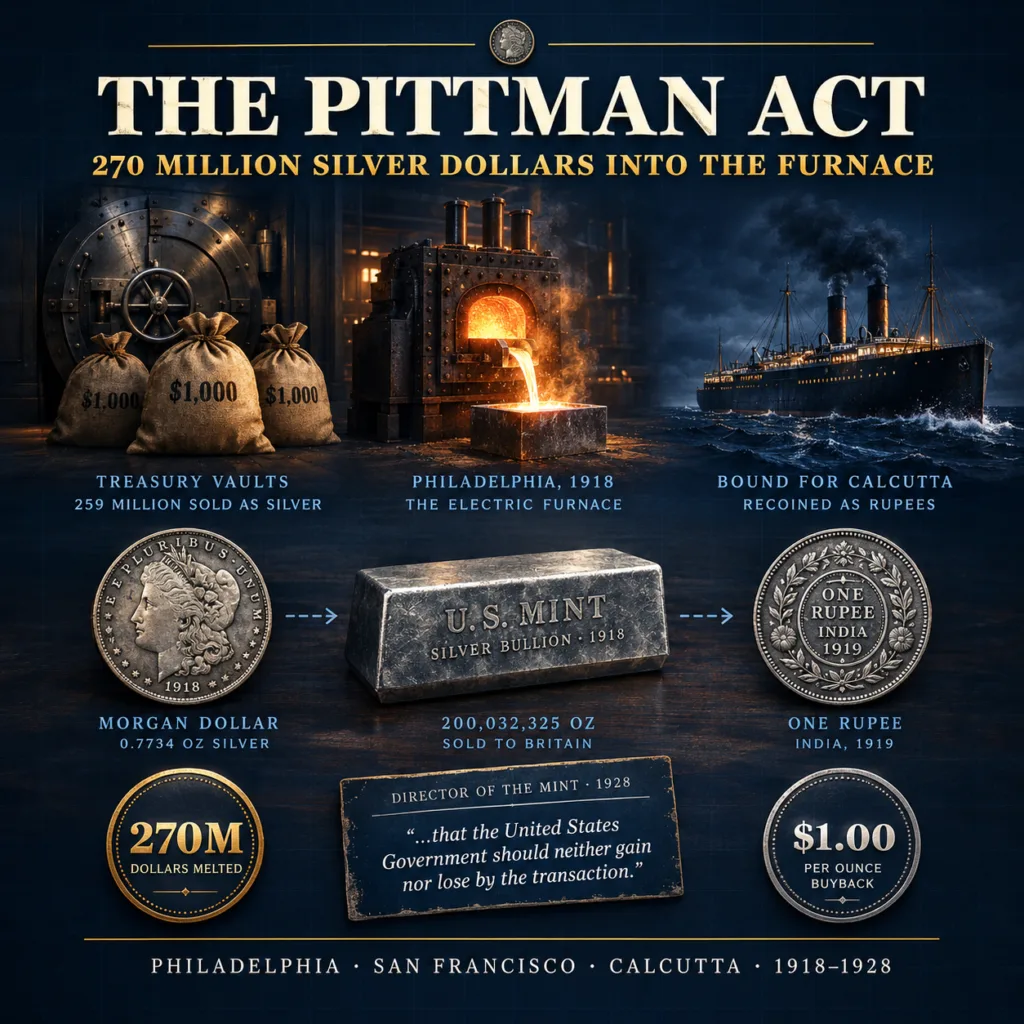
In the spring of 1918, the melting rooms at the Philadelphia Mint ran overtime. An electric furnace installed there the year before sped up the work, and by June 30 the Philadelphia and San Francisco Mints and the New York assay office had turned more than 68 million silver dollars into bullion, according to the Director of the Mint’s report for 1918. The authority came from the Pittman Act, which became law on April 23, 1918, and let the Treasury melt up to 350 million standard silver dollars and sell the silver. The buyer was Great Britain, and the silver was bound for India.
When the furnaces finally cooled, 270,232,722 silver dollars were gone. That equals nearly half of the roughly 570 million Morgan dollars struck from 1878 to 1904. Then the same law made Washington buy back the silver it had sold, from American mines at a fixed $1 an ounce whatever the market said, and strike every melted dollar again. That second half of the Pittman Act is why the Mint struck the 1921 Morgan dollar and the Peace dollar. It also handed Western silver miners a windfall that had little to do with winning the war.
If you own a Morgan or a Peace dollar, this law decided a lot about what you hold. Most of the numbers below come from the Mint Director’s annual reports, which tracked the operation from the first melt to the last replacement coin.
Why Britain needed America’s silver dollars
India ran on silver. Its rupee was a silver coin, and the government’s paper rupee notes could be exchanged for silver rupees on demand, a promise that holds only while the silver is there. Silver averaged 51 cents an ounce in New York in 1915 and about 98 cents in 1918, by the Mint’s price table. America’s consul general in Calcutta, Alexander W. Weddell, described what that did in a report the Mint reprinted in its 1922 annual report: “the advance in the price of silver after 1914 with the consequent absorption of rupees in India placed a severe strain upon the Indian financial structure”. The convertible rupee notes, he wrote, “were only saved from declaration of inconvertibility by the passing of the so-called Pittman Act”.
Britain had nowhere else to turn. When the Mint wrote up the whole episode in its 1928 report, it put the point bluntly: “The only possible source of sufficient silver to meet the war emergency was the United States Treasury stock of silver dollars”.
That stock was the leftover of an older silver deal. Laws passed in 1878 and 1890 had made the Treasury buy silver, and more than 565 million dollars were eventually coined from it, according to the Mint’s coinage tables. Few Americans wanted to carry a coin that weighed 26.73 grams, so the dollars sat in vaults behind paper silver certificates. Our piece on why silver is so cheap compared to gold covers the free-silver politics of that era. In 1918 that idle pile was the one supply of silver big enough to matter.
What the Pittman Act said, and who wrote it
The law is printed in full in the Mint’s 1918 annual report, and it is short. Section 1 let the Secretary of the Treasury melt “not in excess of three hundred and fifty million standard silver dollars” and sell the bullion at “not less than $1 per ounce”. For each dollar melted, $1 of silver certificates had to be retired, and the act let Federal Reserve Bank notes take their place “to prevent contraction of the currency”, as the Mint later summarized. Section 2 is where the money was. After every sale, the Director of the Mint had to buy back the full legal silver content of each dollar melted, “of the product of mines situated in the United States”, at “the fixed price of $1 per ounce”, and keep buying until every melted dollar could be struck again.
The act’s title runs through four purposes, from conserving the gold supply to assisting “foreign governments at war with the enemies of the United States”, and closes with a fifth: “for the above purposes to stabilize the price and encourage the production of silver”. Its sponsor, Senator Key Pittman, represented Nevada, and the buyback language was no accident, because “legislators from the western states wanted to support their local industry”, as NGC puts it. Pittman had won his seat by 89 votes, the smallest margin in any Senate race to that time, according to the Senate’s Nevada history, and from 1933 until his death in 1940 he chaired the Foreign Relations Committee and served as president pro tempore.
In April 1918, with silver trading near a dollar, a fixed $1 buyback price looked harmless. It would not stay that way.
Melting 259 million dollars in 13 months
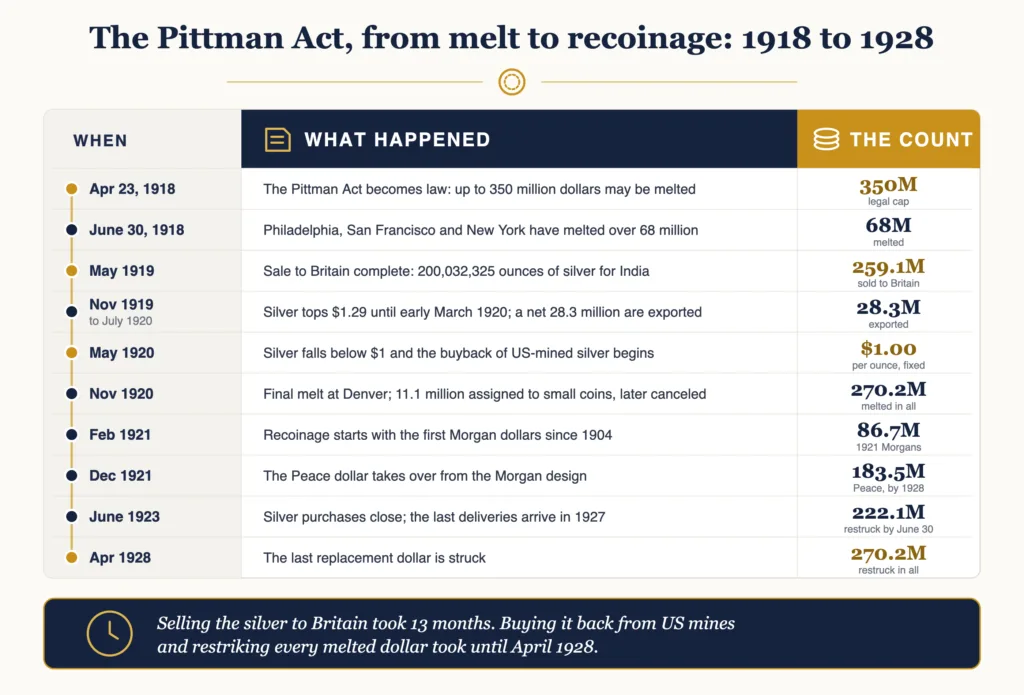
Melting started right after the act passed and ran at three plants: the Philadelphia and San Francisco Mints and the New York assay office. The coins came out of the mints’ own stock, the Treasury in Washington and the New York subtreasury. New Orleans gave up 22.4 million dollars it had stored for years. By May 1919, 259,121,554 silver dollars had become 200,032,325.64 fine ounces of silver, all of it sold to Great Britain, in the Mint’s final accounting. Philadelphia melted 158.6 million of them, San Francisco 74 million and New York 26.5 million.
Britain paid $1 an ounce plus a charge to cover melting, recoining and other costs, “with the intent that the United States Government should neither gain nor lose by the transaction”. On the books it did lose, for a while. A dollar held 0.7734 ounces of silver, so each one sold for about 77 cents plus costs, while $1 of silver certificates was retired against it. That gap came to about $59 million on the dollars sold to Britain. The Mint recovered it as seigniorage, the profit on coining, when it struck new dollars from silver bought at the same $1 price, as its 1922 report explains.
The silver went to India. PCGS writes that it was shipped to Calcutta and struck into rupees bearing King George V. India’s officiating controller of currency reviewed the 1918-19 reports of the Calcutta and Bombay mints. A summary of his review, reprinted by the Mint, called the year’s silver coinage “a new record”: 520,535,309 rupees, against the previous high of 307,707,326 in 1916-17. A “considerable portion” of the silver “consisted of American dollars and other silver made over by the United States under the Pittman Act”, the summary continues. The same review mentions gold shipped abroad “on account of the payment made in gold to the United States of America for silver received therefrom under the Pittman Act”.
The furnaces had one more job. Between September 1918 and November 1920, another 11,111,168 dollars were melted and assigned to the Mint for dimes, quarters and half dollars, bringing the total to 270,232,722. The Treasury canceled that assignment in 1922 and restruck those dollars from silver it already had, rather than buying more. At legal weight that is about 7,200 metric tons of coins, though “many of the dollars melted had been in circulation” and were worn below legal weight, the Mint noted. At the $61.51 an ounce silver fetched on the morning of October 2, 2026, according to Fortune, the 200 million ounces Britain bought would be worth about $12.3 billion today.
The $1 promise to Western silver miners
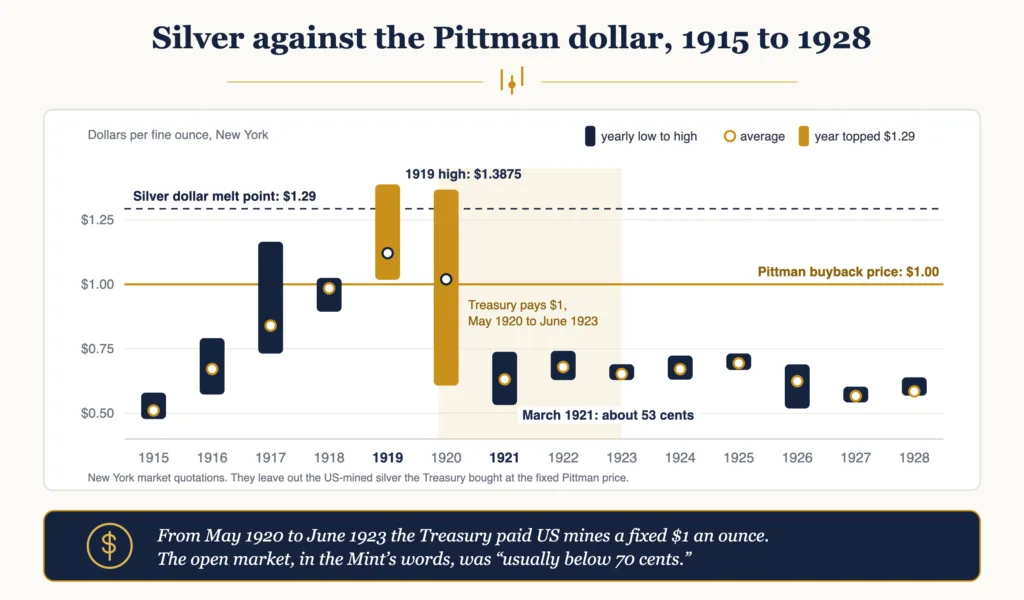
Silver didn’t stop at a dollar. On November 25, 1919, New York silver hit what the Mint’s 1920 report called “a price surpassing all definitely known records”, and the year’s high in the Mint’s own New York price table was $1.3875 an ounce. Above about $1.29 a silver dollar is worth more as metal than as money. It stayed above that melting point until early March 1920, and between November 1919 and July 1920 a net 28,287,142 silver dollars left the country, in what the Mint called a “movement due to the high price of silver”.
Then the price broke. Silver fell below $1 in late May 1920, the point at which the buyback began, bounced briefly back above $1 that August, and on March 5, 1921, hit about 53 cents, per the Mint’s 1921 report. The Treasury kept buying anyway. The law said so. From May 1920 to June 1923 the Mint took in about 5 million ounces a month at $1, “absorbing practically the entire silver production of the United States for this period”, while “the market rate during this time was usually below 70 cents”, the 1928 summary says. The 1920 report had already noticed the effect: the $1 price “has resulted in the opening of additional silver mines”.
Put a number on that gap. The Mint published, year by year, how many Pittman ounces it took in and the average price of silver that didn’t qualify: about 73 cents in fiscal 1921, per the 1921 report, and roughly 64 to 67 cents in the reports for 1922, 1923 and 1924. Multiply the difference out and, by my rough math, the Treasury paid a little more than $60 million above the open market price. Washington’s books still balanced, since it had sold to Britain at $1 and bought back at $1. The Mint said so plainly in its 1920 report: the government “will neither gain nor lose”, while “the producer of domestic silver gets the benefit of the fixed price”.
Every melted dollar came back as a 1921 Morgan or a Peace dollar
Recoinage began in February 1921, “as soon as postwar demands for other coins” allowed, the Mint wrote, and with no new design ready it began with the old one. There was a catch. In 1910, expecting no more silver dollars, the Philadelphia Mint’s engraving department had destroyed the master hubs and models, so chief engraver George T. Morgan had to recreate his own design from scratch, and the 1921 coins differ in small ways from those of 1904, NGC explains. Philadelphia, Denver and San Francisco struck 86,730,000 of them that year.
The Peace dollar replaced the Morgan design in December 1921 and did the rest of the work: 183,502,722 Peace dollars by April 1928, when the last replacement coin was struck. Add the 1921 Morgans and you get 270,232,722, the exact number melted, in the Mint’s own tally. As the new dollars went into storage, silver certificates were issued against them and the stopgap Federal Reserve Bank notes were retired. PCGS ties the act directly to the $1 and $2 Federal Reserve Bank notes dated 1918. The Mint’s verdict, in 1928, was that “the monetary stock of United States silver dollars was neither decreased nor increased by that act”, as its summary concludes.
I like the symmetry of that number, and the irony in it. The replacement coins are some of the easiest silver dollars to find today. Every 1921 Morgan and every Peace dollar dated 1921 through 1928 exists because of the 1918 melt.
What the Pittman melt means for your Morgan dollars
Collectors have used the melt to explain scarce Morgan dates since at least 1947, and they haven’t always been right. The Mint’s summary counts the melted dollars by vault and by mint, not by date, so the guessing started early. The first edition of the Red Book, dated 1947, carried a note under its Morgan listings saying the Pittman melt “probably accounts for the scarcity” of the 1903-O, then the most valuable Morgan in the book, Coin World recounts. Q. David Bowers estimates fewer than 10 uncirculated 1903-O dollars were known before October 1962, when the Treasury released bags of them. The coin had been cataloged at $1,500. In 1963 it sold for as little as a reported $7.
The 1895 Philadelphia Morgan is the mystery case. Mint records list 12,000 circulation strikes, and none is known. Bowers wrote in a 2002 PCGS article that “apparently, all of the business strikes were melted under the Pittman Act of 1918, for none is known today”. PCGS CoinFacts is more cautious, noting that experts believe only the 880 proofs were made. Either way, the date survives only as a proof, which is why our Morgan silver dollar value guide calls it the King of the Morgans.
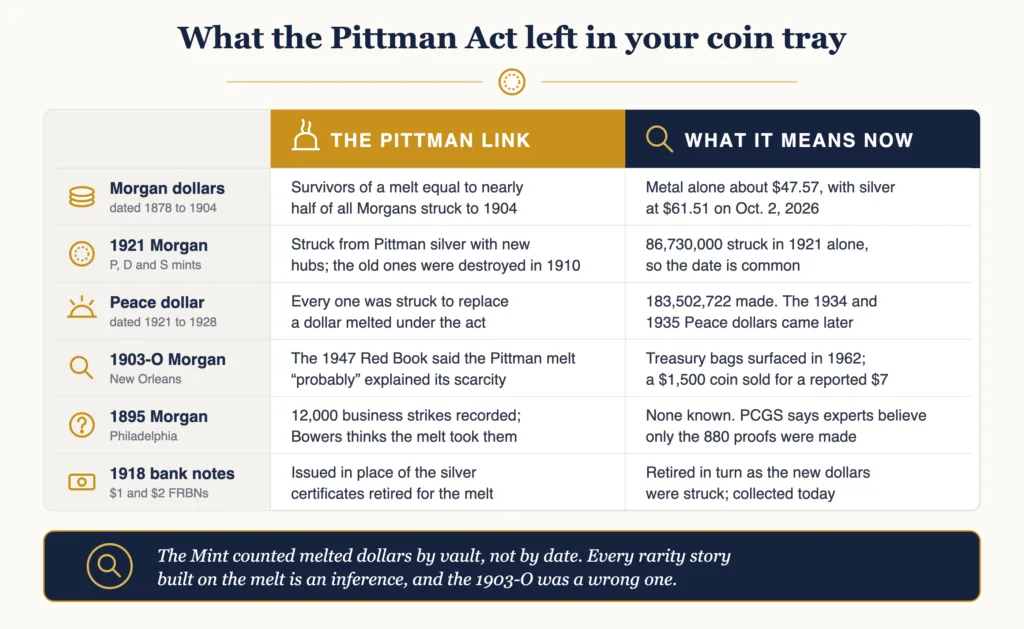
For most owners the takeaway is simpler. A Morgan or a Peace dollar holds 0.7734 troy ounces of silver, so at $61.51 its metal is worth about $47.57, the arithmetic in our guide to calculating the melt value of silver coins. Worn common dates, a group that includes most 1921 Morgans, trade within a few dollars of that floor, as our Morgan guide notes, partly because the Pittman Act made so many of them. If someone tells you a Morgan is rare “because of the Pittman Act”, ask which date, and ask how they know.
In 1918 the Mint’s furnaces decided which Morgan dollars would survive. In 1962 the Treasury’s own vaults showed collectors that at least one of the “rare” ones wasn’t. Our history of why the US stopped making silver coins picks up the Treasury’s silver story from there.