
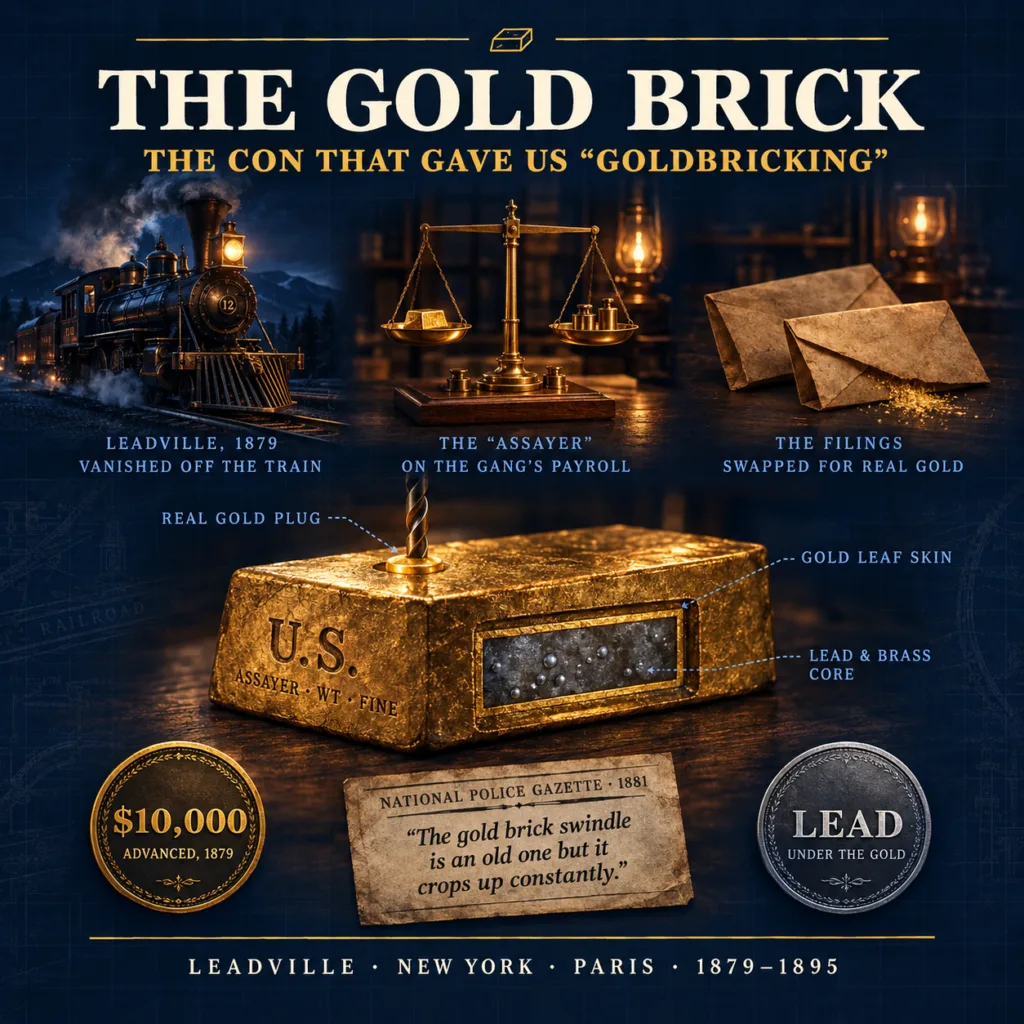
In October 1879, five miners in Leadville, Colorado, ran the gold brick scam on N. D. Clark. Clark, president of the First National Bank of Ravenna, Ohio, was visiting a mine he owned. The miners had a 52-pound gold brick they said they could not ship, and its owner told a hard-luck story about losing all his property. Clark had a blacksmith cut off one corner, an assayer pronounced the gold genuine, and Clark advanced $10,000, with the balance to be paid in Chicago. Somewhere on the train east, the miner vanished. The corners of the brick were gold. The rest of it was worthless. Newspapers called it “the celebrated gold brick swindle”, as the word historian Michael Quinion recounts.
The whole gold brick scam is in that one transaction: a worthless bar with real gold planted exactly where the buyer would test it. Later bricks were lead or brass under a skin of gold. Versions of the con ran across the United States for decades, aimed at people with cash to spare: country bankers, rural buyers, visitors from the East. The con grew so notorious that “gold brick” turned into shorthand for any fraud, and by World War I soldiers were calling shirkers “goldbricks”, the root of the “goldbricking” people still accuse lazy coworkers of.
The trick behind it has never aged. Every version on record controlled which piece of the brick got tested, who did the testing, or both, and those are still the two questions worth asking about any gold you buy.
How the gold brick scam worked
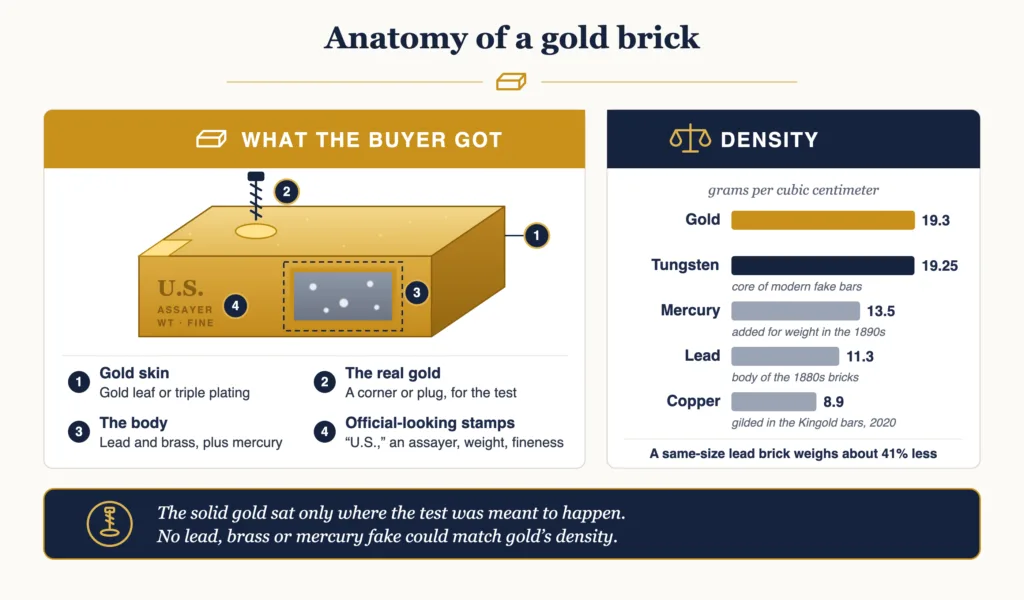
The brick itself was cheap theater. Herbert Asbury’s 1928 history of the New York underworld describes the one Reed Waddell carried into the city in 1880: lead, “triple gold-plated” with a rough finish, with a slug of solid gold sunk in the center. It was stamped like a regulation bar from a United States assay office, with “U.S”. at one end, an assayer’s name, and a weight and fineness underneath, according to Asbury’s account. The National Police Gazette described the standard model in December 1881: the brick “is really of base metal. One corner, however, is of gold”, as quoted in Green’s Dictionary of Slang.
Selling it took a story. An anonymous con man whose confessions the journalist Will Irwin published in 1909 had tried the game around 1895 as the gang’s “assayer”. Gold-brick gangs, he said, traveled in threes, “the steerer, the assayer and the Indian”, and the play “was for country bankers”. The steerer claimed a dead partner had left him a mine shared with an “old Indian”, a character the gang invented and a white confederate played in makeup. The two had supposedly taken out $40,000 worth of gold bricks, and the suspicious partner had come east with them, then refused to go any farther than a river and camped just across it.
For $30,000, the steerer’s $20,000 share plus the $10,000 the “Indian” supposedly thought his half was worth, the banker would get $40,000 in gold. The pitch traded on a racist stereotype, inviting him to get rich by shortchanging a supposedly naive Native partner. The meeting at the camp happened at night by a dim campfire, so the banker never saw the makeup, the con man said.
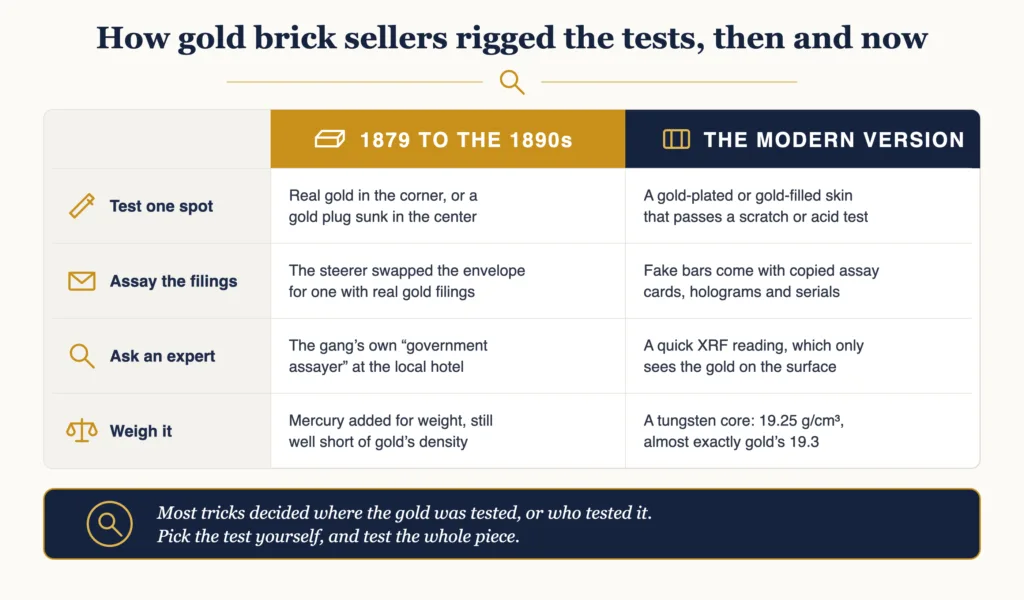
Then came the test, and this is where the con earned its money. In the simplest version, the gold sat exactly where the cut or the drill went in. Asbury says Waddell first took each mark to an accomplice posing as an assayer, office and equipment included. If the buyer still hesitated, Waddell “impulsively dug out the slug of real gold” and told him to take it to a jeweler himself, and in “ninety-nine cases out of a hundred the sale was completed”.
In the game’s early days, Irwin’s narrator explained, the jeweler bored wherever he pleased, so the steerer quietly swapped the envelope of filings for one holding real gold filings. Once jewelers “got on to the game”, the gang supplied its own expert. He played “a government assayer named Baker” and certified that the bricks, by weight, were worth $41,000. By then the game was “getting too well known for safety”, and his crew spent three months “playing at small bankers” along the Ohio River without turning a penny.
Mining frauds still run on the same idea. More than a century later, Bre-X salted its drill core samples rather than a brick, and once again the real gold went exactly where the lab would look.
What a real gold brick would have been worth
In 1879 the dollar was tied to gold at $20.67 an ounce, the official and New York market price in MeasuringWorth’s gold price series. Clark’s 52 pounds would have held about 758 troy ounces if they had been pure gold, or roughly $15,700 of metal, so a $10,000 advance looked safe with plenty to spare. That margin was the bait. At the $4,177 an ounce gold fetched on the morning of October 1, 2026, the same weight in pure gold would be worth about $3.2 million.
The prices con men charged tell you who they were fishing for. Asbury says Waddell sold his first brick for $4,000, never took less than $3,500, and sometimes got twice that. An 1893 account quoted in Green’s has a gold-brick man bragging that “we did up an old cockatoo here to-day for seventeen thousand dollars”. Nobody handed over that kind of money on a whim in the 1880s or 1890s. The marks were people who had it, and greed did the rest.
Reed Waddell, the inventor who probably wasn’t
Popular history gives the scam a single author. Asbury wrote that the gold brick game “is supposed to have been invented by Reed Waddell”, a gambler raised in Springfield, Illinois, who turned up in New York in 1880 with “the first gold brick ever offered for sale”. By Asbury’s account he was said to have made more than $250,000 in ten years from gold bricks and the “green goods” counterfeit-money swindle, and later writers repeated the credit. The con man Joseph “Yellow Kid” Weil even claimed Waddell could, and did, sell the Brooklyn Bridge, according to the Sangamon County Historical Society. Treat that story the way you would treat a gold brick.
Check the dates, though. Merriam-Webster dates “goldbrick” in the sense of a worthless brick that looks like gold to 1865, when Waddell was a small boy. The Leadville swindle happened the year before his New York debut, and by 1881 the Police Gazette was already calling the trick “an old one”. A 1909 book quoted in Green’s, I. L. Nascher’s The Wretches of Povertyville, said the game had been worked since California miners came back to New York with gold “in the early fifties”. The historical society in Waddell’s hometown concludes that he “probably was innocent, for once, of originating that particular swindle”.
Waddell’s own end came in Paris, as the society tells it. In March 1895 he fell out with his old mentor Tom O’Brien, over a woman or over $10,000 O’Brien demanded, while Asbury blamed a dispute over dividing their earnings. After a fight at the Café Americain on March 26, where Waddell hit O’Brien with a bottle, O’Brien shot him the next day at the Gare du Nord, and Waddell died on April 5. O’Brien’s lawyer argued that an exchange of shots was “an ordinary way of settling quarrels in America”, in the New York Times report the society quotes. O’Brien was convicted, sent to a French penal colony, possibly Devil’s Island, and died in prison. Waddell lies in Springfield’s Oak Ridge Cemetery.
How “goldbrick” went from swindle to slacker
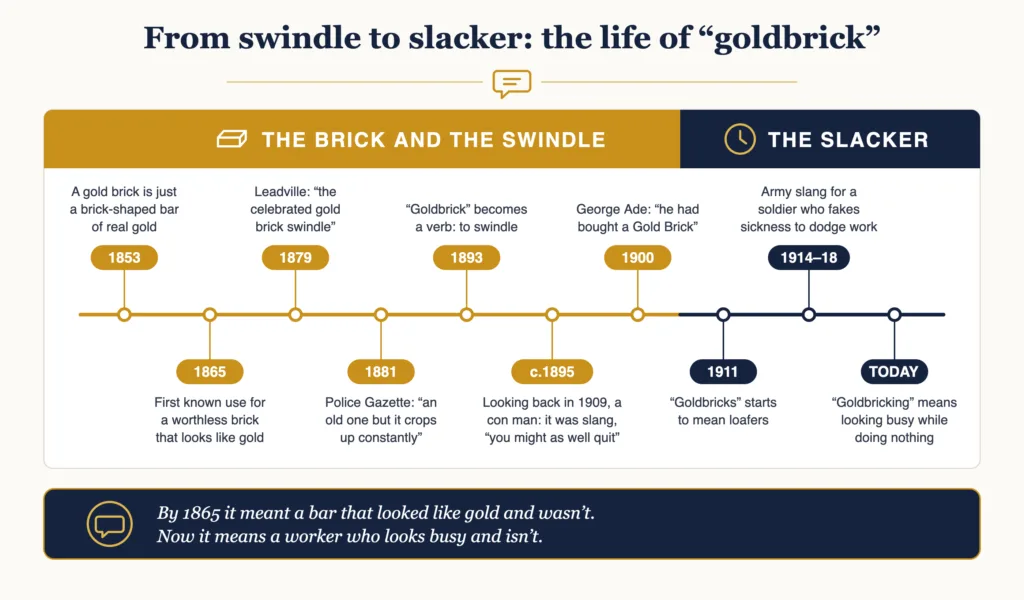
The con men noticed the change too. Looking back on about 1895, Irwin’s narrator said that by then “‘Gold brick’ had already become slang for a bunco game; and when that happens you might as well quit”. Merriam-Webster’s earliest record of “goldbrick” as a verb meaning to swindle is from 1893. By 1900, the humorist George Ade could write about a man who began to suspect that in paying for Lutie’s vocal training “he had bought a Gold Brick”, and readers got the joke.
Then the word drifted toward idleness. Green’s finds “goldbricks” meaning loafers in 1911, in a New York Times Magazine piece by a writer billed as “Sing Sing No. 57,700”. Merriam-Webster says the shirker sense “originated in the slang of the United States Army”, for a soldier who faked illness or injury to get out of work, and Etymonline dates it to 1914, a few years after that prison writer used it. Quinion adds that enlisted men called the incompetent, barely trained officers appointed from civilian life at the start of the war “gold bricks”, and that for second lieutenants the name was probably prompted by their gold-rectangle insignia. In Norman Mailer’s 1948 war novel The Naked and the Dead, a character snaps, “you guys are a bunch of goldbricks”.
I like how neatly the meaning flipped while keeping its core. In 1880 the goldbrick was the bar that looked like gold and wasn’t. By 1918 it was the soldier who claimed to be sick and wasn’t. Today “goldbricking” is a coworker acting out productivity, or, as the language show A Way with Words describes it, “pretending to work but not actually doing anything at all”. Merriam-Webster still defines the verb both ways: to swindle, and to shirk duty.
The gold brick never really went away
Density was the giveaway the old fakes could not fix, which is presumably why Irwin’s crew loaded theirs with mercury. Gold has a density of 19.3 grams per cubic centimeter, while lead is 11.34, so a lead brick weighs about 41 percent less than a gold brick of the same size. Mercury, at 13.5, still falls well short.
Modern counterfeiters closed most of that gap with tungsten, at 19.25, close enough to gold that a tungsten core in a gold shell weighs right in the hand. Tungsten-filled bars fooled a professional dealer in Manhattan’s Diamond District in 2012, and today’s fake branded bars copy holograms, serial numbers and assay cards, as our history of the greatest gold counterfeiters describes.
Partial tests have the same blind spot they had in 1879. A handheld XRF gun reads only a skin 5 to 50 microns deep, as our guide to how gold refining and assaying work explains, and an acid scratch tests only the surface too. Any assay is only as good as its sample, and the corner cut from Clark’s brick passed. Specific gravity catches lead, brass or mercury fakes but not a well-made tungsten core, which weighs right for its size. For that you need an ultrasonic or electromagnetic verifier that reads below the surface, or metal drilled from deep inside, with your eyes on that sample all the way to the result.
The gold brick problem also comes in industrial sizes now. In 2020 the Chinese outlet Caixin reported that Kingold Jewelry of Wuhan had pledged 83 tons of supposedly pure gold as loan collateral, and at least some of it turned out to be gilded copper. More than a dozen lenders had advanced 20 billion yuan, about $2.8 billion, over five years, according to Caixin and the Organized Crime and Corruption Reporting Project. Kingold’s chairman denied anything was wrong, and Caixin said it was still unclear whether the bars were fake from the start or swapped later.
The newest twist runs the old con backward, because criminals now want the real thing. The FBI warned in January 2024 that scammers posing as tech support or government officials were telling victims, many of them seniors, to turn savings into cash, gold or other precious metals and hand it to a “courier” for safekeeping. The bureau counted more than $55 million in losses to these courier schemes from May to December 2023, and its 2025 IC3 Annual Report lists about 725 gold courier complaints and $311.8 million in losses. As the bureau puts it, the U.S. government and legitimate businesses “will never request you purchase gold or other precious metals”.
Who picked the spot where the drill went in?
The uncomfortable part of the best-documented gold brick scams is that the victims did test their gold. Clark had a corner cut off and assayed. Waddell’s doubters carried the real slug to a jeweler themselves. They lost because the seller controlled what got tested or who tested it, and because the price made them want to believe.
That gives a modern buyer a short checklist. Who chose the sample, and who chose the tester? Will the seller let you weigh, measure and test the whole piece, inside as well as out? Is the deal below what the metal itself is worth, or is someone hurrying you? Our guide to spotting fake gold and silver covers the tests themselves. A real bar survives whatever test you pick. A gold brick only survives the tests it was built to pass.