
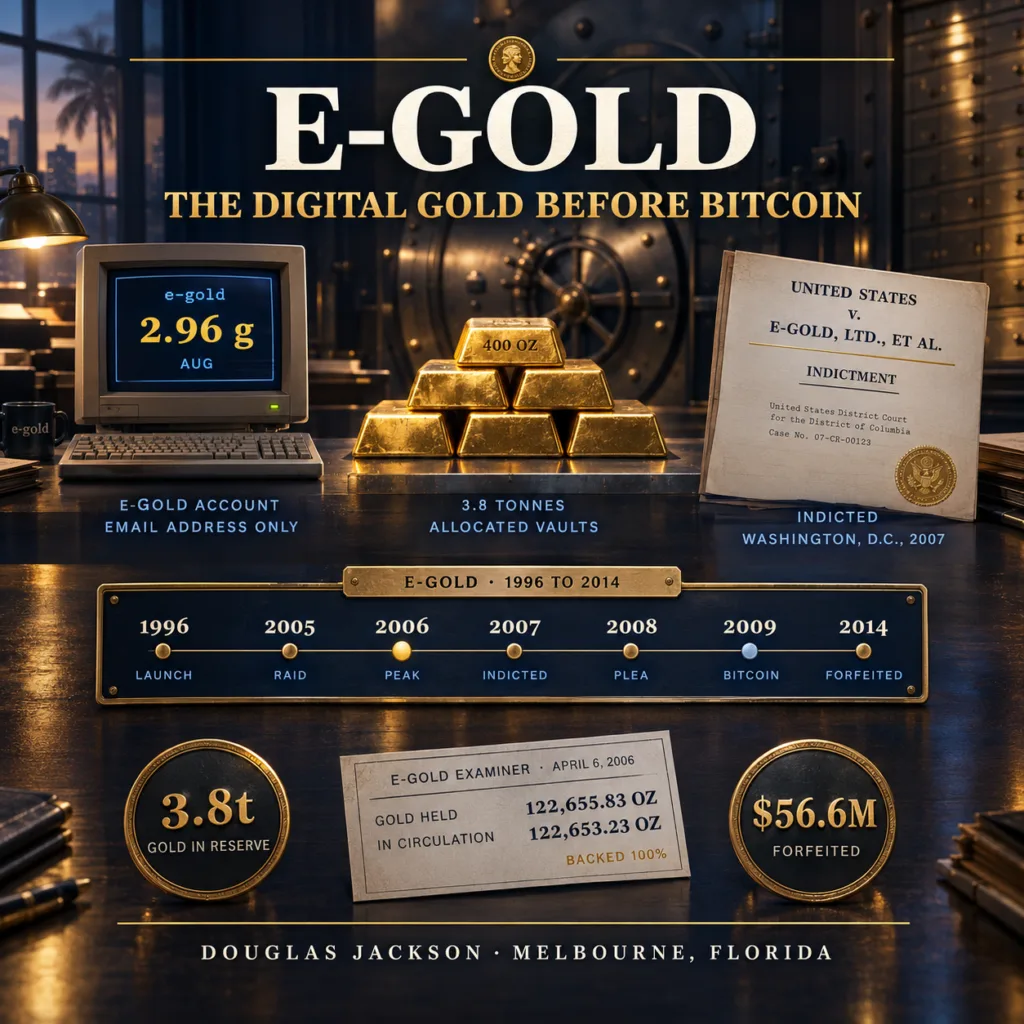
E-gold was one of the internet’s first digital currencies, and the company said every unit was backed 100 percent by gold in allocated storage. An oncologist named Douglas Jackson launched it in 1996 with co-founder Barry Downey. In April 2006 its own pages counted 2,966,940 accounts and about 3.8 tonnes of gold in the reserve. In July 2008 its two companies and Jackson pleaded guilty to money laundering conspiracy and unlicensed money transmitting charges. Six weeks after Jackson was sentenced, the first Bitcoin block was mined on January 3, 2009.
The gold appears to have been real. E-gold published what it said was a real-time count of its holdings, and the charges against it were about laundering and licensing, not missing metal. What sank it was the account system around the gold. Anyone with an email address could open an account, and the company did not register as a money transmitter until after its plea, so card thieves and Ponzi operators were using it for years before prosecutors moved against it. By April 2014 the government had forfeited more than $56.6 million from e-gold accounts and returned just over $20 million to verified holders.
A cancer doctor’s plan to put the internet on gold
Jackson was still treating cancer patients when the idea took hold. He believed gold made better money than paper, took inspiration from economist Vera Smith’s 1936 case for free banking, and saw the young internet as a way to put the idea to work. He coded the back end himself in early 1996, at night while practicing medicine by day, and hired an engineer for the interface. E-gold went live four months later. Over the next few years he emptied his retirement accounts, sold his practice and ran up credit cards, putting more than $1 million into the company, according to a 2009 profile by Kim Zetter in Wired.
The storage started out almost homemade. According to Wired, the first coins and ingots went into safe deposit boxes at local banks, then into an office safe, and Jackson recalled that the silver was “just stacked around the office”. E-gold’s own Examiner page from December 1998 reads like a coin shop inventory: 2,890 ounces of gold in 1,237 pieces, including 577 French 20-franc coins, seventeen 100-ounce bars from Zurich and one 400-ounce bar, and a silver reserve that included more than 100,000 pre-1965 U.S. dimes, quarters and half dollars, the 90 percent “junk” silver stackers still buy. By January 2001 the gold had become 115 bars of 400 ounces in Toronto, and by April 2002 the bars sat in London, Dubai and Zurich.
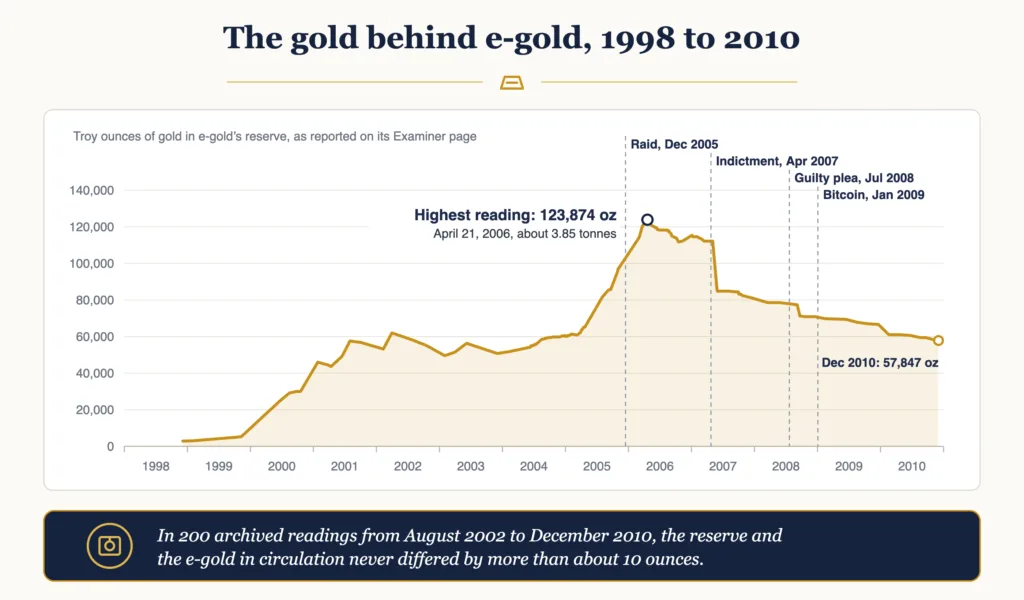
From August 2002 the Examiner page quoted the product’s central promise. The user agreement said every e-metal unit in circulation would be backed “100% at all times with unencumbered metal in allocated storage”, and the page claimed to report compliance in real time. Nearly every archived snapshot shows the reserve covering the e-gold in circulation, though two, from July 2004 and June 2006, show it a few ounces short.
On April 6, 2006, it listed 122,655.83 ounces of gold against 122,653.23 ounces of e-gold in circulation. Allocated storage means specific bars set aside rather than a general promise, the line that separates allocated from unallocated gold storage at any vault. In e-gold’s case the bars were held by the e-gold Bullion Reserve Special Purpose Trust, and the Examiner listed them as its assets and customers’ e-gold as its liabilities. The page matched the pool of bars against all e-gold in circulation, not bars against individual accounts.
How e-gold worked, and who it worked for
Opening an account required only a valid email address, with no other contact details verified, according to the Justice Department’s 2007 announcement. Users funded accounts through independent exchangers, which swapped national currencies for e-gold, or through e-gold’s own exchange service, OmniPay. After that, value moved between accounts anywhere in the world in seconds, in amounts as small as a fraction of a milligram. Wired put the fee at 1 percent of each transfer, capped at 50 cents.
On April 12, 2006, e-gold’s statistics page showed more than 73,000 spends in the previous 24 hours, moving 604 kilograms of gold that the company valued at $11.6 million.
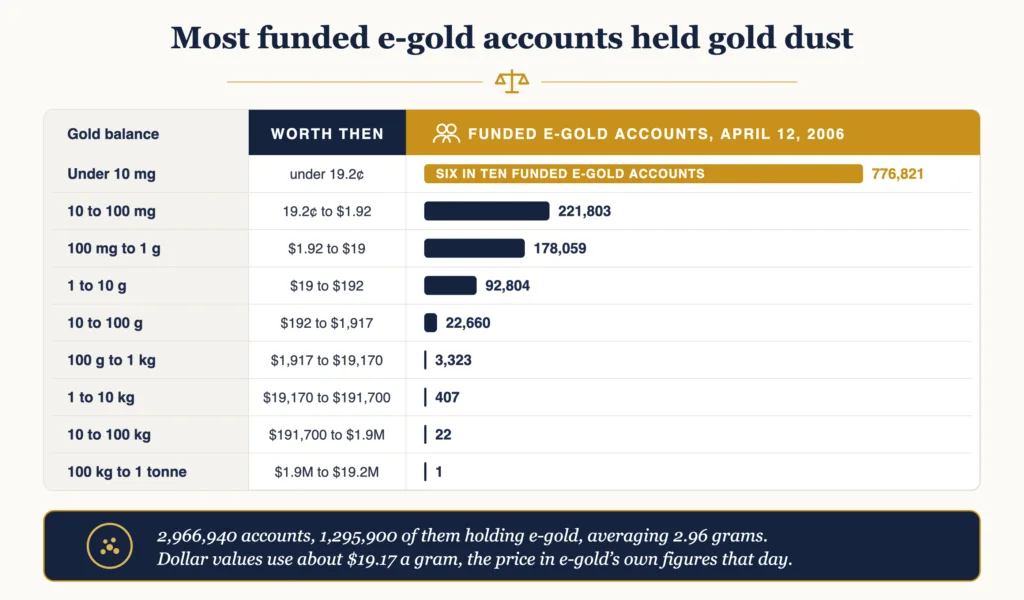
The same page shows how thin most accounts were. Of 1,295,900 accounts holding e-gold, the average held 2.96 grams, about $57 at the time. Six in ten held less than 10 milligrams, worth under 20 cents.
Prosecutors later said e-gold was widely used for credit card and identity fraud, high yield investment programs and child exploitation, but was not widely accepted by large or mainstream vendors.
The raid, the charges and the plea
The Secret Service came across e-gold while chasing carders. Its undercover case against Shadowcrew, a forum for trading stolen card numbers, showed that the forum’s members liked e-gold for moving money, according to Wired. In mid-December 2005 agents raided Jackson’s home and the offices of Gold & Silver Reserve, the Florida company that ran e-gold, and carried off more than 100 boxes of records. The bullion was safe overseas, but the company’s domestic bank accounts were frozen.
Jackson then did something unusual for a man under investigation. He searched his own database for carders, Wired reported, and found a network of linked accounts. One user, “Segvec”, had received more than half a million dollars from four others, and $17,000 of it was labeled “for beer”. Jackson traced them through the exchangers who had cashed them out and passed names and addresses to postal inspectors. Segvec turned out to be Albert Gonzalez, one of the hackers behind the TJX breach, who was sentenced to 20 years in 2010. An FBI agent, speaking to Wired without authorization, said Jackson’s information had been “instrumental in helping track people down”. Wired noted that prosecutors had not acknowledged his help.
None of that stopped the prosecution. On April 24, 2007, a grand jury in Washington, D.C. returned a four-count indictment against E-Gold Ltd., Gold & Silver Reserve, Douglas Jackson, his brother Reid Jackson and Barry Downey, on money laundering conspiracy and unlicensed money transmitting charges. The indictment alleged, as Assistant Attorney General Alice Fisher put it, that e-gold had been “a preferred means of payment” for child pornography distributors, identity thieves and online scammers. The Justice Department also obtained seizure warrants on more than 58 accounts.
Jackson believed e-gold was a payment system, not a money transmitter and not a bank, Wired reported, but the law did not recognize a new category. Under federal and District of Columbia law, the Justice Department said, the business needed a license and a federal registration, and according to the plea materials it had neither. The Examiner shows how fast the reserve shrank once the charges were public. Between May 4 and May 30, 2007, the gold in the trust fell from 112,188 ounces to 84,856.
On July 21, 2008, both companies pleaded guilty to conspiring to launder money and to operate an unlicensed money transmitting business. Jackson pleaded guilty to the laundering conspiracy and to running an unlicensed money transmitting business, and Downey and Reid Jackson to District of Columbia licensing felonies. The companies agreed to a $1.75 million forfeiture and promised identity checks, suspicious activity reports, IRS supervision and an auditor to verify their claims that all transactions were fully backed by gold bullion.
On November 20, The Register reported, Judge Rosemary Collyer sentenced Jackson to three years of supervision and 300 hours of community service. He had faced up to 20 years on the laundering count alone, according to the Justice Department. Wired said the supervision included six months of electronically monitored home detention. The judge said the men deserved leniency because they had not set out to serve criminals, and she fined Jackson $200 after his lawyer argued he was nearly broke. E-Gold Ltd. and Gold & Silver Reserve were each fined $300,000.
Six weeks later, Bitcoin
On October 31, 2008, three weeks before Jackson’s sentencing, someone using the name Satoshi Nakamoto wrote to a cryptography mailing list about a new electronic cash system with “no trusted third party”. The first block of that system, Bitcoin, was mined on January 3, 2009. It had no company, no vault and no gold, and no office for agents to raid.
Nakamoto made a related point the following month, in the forum thread where he had announced Bitcoin’s software. A lot of people dismissed e-currency because of the companies that had failed since the 1990s, he wrote on February 15, 2009, but it was “only the centrally controlled nature of those systems that doomed them”. He did not name e-gold. Its guilty plea was nearly seven months old.
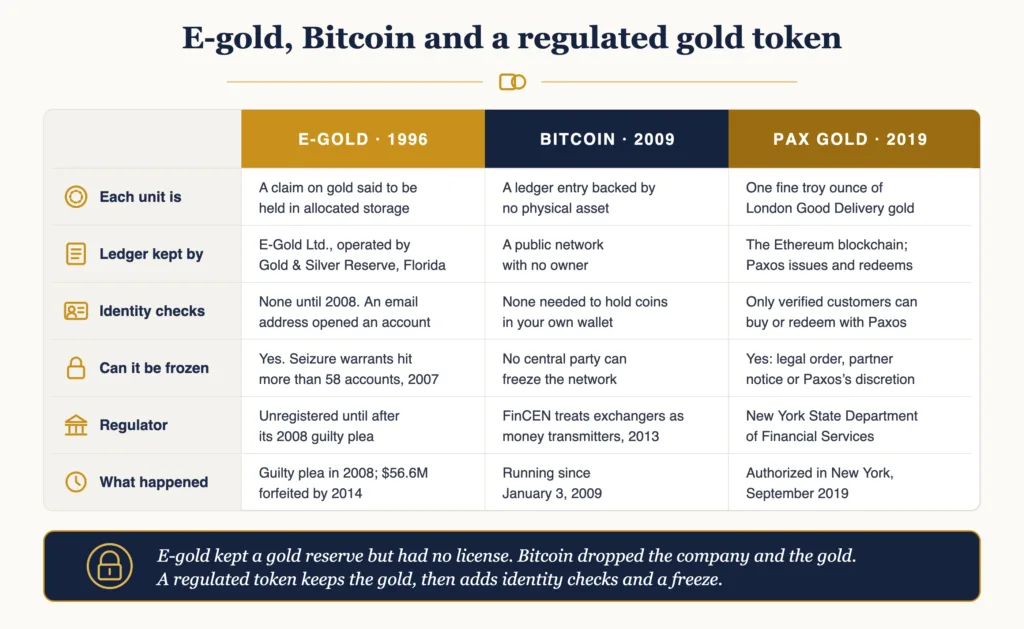
Regulators drew a different lesson. FinCEN’s March 2013 guidance treats administrators and exchangers of convertible virtual currency as money transmitters unless an exemption applies, and says the same rules cover dealers in e-currencies and e-precious metals, because moving value between customers’ accounts is money transmission. That is the federal registration e-gold failed to obtain.
What happened to e-gold
Wired found the currency “barely alive” in June 2009, with Jackson wearing an ankle monitor and trying to relaunch it as a licensed business, and the reserve kept shrinking through 2010. The last archived Examiner, from December 2010, shows 57,847 ounces, less than half of the April 2006 high.
In 2011 the government filed a civil forfeiture action in Maryland against the value of the e-gold accounts, more than $86.3 million, and notified the registered holders. As part of its plea, the company had identified 12,869 accounts holding criminal proceeds, and in 2012 a judge forfeited more than $10.8 million from them. In April 2014 Judge Ellen Hollander forfeited the unclaimed balance, $45.8 million. Account holders who verified their ownership had received more than $20 million, the U.S. Attorney’s office in Maryland said.
At $4,158 an ounce, where gold traded on the morning of September 29, 2026, the 123,874 ounces e-gold reported on April 21, 2006, its highest archived reading, would be worth about $515 million.
What e-gold teaches anyone who owns gold
E-gold’s customers do not appear to have been robbed by an empty vault. From August 2002 on, the Examiner matched metal to accounts within about 10 ounces until the end. Many lost access because the ledger belonged to a company whose legal footing gave way, and not until 2014, seven years after the indictment, did a court finish returning money to verified holders and forfeiting the rest.
Gold on a digital ledger has since come back with a license. In September 2019 New York’s Department of Financial Services authorized Paxos Trust Company to issue PAX Gold, the first gold-backed virtual currency it had approved. Under the token’s terms, each PAXG equals one fine troy ounce of London Good Delivery gold held on a segregated basis, and only verified customers can buy it from Paxos or redeem it. Its smart contract includes a role that can freeze and wipe a balance, and its terms let Paxos freeze tokens when the law requires, on a partner’s formal notice or at its own discretion. That is the e-gold case written into code. A token still leaves the metal in someone else’s vault, and bank-issued tokens raise their own questions, as this comparison of tokenized dollars and physical gold explains.
The same questions apply to any gold held for you by someone else, in a vault program, a dealer’s storage account or a token. Who keeps the ledger, and who can freeze it? When a custodian fails, what happens to your metal depends on whether it was held for you or merely owed to you. Metal you hold yourself trades those risks for others, like theft and storage.
Douglas Jackson wanted a currency that no government controlled, and he designed it to be backed by gold. Nothing in the charges or court records cited here alleged the gold was missing. What went wrong happened in the account around it, and the account is what to examine before you trust anyone to hold metal for you.