
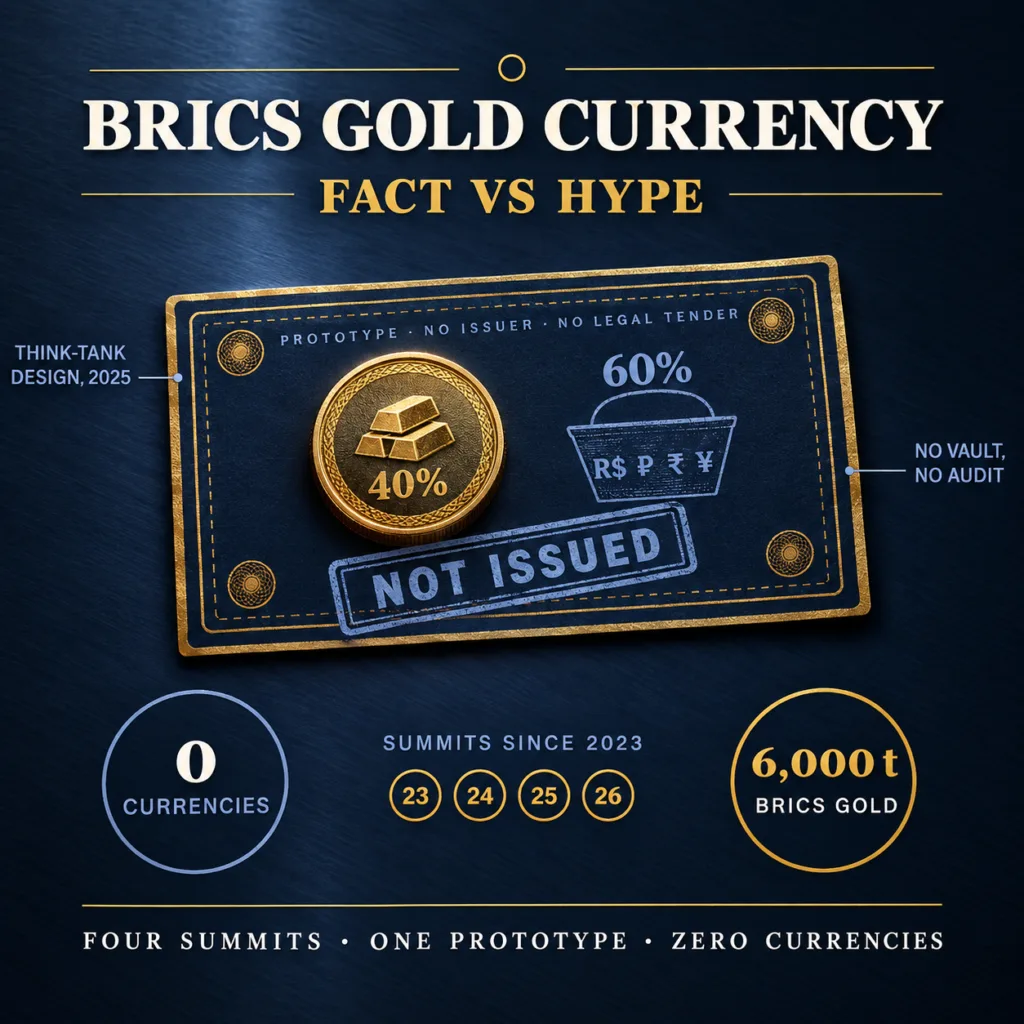
There is no BRICS gold-backed currency. Nobody can spend one, no member government has signed off on a pilot, and the declaration adopted at the summit that just ended does not mention one. On September 12, 2026, BRICS leaders adopted a 140-paragraph New Delhi Declaration that does not propose a common currency, gold-backed or otherwise. That makes four summits in a row where the headline that flooded social media in the weeks before never happened. Meanwhile gold traded at about $4,350 an ounce on the morning of September 16, more than double its price when the rumor first caught fire in 2023. So something is going on, and it is worth understanding. It is not what the viral posts say.
Four different things get mashed together under that label, and they deserve separate treatment: what the summits signed, what a Russian think tank built, what BRICS central banks are doing with gold, and what the scammers are selling.
What each summit said about a currency
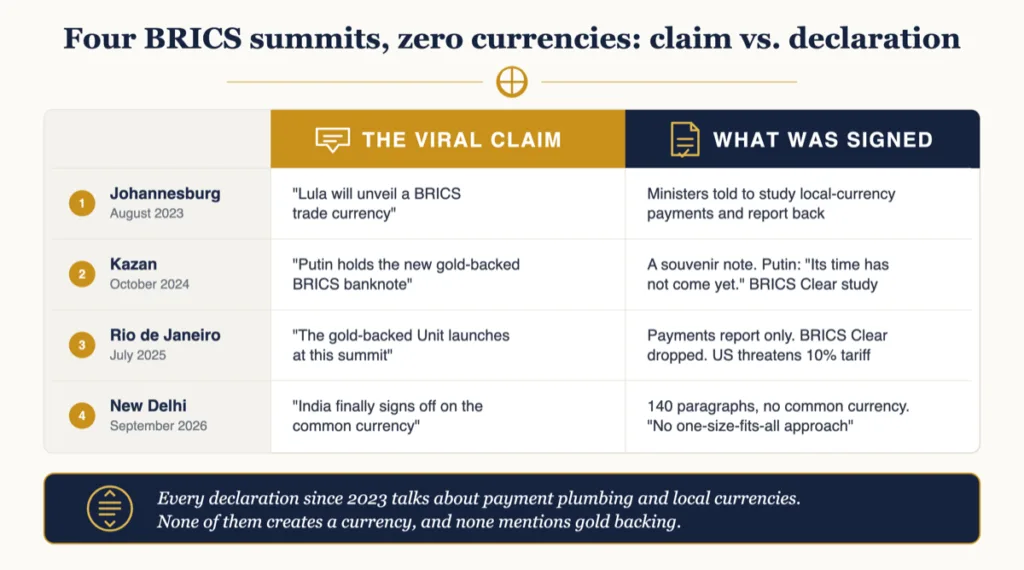
The story starts in Johannesburg in August 2023, when Brazil’s President Lula arrived asking publicly why the bloc could not trade in its own unit of account. The declaration that came out tasked finance ministers and central bank governors with studying local currencies, payment instruments and platforms, and reporting back. That was the whole outcome, and it set the template for everything since.
Kazan, October 2024, produced the single most misleading image of the entire saga. Vladimir Putin was handed a colorful mock banknote printed with the five founding members’ flags, held it up for the cameras, and the photo went around the world as proof that the currency had launched. It is a good photo, which is the problem. A fact-check traced it to the director of a regional Russian printing house, the note itself carried the words “not a means of payment,” and Kremlin spokesman Dmitry Peskov said it merely symbolized joint work within BRICS.
Four days before the summit, in a meeting with journalists from BRICS countries, Putin had already answered the question directly: “As for the BRICS common currency, we are not considering this issue. Its time has not come yet.” A common currency, he added, needs economies that are “highly integrated” and “roughly equivalent in terms of structure and efficiency.”
The Kazan Declaration runs 134 paragraphs. It welcomed local-currency settlement, asked members to “discuss and study the feasibility” of an independent settlement and depository infrastructure it called BRICS Clear, and encouraged stronger correspondent banking, all “voluntary and non-binding.” The word gold does not appear in it once.
Rio de Janeiro, July 2025, was quieter still. The bloc’s payments task force delivered a technical report on a cross-border system meant to be “fast, low-cost, more accessible, efficient, transparent, and safe,” and the Rio Declaration told ministers to keep discussing it. BRICS Clear, the one concrete settlement idea from Kazan, was not mentioned. What did make news that week was Donald Trump’s post promising an extra 10 percent tariff on any country “aligning themselves with the anti-American policies of BRICS,” stacked on his November 2024 threat of 100 percent tariffs on any member that tried to replace the dollar.
New Delhi was always going to disappoint the currency crowd. India held the 2026 chair, and India has been the bloc’s most consistent skeptic of a shared currency since External Affairs Minister S. Jaishankar told the Doha Forum in December 2024 that “there is no proposal to have a BRICS currency” and that “India has never been for de-dollarisation.” The New Delhi text follows that line. It talks about local currencies, cross-border payment tools, and linking national fast payment systems. The framing coming out of Delhi all week was de-risking, meaning more channels for trade so a single sanction or tariff cannot shut everything down, rather than de-dollarizing. The declaration even states there is no “one-size-fits-all approach,” which is diplomatic language for “we do not agree on this.”
The “Unit” exists, and it is not a BRICS currency
This is the part the debunkers tend to skip. A token marketed as the BRICS gold-backed currency does exist, and it did launch. BRICS did not launch it.
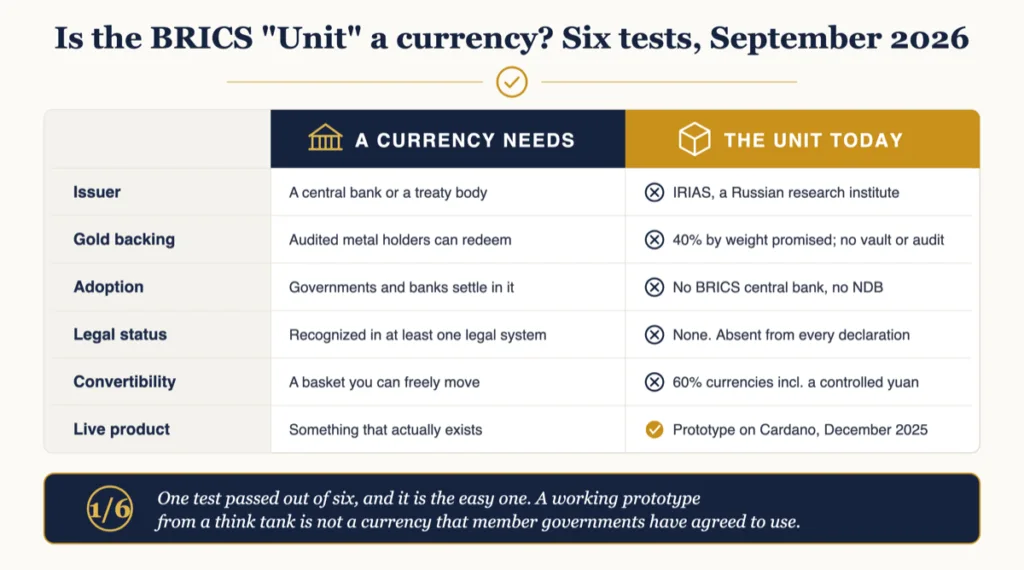
The Unit is a design pushed by IRIAS, a Moscow-based research institute, and a body called the Unit Foundation. It was first floated in 2024 as a benchmark token backed 40 percent by gold, measured by weight rather than nominal value, and 60 percent by a basket of the five founding members’ currencies. After Kazan the BRICS Pay website listed it as “an issue under discussion,” which supporters treated as endorsement and which is, in plain English, the opposite of a decision. Then on October 31, 2025, the institute’s researchers ran a quiet pilot with each Unit referenced to one gram of gold, and on December 8 a prototype went live on the Cardano blockchain. Forbes columnist Nathan Lewis called it “a good step forward,” and Forbes Africa reported that the group “considers” the idea.
Look at the verbs in those reports: considers, pilot, prototype. No BRICS central bank has adopted the Unit. The New Development Bank has not adopted it. A widely shared claim that NDB president Dilma Rousseff confirmed an “agreement in principle” to settle trade in Units has never been traced to anything she actually said. Nothing in the Rio or New Delhi declarations mentions it. What exists is a proof of concept from a think tank in Moscow. Calling it a BRICS currency is like calling a patent drawing a car.
Why a BRICS gold-backed currency is so hard to build
Even with the politics set aside, the design problem is hard. A currency backed 40 percent by gold needs the gold to sit somewhere. Whose vault? Russia has watched roughly $300 billion of its reserves sit frozen in Western clearing systems since 2022, which is exactly why it wants an alternative, and exactly why it will never park its bullion in Shanghai or Mumbai. China feels the same about Moscow. India and China share a disputed border and a trade relationship neither side trusts. A shared currency means trusting another government with your reserves, and nobody in this group is about to do that.
Then there is redemption. A gold backing only means something if holders can demand the metal, and history is unkind to issuers who let them. The London Gold Pool spent the 1960s selling bullion to hold the dollar at $35 an ounce and fell apart in 1968, and Nixon closed the gold window three years later when France and others kept turning up to redeem. The whole unwinding is in the piece on the Bretton Woods system. Gold did not fail in 1971. Governments did what governments do and suspended convertibility the moment it hurt. A BRICS Unit would go the same way unless its members handed real gold to a body they do not control, and they have shown zero sign of doing that.
And the yuan, the obvious anchor for the 60 percent currency basket, is not freely convertible. China keeps capital controls. A settlement token that is 60 percent currencies you cannot freely move and 40 percent gold you cannot redeem is a very complicated way of doing something the members can already do bilaterally, so they keep doing it bilaterally.
What BRICS members are doing instead of a currency
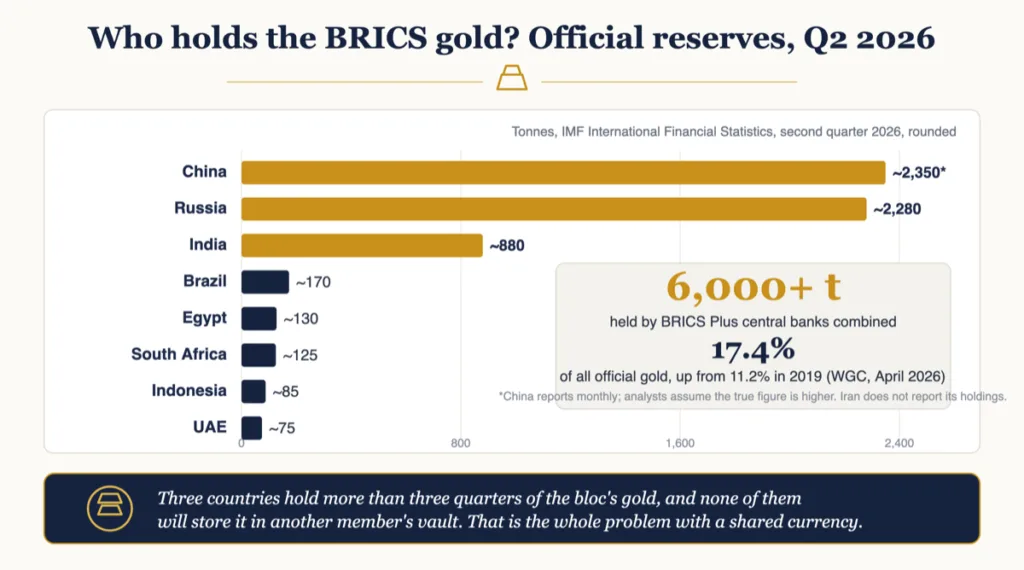
The currency is talk. The gold buying is not, and it is the part that should interest anyone who owns metal. Central banks as a group bought more than 1,000 tonnes of gold in each of 2022, 2023 and 2024, roughly double the average of the previous decade, and the official pile now stands near 36,000 tonnes, close to the Bretton Woods era peak. BRICS Plus members now hold over 6,000 tonnes between them, about 17.4 percent of all official gold, up from 11.2 percent in 2019, according to World Gold Council data compiled this spring. Russia and China each report roughly 2,300 tonnes, and India about 880. China’s reported figure has crept up nearly every month since November 2024, and since Beijing has gone years at a stretch without reporting at all, treat that number as a floor.
You can see the effect in the reserve statistics. The European Central Bank’s June 2025 report on the international role of the euro found that gold, valued at market prices, made up 20 percent of global official reserves at the end of 2024, ahead of the euro’s 16 percent. That had not happened since Bretton Woods ended.
The IMF’s COFER data, which counts only foreign exchange and leaves gold out, had the dollar at 57.13 percent of reserves in the first quarter of 2026, up slightly on the quarter. Put the two together: the dollar’s share of currency reserves is flat, while gold is taking share from everything else. That is the reserve shift of 2026, and it needs no new currency to keep going.
The plumbing is also further along than the currency. Payment interoperability was the centerpiece of the 2026 finance track. The task force is studying how to link national systems such as China’s CIPS, India’s UPI, Brazil’s Pix and Russia’s SPFS, work usually filed under the BRICS Pay label, and India’s central bank has reportedly floated linking members’ digital currencies for trade and tourism payments. None of that is a rival to the dollar. It is a way to settle a rupee-for-oil trade without a New York correspondent bank in the middle. The Bank for International Settlements, for its part, walked away from Project mBridge, the wholesale digital currency platform Putin had publicly promoted, in October 2024, with its general manager stating flatly that “mBridge is not the BRICs bridge” and that nothing it built should become “a conduit to violate” sanctions.
The scams riding on the rumor
Every summit brings a wave of “BRICS coins” for sale, and every one of them is fake. The souvenir banknote from Kazan has been passed around online as a real note. As early as February 2024, cybersecurity firm Resecurity documented a counterfeit “BRICS” token that borrowed the currency rumor, ran an initial coin offering, and kept trading long enough to keep drawing victims. The firm cited industry data putting the toll of this kind of rug pull at more than two million investors overall, more than FTX, Celsius and Voyager combined. Until a government says otherwise, the rule is simple. You cannot buy a BRICS currency, because none exists. Anyone offering one is selling you a story. The older versions of this nonsense are in the piece on dollar collapse predictions, and this is the same thing in a new costume.
What a gold owner should take from all this
I have watched this rumor cycle three times now and it runs the same way every time. Newsletter headlines promise a summit announcement, the summit issues a declaration about payment interoperability, and the writers move the date. What gold has done over the same stretch is climb from about $1,900 an ounce at the Johannesburg summit to about $4,350 this week, and none of that came from a currency. It came from central banks, inside the BRICS bloc and well beyond it, deciding one tonne at a time that a reserve asset nobody can freeze is worth paying up for.
That is the trend worth owning. If a Unit ever does get adopted, it would need to buy a great deal of gold to back it, and the metal in your safe would benefit. If it never does, which is my bet, the buying continues anyway. Either way, the thing to watch was never the headline. It was the tonnage.