
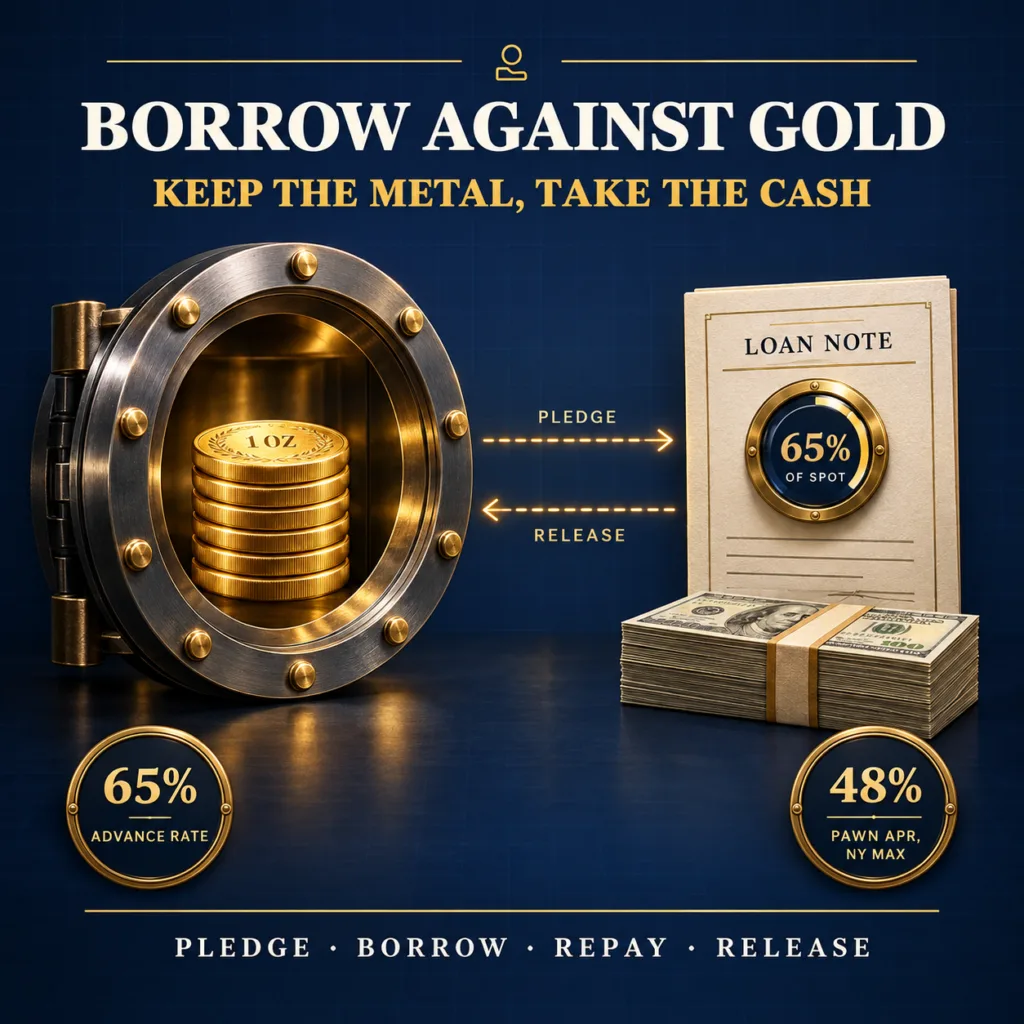
Yes, you can borrow against gold you already own, and in a year when an ounce trades near $4,350 it is a question I hear more often than “where can I sell”. The short version: a pawnbroker will lend you cash against coins or bars in about ten minutes, a handful of specialist bullion lenders will advance 65 to 75 percent of spot value if you ship the metal to their vault, and a loan is not a sale, so nothing is owed to the IRS while the gold sits as collateral. Whether borrowing beats selling comes down to loan-to-value ratios, rates that run from single digits to 48 percent a year, margin calls, and what happens to your coins if you cannot pay. This article works through each of them with real terms from real lenders, current as of September 21, 2026.
Why borrow against gold at all?
Selling ten Gold Eagles to cover a tax bill or a payroll gap means giving up the position, paying tax on the gain, and paying a fresh premium if you buy back in later. A loan lets you keep the ounces and rent the liquidity. The metal stays yours, the price exposure stays yours, and when the loan is repaid the coins come back.
It is smart only when the loan costs less than selling would. Take ten one-ounce Gold Eagles bought in 2020 at $1,800. At $4,350 they are worth about $43,500, and selling them books a $25,500 gain. Because the IRS treats coins and bullion as collectibles, that gain is taxed at a maximum federal rate of 28 percent if held more than a year, which on this lot could mean a check to the Treasury of around $7,100 before state tax. The piece on the 28 percent collectibles tax walks through exactly how that bill is calculated. Borrow $28,000 against the same coins instead, pay it back in six months, and the gain is never realized. The interest is the only cost, and on the better loans it is a fraction of the tax.
The three places that lend against gold
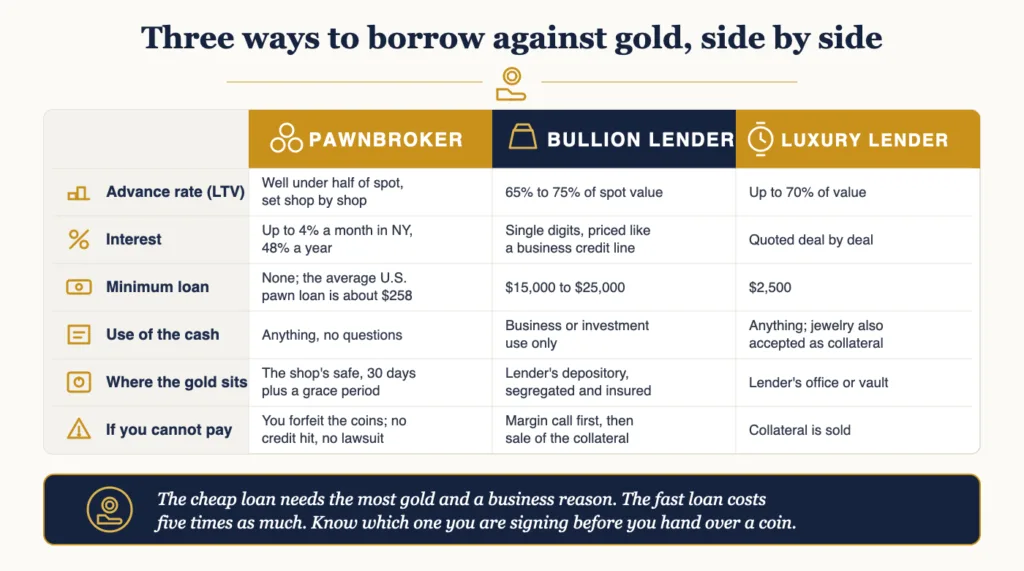
The oldest is the pawnshop, and it is more regulated than its reputation. In New York, a collateral loan broker may not charge more than 4 percent per month under General Business Law section 46, and may not charge interest at all beyond fifteen months without an agreed extension. Four percent a month is 48 percent a year, which sounds ruinous until you notice what comes with it. A pawn loan is non-recourse: if you never come back, the shop keeps the gold and that is the end of it, with no collection calls and nothing reported to a credit bureau. FirstCash, the largest pawn-store operator in the country, describes the model in its annual report: a typical 30-day term, a grace period of 14 to 90 days depending on the state, and forfeiture of the collateral into store inventory if the loan is not redeemed. Its average U.S. pawn loan at the end of 2023 was $258.
The pawn loan is built for a small, short gap, and for that job nothing is faster or more private.
The second kind of lender is one most gold owners have never heard of. Bullion dealers and the depositories attached to them write loans against metal stored in their own vaults. Money Metals Capital Group, the lending arm of an Idaho dealer, will advance up to 65 percent of the spot value of gold, silver, platinum or palladium bullion, with a $15,000 minimum loan that requires about $23,000 of metal shipped to its depository in Eagle, Idaho. Payments are interest-only, there is no origination fee and no prepayment penalty, and the company says its rates sit in the single digits and compete with business lines of credit, though it does not publish a number. Collateral Finance Corporation, a California-licensed lender in business since 2005 that JM Bullion now offers to its customers, goes further on the advance rate. It writes revolving lines at 75 percent of spot on bullion and 65 percent of appraised value on graded numismatic coins, stores the pledged metal at a UL-certified depository, and funds in roughly ten days. Its minimum is $25,000.
Both of these lenders share a catch that the marketing does not shout about. The loans are for business or investment purposes. Money Metals says proceeds must go to commercial purposes rather than personal, family or household expenses, and must not be used to immediately buy more metal; CFC’s disclosures limit its program to business and commercial loans. The reason is almost certainly consumer lending law, which piles licensing and disclosure rules onto personal loans that these firms have chosen not to take on. Borrowing against gold to pay for a kitchen sends you back to the pawnshop, or to the third type of lender.
That third type is the luxury-asset lender, which also finances watches and art. Borro, with offices in New York and Denver, will lend up to 70 percent of value against bullion and coins with a minimum loan of just $2,500, and it takes jewelry as well, which the bullion lenders generally will not. These lenders price by the deal rather than by a published schedule, so the only way to know the rate is to ask, and it will land somewhere between the pawnbroker and the bullion vault.
What loan-to-value means when gold moves
Every one of these loans is governed by a single ratio, the loan-to-value, and it is worth understanding because it is the number that can hurt you. A 65 percent advance on $43,500 of Eagles is a $28,275 loan. The 35 percent cushion protects the lender, not you. If the price drops 20 percent, the same ten coins are worth $34,800 and the loan is now 81 percent of the collateral. At that point the bullion lenders do what any margin lender does: they call. Money Metals describes the options as adding more collateral, making a partial repayment, or authorizing the sale of part of the metal. On the example above, restoring a 65 percent ratio means either shipping in another two and a half ounces, about $8,700 of gold at the new price, or repaying about $5,650 in a hurry.
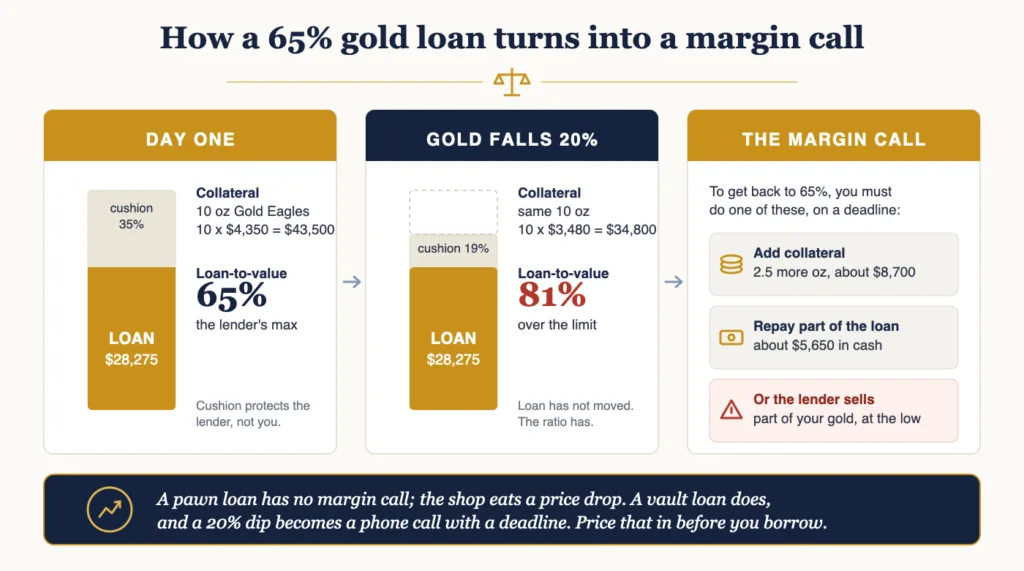
A pawn loan has no margin call, an underrated point in its favor. The pawnbroker prices that risk into a lower advance instead, and if gold collapses during your 30 days the loss is the shop’s problem. For a sense of where regulators land on the ratio, the Reserve Bank of India’s 2025 lending directions for its enormous gold-loan market cap loan-to-value at 85 percent on small loans, 80 percent on mid-sized ones and 75 percent above that, maintained for the life of the loan. American lenders sit below all three tiers, and after a year in which gold slid from a January peak near $5,600 to about $4,350, it is hard to blame them.
The tax angle: a loan is not a sale, until it is
The single best reason to borrow rather than sell is the one already mentioned: pledging gold as collateral is not a disposition, so it creates no gain, no loss and no reporting. That changes the moment you default. IRS Publication 544 is explicit that a foreclosure or repossession is treated as a sale or exchange from which you may realize a gain or loss. Walk away from a pawn ticket on coins you bought at $1,800 and, on paper, you have sold them for the loan balance. On a non-recourse pawn loan the amount realized is the debt cancelled. On a recourse loan, the usual structure at the bullion lenders, the gap between the debt and the metal’s value can become ordinary income. None of this is a reason to avoid borrowing.
It is a reason to treat a default as the sale it legally is, and to keep the purchase records that establish your basis, because the lender will not do it for you.
What it costs: a six-month example
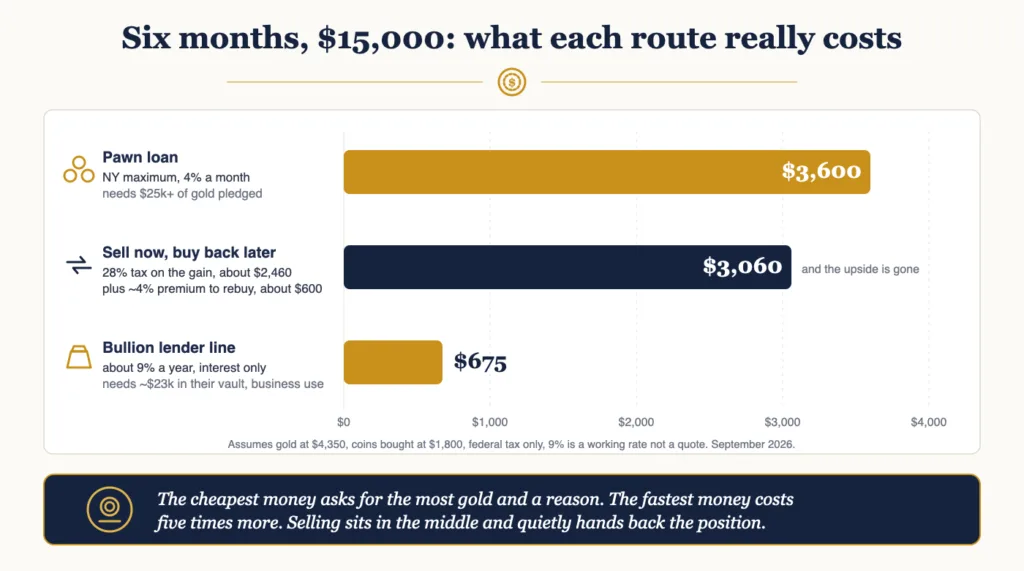
Put numbers on a realistic case. You need $15,000 for six months and you own a little over 3.4 ounces of Gold Eagles, worth about $15,000 at today’s price, bought at $1,800 an ounce. Selling books a gain of roughly $8,800, and at the 28 percent collectibles rate the federal tax alone is around $2,460. Buying the same coins back in March costs whatever the dealer premium is that week, and on one-ounce Eagles that is commonly a few percent over spot, a cost the piece on the gold premium trap unpacks, so call it $600. Selling and rebuying therefore costs a bit over $3,000 before the bid-ask spread on both legs, which the guide to the best place to sell gold covers in detail.
Pawn the same coins at the New York maximum and six months of interest on $15,000 is $3,600. In practice a pawnbroker would want $25,000 or more of gold pledged to lend that much. Borrow from a bullion lender and the picture changes completely. The prime rate moved to 7.00 percent on September 17, 2026, and the specialist lenders describe their pricing as comparable to business credit lines, so a rate around 9 percent is a fair working assumption though not a quote. Six months of interest-only payments on $15,000 at 9 percent is $675. You need about $23,000 of metal in the lender’s vault and a business reason, but the loan costs a fifth of the pawn ticket and a quarter of the tax on a sale.
When borrowing against gold is the wrong move
It is the wrong move when there is no realistic path to repaying. A pawn loan you cannot redeem is a sale at perhaps half of what a dealer would have paid you across the counter, dressed up as a loan. If the honest answer is that the money is not coming back, sell the coins outright to a buyer who pays close to melt and keep the difference. If you are near New York, you can compare offers against our posted gold and silver buyback prices.
It is also the wrong move as leverage. Borrowing against gold to buy more gold feels clever in a rising market and is exactly how margin calls ruin people in a falling one, which is why Money Metals bars it in its loan terms. A 20 percent drop that would be an annoyance to an unlevered owner becomes a forced sale at the bottom for a levered one.
And it is the wrong move if you do not understand whose vault the gold is sitting in. Ship coins to a dealer-affiliated depository as collateral and you are trusting that firm’s custody and solvency for the life of the loan. The question of whether metal in a failed dealer’s vault belongs to you or to the bankruptcy estate is not theoretical; the article on what happens to your metal when a gold dealer goes bankrupt covers cases where customers spent years finding out. The difference between segregated and pooled custody, explained in the guide to allocated and unallocated storage, matters even more when a creditor relationship sits on top of it.
Questions to settle before you pledge a single coin
Get the advance rate in writing and ask what price it is measured against, because spot and the lender’s bid are not the same thing; Money Metals’ own calculator warns that its estimate may overstate collateral value for exactly that reason. Ask for the rate as an annual figure and whether it floats with prime. Ask what triggers a margin call, how long you get, and whether the lender can sell your metal without your signature. Ask where the gold sits, in whose name, whether the depository is independent of the lender, and whether the same coins come back at the end. And ask the pawnbroker the one question that matters there: the exact date the grace period ends.
Borrowing against gold is a rental of liquidity against an asset you want to keep, priced anywhere from 9 percent to 48 percent a year depending on how much you can pledge and why you need the money. Priced right, it carries you through a bad month without turning a paper gain into a tax return. Priced wrong, it is a slow sale with extra steps. Knowing which one you are signing is the whole skill.