

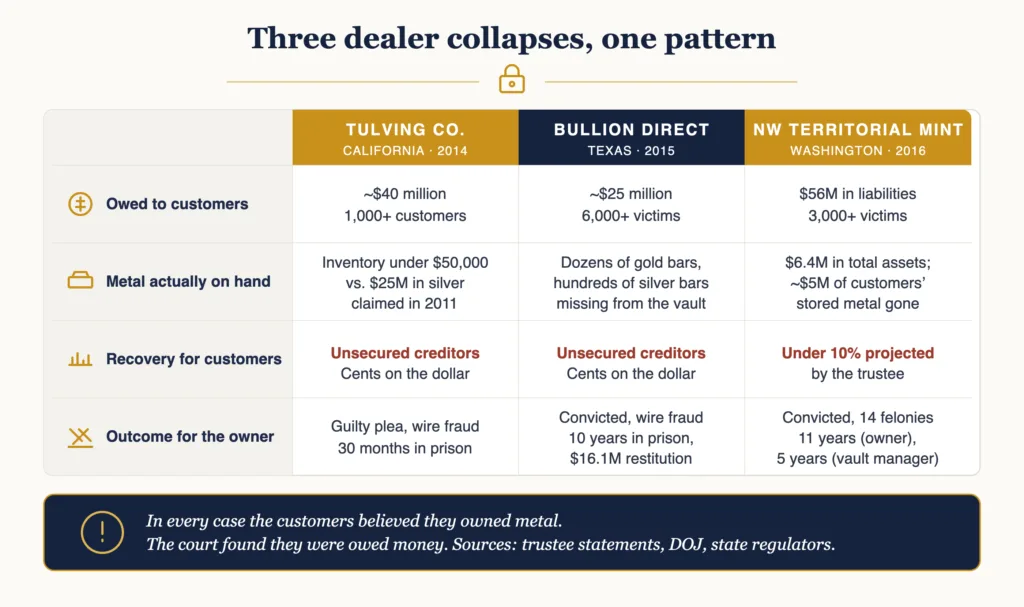
Here is the uncomfortable answer first. In a gold dealer bankruptcy, the court does not ask how much gold the company has. It asks whose gold it is. If you hold title to specific, identified bars under a bailment, the metal never belonged to the company, so it sits outside the bankruptcy estate and you get it back. If what you hold is a promise, whether a prepaid order, a pooled storage account, or a line in a dealer’s ledger that says “stored for you”, you are an unsecured creditor standing in line behind the lawyers, the landlord, and the tax authorities. History is not kind to that line. Three American collapses in three years, Tulving in 2014, Bullion Direct in 2015, and Northwest Territorial Mint in 2016, paid unsecured customers somewhere between very little and nothing, and the same mechanism resurfaced this summer in a far larger name.
The one legal line that decides everything
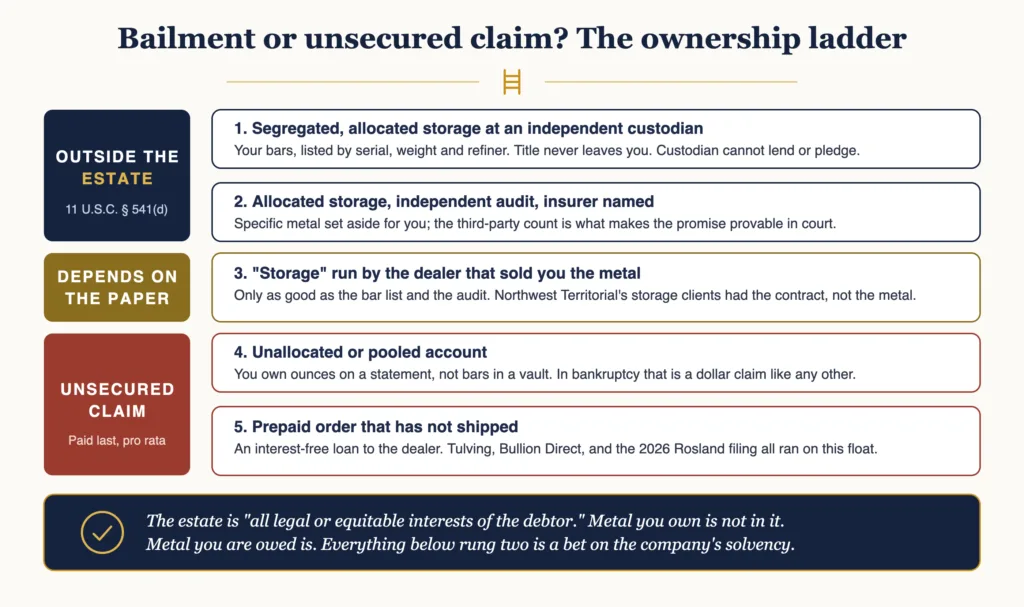
The Bankruptcy Code defines the estate, meaning the pool of assets a trustee can sell to pay creditors, as “all legal or equitable interests of the debtor in property as of the commencement of the case”. The same section then carves out property in which the debtor holds “only legal title and not an equitable interest”. That carve-out is where your gold either lives or dies.
A bailment is the arrangement you want. You hand specific property to someone for safekeeping, title stays with you, and the keeper has no right to sell it, lend it, or pledge it. A coat check is a bailment. So is a properly structured allocated, segregated vault account where bar numbers, weights, and refiner marks are recorded against your name. When that custodian fails, the trustee inventories the vault, matches bars to owners, and hands them back, because those bars were never the company’s to begin with. The distinction between this and a pooled account is the entire subject of our guide to allocated versus unallocated gold storage, so I will not repeat it here beyond the part that matters in court: unallocated means you own a claim, not metal.
Everything else is a debt. If you paid for coins that have not shipped, the company owes you coins, which in bankruptcy becomes a dollar claim. If a dealer’s website showed you a “storage balance” but no bar list existed, you own a number on a screen. Secured lenders are paid first, then the professionals running the case, then priority claims like wages and taxes, and only then the general unsecured pool, shared pro rata. When the estate is a few million dollars against fifty million in claims, pro rata is a polite word for pennies.
Tulving, 2014: the order that never ships
The Tulving Company of Newport Beach, California, was for years one of the largest online bullion sellers in the country, and its collapse is the cleanest illustration of what a prepaid order really is. The company stopped operating on March 3, 2014 and filed Chapter 11 a week later, on March 10. CoinWeek’s reconstruction of the failure put the debt at roughly $40 million owed to upwards of a thousand customers. The same account notes that the firm had claimed $25 million in silver inventory in 2011; by the time of the bankruptcy the inventory was worth less than $50,000.
The mechanism was not exotic. Shipping delays stretched to seven or eight weeks through 2013, well past the 30 days the Federal Trade Commission’s Mail Order Rule allows without a customer’s consent, and money from new orders was used to fill old ones. Prosecutors later charged the narrow window where that became knowing fraud. Between August 2013 and January 2014, according to the Department of Justice, the company took orders it knew it could not fill from more than 380 customers worth over $15 million. Hannes Tulving Jr. pleaded guilty to wire fraud and was sentenced to 30 months in prison on February 17, 2016.
The lesson is blunt. A prepaid order is an unsecured, interest-free loan to the dealer for as long as the metal has not shipped. That is fine when the wait is three business days. It is a different proposition when the wait is two months.
Bullion Direct, 2015: the vault that was mostly empty
If Tulving shows the risk of paying early, Bullion Direct in Austin, Texas, shows the risk of paying for storage at the company that sold you the metal. Customers bought through the site and were offered the convenience of leaving their metal in the company’s vault. When the firm filed for bankruptcy in July 2015, according to reporting on the criminal case, the missing metal ran to dozens of standard gold bars, hundreds of silver bars, and roughly 1,400 ounces of platinum and palladium. Customers valued their vanished money and metal at about $25 million.
The post-confirmation trustee’s findings, summarized by the firm that handled the estate, are the part every storage customer should read twice. In fifteen years of operation, the company had funded its operating losses, including salaries and software development, “through the use of customer metals”. The FBI counted over 6,000 victims. Founder Charles McAllister was convicted of wire fraud and money laundering in October 2019 and, per the Texas State Securities Board, sentenced on February 13, 2020 to 10 years in prison and $16.1 million in restitution.
Notice what those customers thought they had: specific metal in a specific vault. What they legally held was an account balance maintained by the seller, with no independent custodian, no bar list they could audit, and nobody whose job it was to confirm the number on the screen matched the metal on the shelf. That is not a bailment. That is trust, and trust is not a category the Bankruptcy Code recognizes.
Northwest Territorial Mint, 2016: when even the stored metal walks
Northwest Territorial Mint of Federal Way, Washington, was a private mint and a major bullion dealer, and its failure should worry even careful people, because some of its customers had done the sensible thing and paid for dedicated storage. The company filed Chapter 11 on April 1, 2016. Within weeks the court appointed a trustee, Mark Calvert, who told creditors the firm had roughly $56 million in liabilities against $6.4 million in assets, that it had been insolvent since 2009 or earlier, and that unsecured creditors could expect to recover less than 10 percent. His phrasing about the bullion business has been quoted ever since: “attributes of a Ponzi scheme”.
Then came the vault count. During the 2016 inventory, as later recounted at sentencing, nearly $5 million in precious metals belonging to more than 50 storage customers was simply missing. These were people who had paid fees specifically so their metal would be held apart and kept safe. Owner Bernard Ross Hansen and vault manager Diane Erdmann were indicted in April 2018 and convicted on federal fraud counts in 2021. They skipped their May 2022 sentencing, were caught by the FBI after eleven days, and received 11 years and 5 years respectively for a scheme prosecutors said cost more than 3,000 people some $30 million.
Those storage customers had a stronger legal position on paper than Bullion Direct’s account holders. Their problem was proof. A segregated storage promise is only as good as the independent audit behind it, and a dealer that runs its own vault and counts its own inventory can make that promise mean whatever it needs to. When someone else finally does the counting, it is usually a trustee, and by then the question is not whether you owned the metal but whether it still exists.
Why futures customers did better than bullion customers
One corner of the metals world did make failed-firm customers whole, and the contrast explains what bullion buyers lack. When the futures broker MF Global collapsed in October 2011, a Congressional Research Service report put the hole in customer accounts at about $1.6 billion, yet the trustee’s final distribution in April 2014 returned 100 percent of customer property to both securities and commodity customers. The Commodity Exchange Act requires brokers to hold customer funds in segregated accounts the law treats as customer property, and a special liquidation regime enforces that. Nothing comparable exists for physical bullion held with a dealer. No SIPC, no FDIC, no segregation statute, no trustee with a mandate to return customer metal first. Your protection is the wording of your storage agreement, the bar list attached to it, and whether an independent party has verified that the list is true.
The 2026 gold dealer bankruptcy that reran the script
None of this is ancient history. On July 2, 2026, one of the most heavily advertised gold sellers in the country filed a liquidating Chapter 11, and the petition reads like a composite of the three cases above. We covered the filing in detail in our piece on the Rosland Capital collapse, but the two line items that matter here are a roughly $49 million balance of deferred revenue, which is accounting language for money customers had paid for metal that had not shipped, and an $11.8 million list of buyback promises the company could no longer honor. Those customers are now general unsecured creditors of an estate whose principal remaining asset, by the company’s own account, is its customer list.
Twelve years separate Tulving’s last shipment from that filing, and the mechanism did not change at all. A dealer that takes payment before it buys the metal is running a float, and a float works until prices move the wrong way fast enough. Bull markets are precisely when that happens.
How to make sure the metal is actually yours
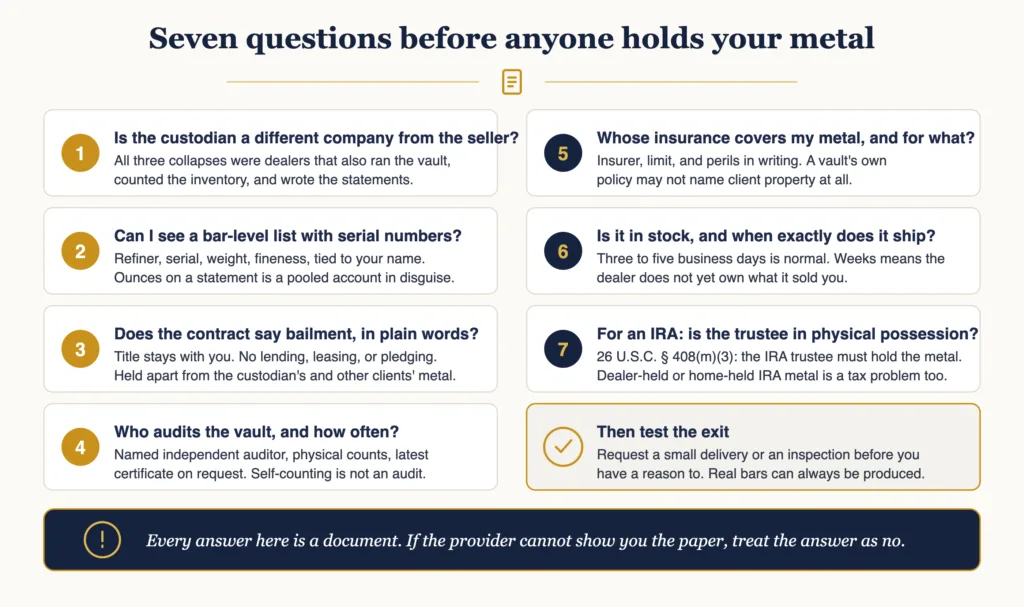
Start by separating the seller from the keeper. All three collapses involved a dealer that also ran the vault, counted the inventory, and issued the statements. When the custodian is an independent depository with its own balance sheet and its own regulators, the dealer’s insolvency is simply not the custodian’s insolvency, and your metal was never on the failed company’s books. Our comparison of offshore and domestic storage options walks through what that separation looks like in practice.
Next, insist on a bar-level record: a document listing each bar or coin lot by refiner, serial number, weight, and fineness, tied to your name. Serial numbers are the evidence a trustee uses to match metal to owners, which is why we spend a whole article on how bar serial numbers work. A statement that shows only ounces is a pooled account wearing a nicer name.
Read the custody agreement for bailment language, stated plainly: title remains with you at all times, the custodian may not lend, lease, pledge, or otherwise use the metal, and the metal is held apart from the custodian’s own property and other clients’ property. If the agreement instead talks about your “entitlement” or “balance”, or lets the provider substitute equivalent metal, you are a creditor.
Then ask who checks. A serious vault names its independent auditor and its insurer, says how often physical counts happen, and can produce the latest certificate on request. Northwest Territorial’s storage customers had a contract. What they lacked was anyone outside the company confirming the vault matched it.
Do not prepay for long lead times. Three to five business days from cleared payment to shipment is normal for in-stock product. Anything quoted in weeks is the dealer telling you it does not yet own what it sold you, and the float risk is now yours. Our older guide to choosing a bullion dealer covers the softer signals, but shipping time is the hard one.
Retirement accounts get one extra rule. The tax code exempts qualifying bullion from the collectibles penalty only when it is “in the physical possession of a trustee” under section 408(m)(3), which in practice means an approved depository. A dealer offering to hold your IRA metal itself, or to help you hold it at home, is offering you a tax problem on top of a custody problem.
Finally, test the exit. Request a small delivery, or ask to inspect your holdings, before you have a reason to worry. Anyone honestly holding your specific bars can produce them.
The question to ask before the headline
I keep coming back to how ordinary the victims in these cases were. They were not chasing yield. They bought a real asset from a real company and either waited for the box or paid a fee to have it kept safe, which is exactly what the industry tells people to do. What failed them was not gold and not storage. It was the gap between owning metal and being owed metal, a gap that stays invisible until a trustee opens the vault. Close it while the question is still hypothetical, because on the day it stops being hypothetical the answer has already been written into someone else’s ledger.