
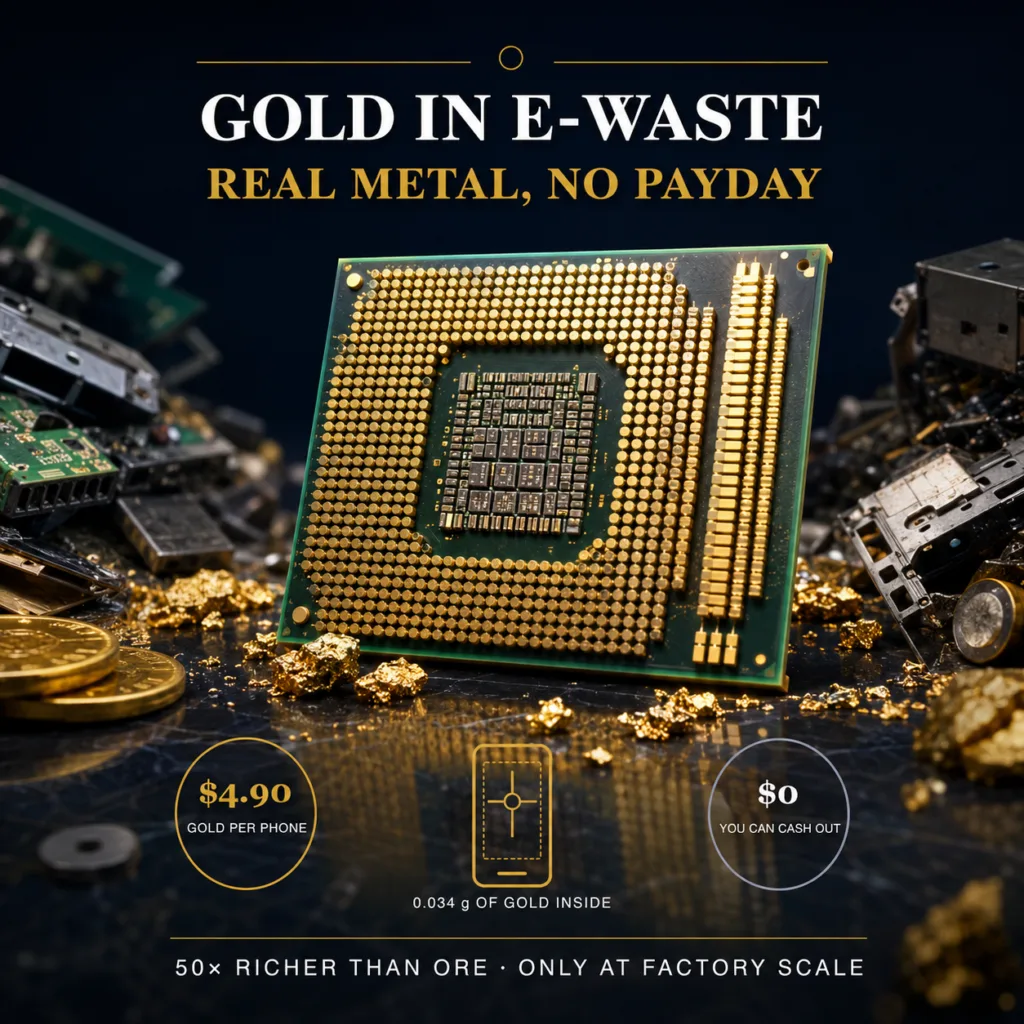
People ask me how much gold is in old electronics more often than you’d think, usually right after they’ve watched a video of someone dissolving circuit boards in a bucket. So here’s the number for the phone in your junk drawer: about 34 milligrams. At the September 3, 2026 spot price of roughly $4,490 an ounce, that’s $4.90 of gold, sealed inside a device you’d need a chemistry lab to take apart. A desktop from the 1990s has more. A vintage ceramic processor has more still. And yes, a ton of circuit boards really does outgrade most gold mines on earth. None of that is going to put money in your pocket, though, and the rest of this article is about why.
Where the gold hides, and why engineers put it there
Gold ends up in electronics for the same reason it ends up in coins. It doesn’t corrode. A copper contact oxidizes and the connection slowly degrades, while a gold-plated one stays clean for decades. That’s why you find gold on the edge connectors of memory sticks, on the pins under a processor, on the contacts inside a SIM tray, and in the microscopic bond wires that tie a silicon chip to its package. The layers are thin, often a few millionths of an inch, and manufacturers have spent thirty years making them thinner.
Because it’s a coating, the age of the device matters more than its size. Engineers in the 1980s and 1990s were generous with plating because gold was cheap and reliability sold computers. Modern designs use a fraction as much, and the industry has been swapping gold bond wire for copper wherever it can get away with it. The U.S. Geological Survey put a memorable number on the older generation of hardware: one metric ton of scrap from personal computers held more gold than 17 tons of gold ore. Worth remembering that the statistic dates from 2001 and describes machines that are now collectibles. Today’s slim laptop wouldn’t come close.
How much gold is in old electronics, device by device
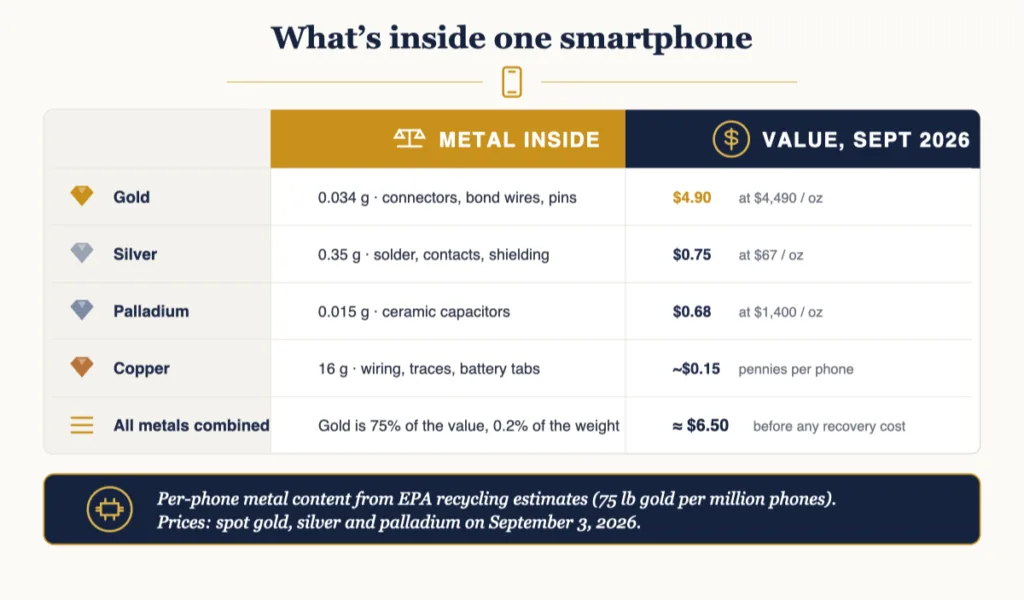
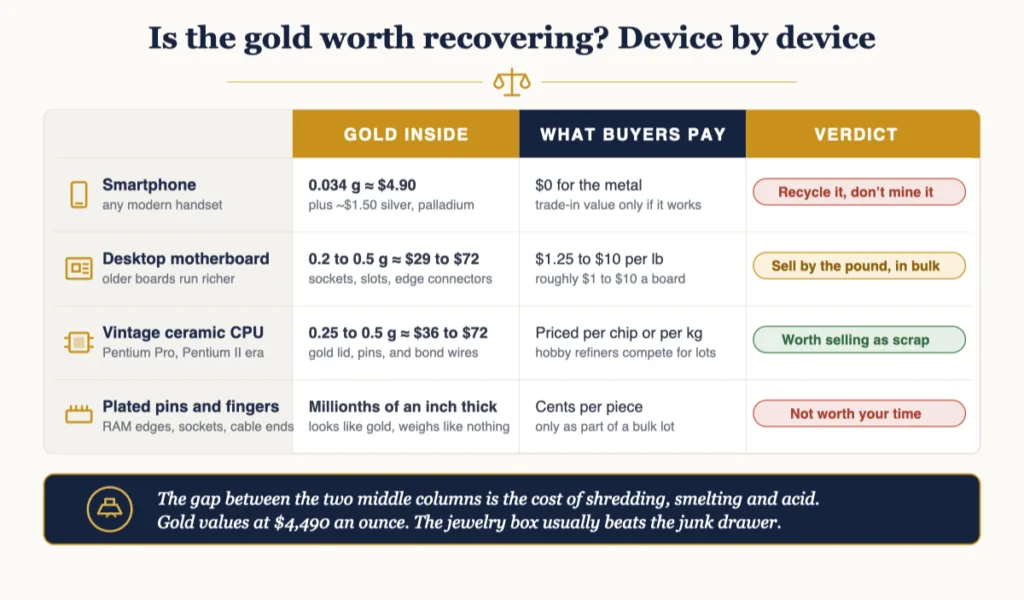
Start with the phone, since that’s what most households have in quantity. The Environmental Protection Agency’s recycling estimate works out to 75 pounds of gold, 772 pounds of silver, 33 pounds of palladium, and about 35,000 pounds of copper for every one million phones. Divide through and each handset carries about 0.034 grams of gold, 0.35 grams of silver, 0.015 grams of palladium, and 16 grams of copper. Priced at September 3, 2026 levels, with silver near $67 and palladium around $1,400 an ounce, the gold comes to $4.90, the silver about 75 cents, the palladium roughly 68 cents, and the copper a dime or two. Call it $6.50 in metal per phone. That assumes you recover every atom, which nobody does.
A desktop is the richer target, mostly because it’s bigger and older. One industry scrap guide puts a full motherboard between two tenths of a gram and half a gram of gold depending on age and quality, most of it in the CPU socket and the expansion slots. At today’s price that’s $29 to $72 of gold on a board weighing about a pound. Laptops fall in between. Servers and telecom boards from the same era run richer, because uptime mattered and nobody trimmed the plating budget on a machine that couldn’t be allowed to fail.
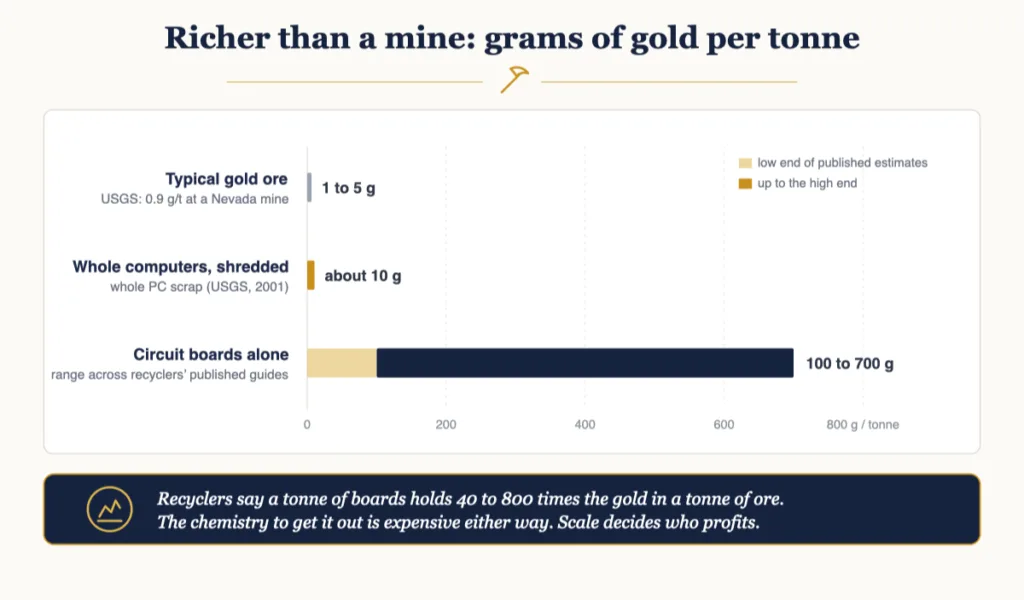
Put a tonne of boards together and the grade gets startling. The USGS footnote behind that 17-to-1 figure assumed 10.4 grams of gold per tonne of whole computer scrap against 0.9 grams for a Nevada heap-leach mine, and recyclers’ own price guides claim a tonne of boards alone holds 40 to 800 times the gold in a tonne of ore. I’ve seen the lower figures disputed and the higher ones treated as marketing, but even the skeptical version is a grade any mining company would kill for.
Then there are the famous ones. Ceramic processors from the Pentium Pro and Pentium II era carry gold on the lid, on the pins, and in the internal wiring, and scrap guides estimate a quarter to half a gram per chip. That’s $36 to $72 in gold on a component the size of a matchbook, which is why old chips sell by the pound to hobby refiners and why a Pentium Pro is worth more today as scrap than it ever was as a computer. If you have a shoebox of those, you have something. A shoebox of phones is a different story.
The math on a drawer full of old phones
The average American household now keeps 1.8 unused smartphones, according to Allstate Protection Plans’ 2025 mobile survey, and a June 2026 survey of 4,000 consumers found that 39 percent of Americans just store their old devices in a drawer rather than recycle or resell them. Picture a generous version of that drawer. Ten phones, two tablets, one old laptop. The gold inside all of it is somewhere around half a gram, or about $70. Count every other metal too and you might reach $100. And that’s the ceiling, before a single dollar of recovery cost.
Scale is the whole story here, and it’s the point the recyclers are making when they quote that one-million-phone figure. A million handsets hold about 1,094 troy ounces of gold, worth $4.9 million at current prices, plus three quarters of a million dollars of silver and about the same in palladium. Real revenue, if you own a shredder and a smelter and employ a few chemists. Meaningless if you own ten phones, no matter how many tutorials you watch.
Why you can’t simply cash it in
Follow the gold on a circuit board through the process that turns it into a bar. The board gets shredded. The metals get separated from the plastic and fiberglass. The concentrate is smelted with copper as a carrier, the copper is electrolytically refined, and the precious metals drop out in the sludge, which then goes through more chemistry before anything that looks like gold appears. Every step costs money, loses a little metal, and produces waste that has to be handled legally. An industrial refiner spreads those costs across thousands of tonnes a year. You’d be spreading them across a shoebox.
Which is why scrap buyers pay what they pay. Modern small-socket motherboards trade at roughly $1.25 to $3 a pound in 2026, and the older large-socket boards that hobby buyers and small refiners fight over bring $3 to $10. Against $29 to $72 of gold content, a $2 offer looks like robbery. It isn’t, or at least not usually. The buyer is taking on the shredding and the smelting and the acid and the hazardous waste, and still has to make a margin. What you’re seeing in that gap is what it costs to turn plating back into bullion.
I understand the appeal of doing it yourself. I’ve watched the same videos. The standard chemistry uses nitric acid to strip the base metals, then aqua regia, a mix of nitric and hydrochloric acid, to dissolve the gold before you precipitate it back out, and it does work. It also gives off nitrogen dioxide, a poisonous reddish-brown gas, which is why the University of Illinois safety office requires every step to happen inside a fume hood. The spent solution is a hazardous waste laced with lead and tin and whatever else was on the board. A university lab has a neutralization protocol and a disposal contract. A garage has a window. A study of informal e-waste sites in Nigeria, where people do this for a living, found cumulative cancer and non-cancer exposure risks above acceptable limits at every site measured. Seventy dollars is not worth breathing that.
Who actually makes money on e-waste gold
The people making money solved the scale problem first. The Royal Mint opened a plant in Llantrisant, South Wales, in August 2024 built to process up to 4,000 tonnes of circuit boards a year using a room-temperature chemistry from a Canadian firm called Excir. When the project was announced in 2023, the target was 500 kilograms or more of pure gold a year, and the recovered metal now goes into the Mint’s own jewelry line. So that’s a national mint, a purpose-built factory, and boards arriving by the truckload under contract. The economics work at that altitude. I haven’t seen them work anywhere below it.
You can see why they bothered. The Global E-waste Monitor 2024, published by the United Nations Institute for Training and Research with the International Telecommunication Union, counted 62 million tonnes of electronic waste in 2022 carrying $91 billion of metals, $15 billion of it gold. Only 22.3 percent of that mass was documented as formally collected and recycled. Gold has more than doubled since the survey period, so the unrecovered pile is worth more now than when the report was written, and every major refiner knows it. When you read a headline about urban mining, that’s who it’s about.
Where the gold in your house actually is
Here’s the part I wish those videos would mention. Most homes do contain gold worth recovering. It just isn’t in the electronics. The junk drawer of phones holds about $70 in gold that nobody can get at. The jewelry box, meanwhile, probably holds a broken 14 karat chain, one earring whose partner vanished years ago, maybe a class ring, and that pile can be walked into a buyer this afternoon and sold at a price you can check yourself first. A 14 karat chain weighing 10 grams carries 5.83 grams of pure gold, worth about $840 at today’s spot. The arithmetic is in our guide to calculating melt value, and it takes a kitchen scale, not a fume hood.
The same logic that applies to circuit boards applies to jewelry marked gold-plated or gold-filled, and it’s worth knowing the difference before you drive anywhere. Plated pieces carry roughly the same microscopic film as a connector pin, so a buyer will offer nothing for them. Gold-filled is a thicker mechanical layer and sometimes pays a little. Solid karat gold is the only category where the buyer is paying for the metal itself, and our piece on vermeil, gold-filled, plated, and solid gold shows how to read the stamps. If the stamps are worn off, the guide to gold fineness and hallmarks covers how a buyer tests purity instead.
As for the electronics, send them where the scale exists. Trade-in programs pay for working phones. Manufacturer and retailer take-back programs will accept dead ones for free and feed them into the industrial chain that can recover the gold. If you’re sitting on vintage hardware, the ceramic processors and the old gold-heavy boards, a specialist e-scrap buyer will pay by the pound and sometimes by the piece. Everything else is a recycling problem with a few dollars of metal attached, and treating it as a treasure hunt is how people end up with a garage that smells of acid and a pile of blackened fiberglass they can’t legally throw away.
What to do with this
I still find it satisfying that a phone contains gold. It’s a reminder that the metal earns its place through chemistry, not tradition, and sealing a few milligrams into something that has to survive a decade in a pocket is precisely the job gold is good at. The catch is that the same property that makes it useful, being spread across the device in films too thin to see, is what makes it uneconomic to recover on any scale smaller than a factory. The mint in Wales can do it. A refiner with a smelter can do it. You and I can’t. The sooner that sinks in, the sooner you stop pricing the junk drawer and start weighing the jewelry box, which is where the money was the whole time. And if you’d like a second opinion before selling any of it, the guide to the best place to sell gold walks through what each kind of buyer will and won’t pay for.