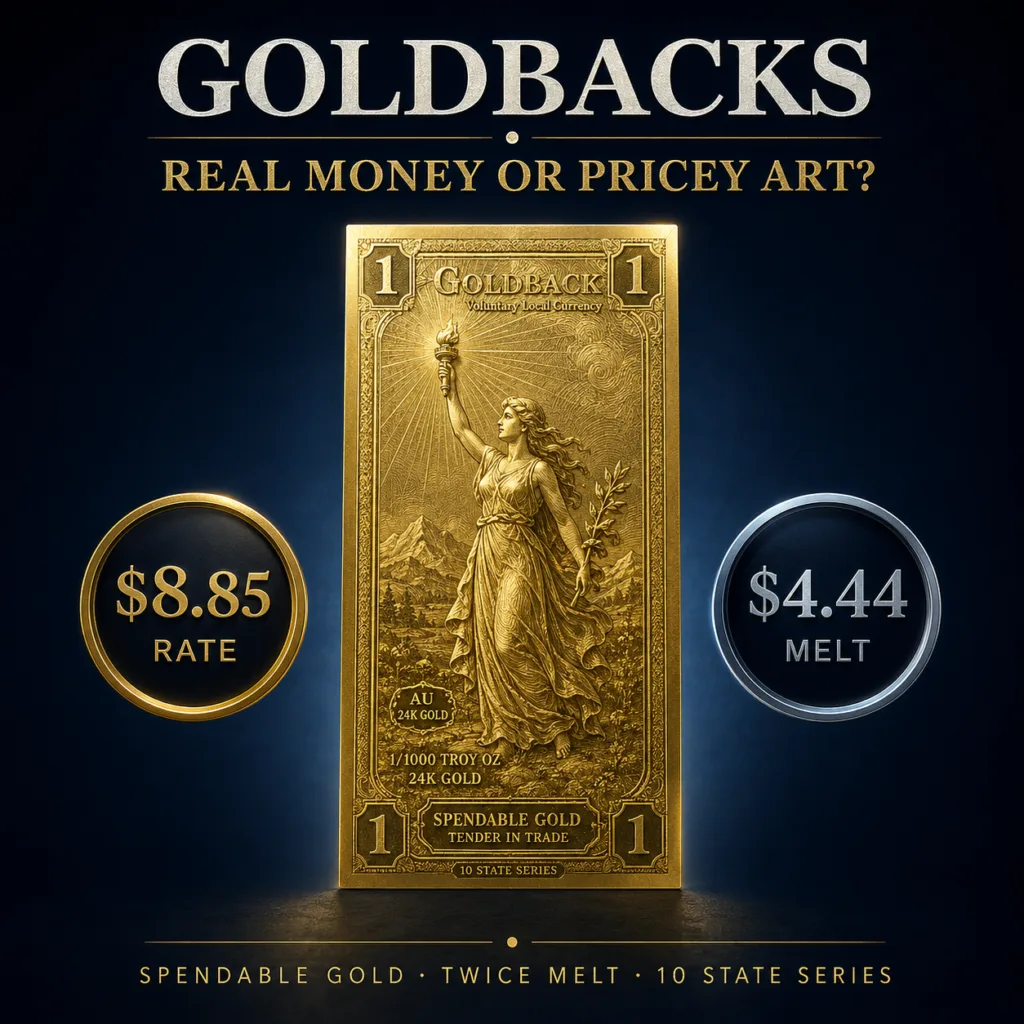
Both, honestly. Goldbacks are real gold, every note carries a measured layer of 24 karat metal sealed inside it, and you can verify the content yourself. The same note also costs about twice what that gold is worth melted down. On the last day of August 2026, the official goldback exchange rate stood at $8.85 for a 1 goldback note holding 1/1000 of a troy ounce. Spot gold traded near $4,435 that day, which makes the metal inside worth about $4.44. Pay $8.85, get $4.44 of gold. Whether that is a rip-off or a fair price for something genuinely new depends on what job you want the note to do. The sales pages never run this math, so I will.
What a goldback actually is
A goldback is a small polymer note, close to paper money in size and feel, with a layer of .9999 fine gold sealed inside. Goldback, Inc., the Utah company behind them, launched the first series in 2019 using a vacuum deposition process patented by Valaurum: gold gets vaporized in a vacuum chamber, bonded onto the polymer in a layer measured to the denomination, then laminated so it cannot flake off in a pocket. The finished product looks more like an engraved banknote than a bullion product. Each state series carries its own allegorical artwork, and the designs are genuinely good.
Counterfeiting gets handled the way banknotes handle it, with UV security ink, serial numbers, and micro detail in the art, plus one trick paper cannot copy. Gold thin enough to pass light through takes on a distinct blue-green hue, so a strong flashlight held behind a real goldback glows green. Valaurum measures that transmitted spectrum on every production run, and you can run the crude version of the same check at your kitchen table.
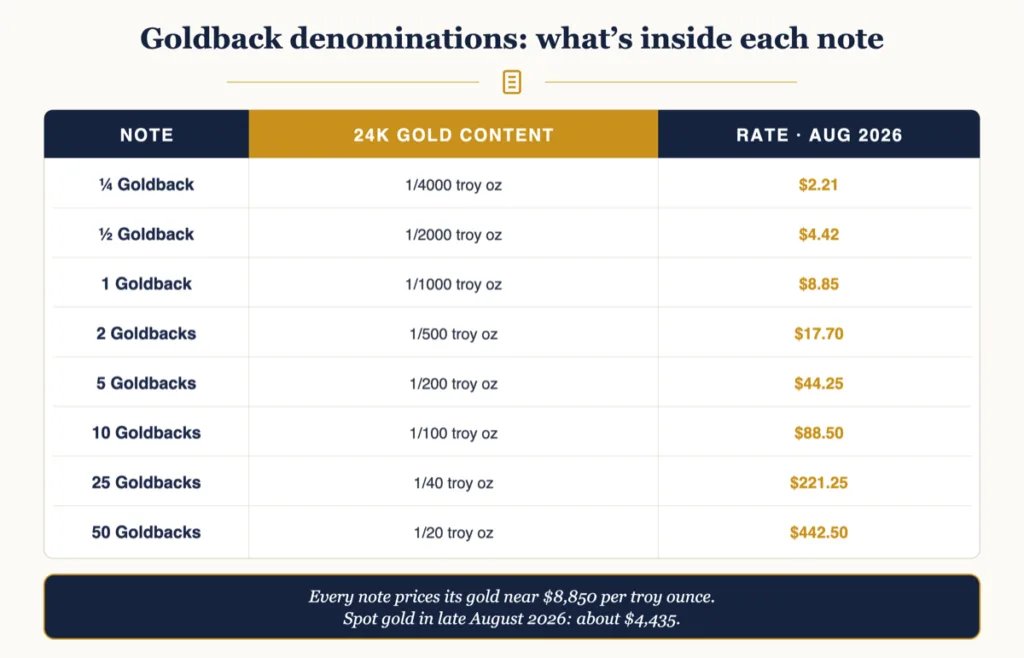
The lineup runs eight denominations. A quarter goldback carries 1/4000 of a troy ounce, a half carries 1/2000, and the scale climbs through 1, 2, 5, 10, and 25 to the 50, which holds 1/20 of an ounce. The proportions are exact, and that is the point. A 50 is always worth fifty times a 1, so the notes behave like denominations of one currency instead of a pile of individual collectibles with fuzzy values.
The Utah experiment spread. As of 2026 there are ten state series in circulation: Utah, Nevada, New Hampshire, Wyoming, South Dakota, Florida, Oklahoma, Arizona, Idaho, and California, plus single note issues for Dallas-Fort Worth and Washington, D.C. Idaho’s series introduced the quarter goldback, the smallest denomination the company has made. None of this requires any state’s permission, by the way. A “Nevada” goldback is a design theme, not a government issue.
The exchange rate, and what you are really paying per ounce
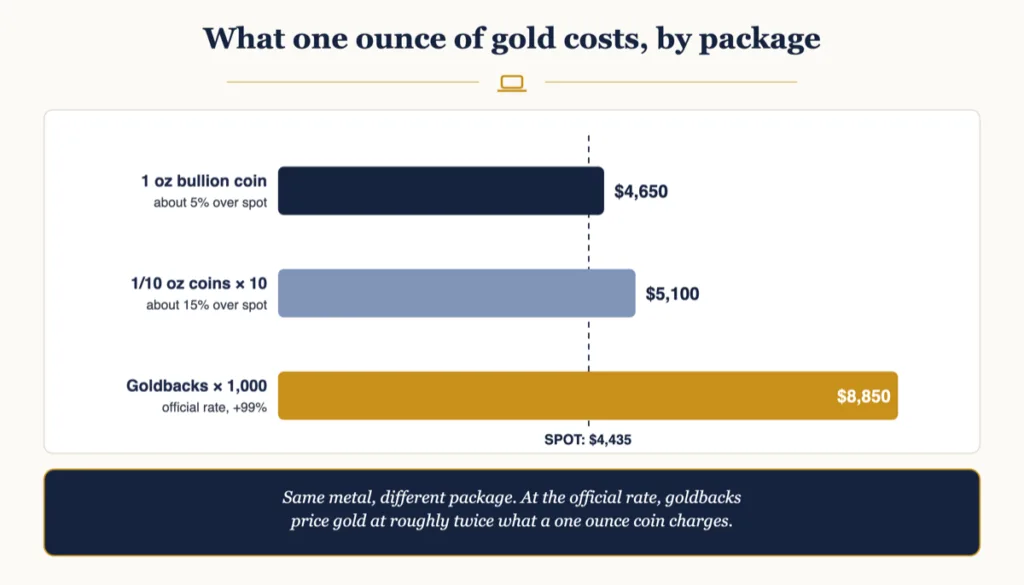
Goldback, Inc. publishes an official exchange rate every day at 10 a.m. Mountain time. People routinely mistake that number for the value of the gold in the note. It is not. It is the company’s suggested retail price, and the two figures live far apart. At the August 31, 2026 rate of $8.85, a 1 goldback prices its 1/1000 ounce of gold at the equivalent of $8,850 per troy ounce. Spot gold traded between $4,400 and $4,470 that same day.
Flip the math around and the premium shows itself. Melt value of a 1 goldback: about $4.44. Official rate: $8.85. That is a 99 percent markup at the publisher’s own posted price, before any dealer adds margin on top. For comparison, a one ounce American Gold Eagle typically sells 4 to 6 percent over spot. Even small fractional coins, the most expensive mainstream way to buy gold, run 10 to 18 percent over melt. I wrote about how those markups work in the gold premium trap, and goldbacks sit in a category of their own: the highest premium gold product that ordinary buyers purchase in volume.
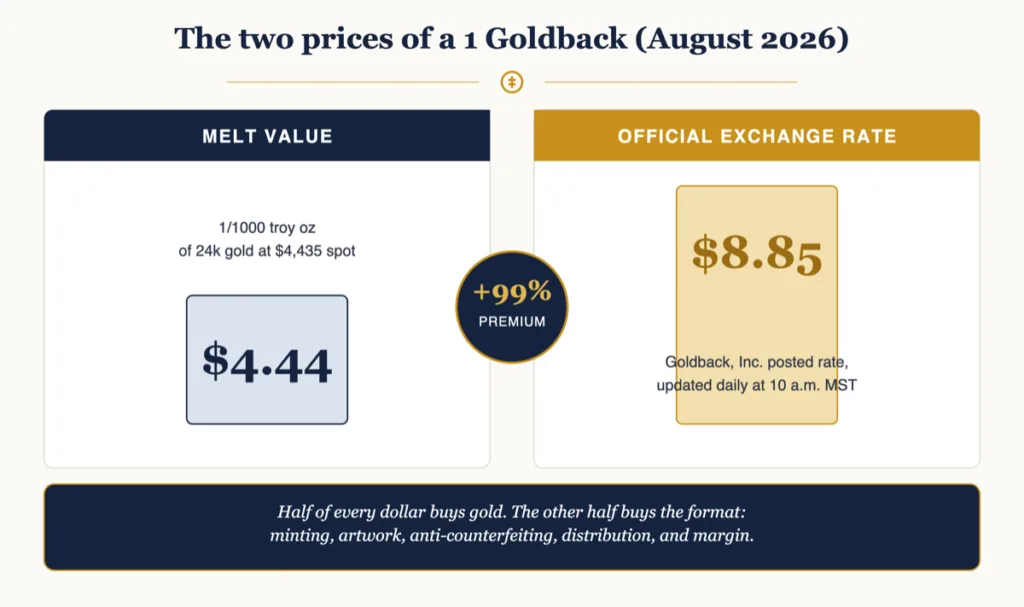
Where does the extra dollar for every dollar of gold go? Some of it is real cost. Vapor depositing gold a few thousandths of an ounce at a time costs far more per ounce than pouring kilo bars, and a production run in the thousands has to carry overhead that a major mint spreads across millions of coins. The artwork is not free either. The rest is margin for the company and its distributor network. Goldback’s defense is that the premium has held steady for years, so a buyer who later sells at the prevailing rate gets most of it back. Broadly true so far. It is also a promise that depends on the goldback market staying healthy, and that is the thing I would sit with before paying double melt.
Can you actually spend them?
The pitch is that a goldback is currency, meant to circulate rather than sit in a safe. The company says its notes are accepted by thousands of independent businesses that take goldbacks voluntarily as payment, with the deepest acceptance in Utah, where the whole project began. Coffee shops, barbers, contractors, farm stands. There is even a calculator and a phone app so a cashier can price your groceries in notes at the day’s rate. In sound money circles, paying for eggs with a goldback is a small act of monetary independence, and I understand the appeal. There is something clarifying about a transaction where the money itself is the settlement.
The legal reality is narrower than the marketing sometimes implies. Goldbacks are not legal tender. No merchant anywhere in the United States has to accept them, and the federal government does not recognize them as money. Even Utah’s Specie Legal Tender Act, the friendliest law on the books, only covers gold and silver coin issued by the United States, and it says outright that no one can be compelled to accept specie. Privately issued notes sit outside the definition unless a court or Congress someday decides otherwise. Acceptance is a merchant by merchant handshake, nothing more.
Taxes add one more wrinkle to the spending dream. The IRS treats physical gold as a collectible, so spending an appreciated goldback on groceries is technically a taxable disposition of property, exactly as if you had sold it. The rules are the ones I covered in the piece on the 28 percent collectibles tax. Nobody is auditing $9 coffee purchases. But anyone planning to move serious value through goldbacks should know the framework applies.
Selling them back is where the premium gets tested
A one ounce Eagle sells in thirty seconds anywhere on earth at a price everyone can look up. A goldback sells into a much smaller market, and what you get depends on who is buying. Dealers plugged into the goldback network typically pay somewhere below the daily exchange rate, keeping a spread of a few percent. A bullion dealer with no goldback clientele will price the note as what it physically is, a very small amount of gold in an unusual package, and offer something closer to melt. Early notes also trade on eBay as collectibles, where prices follow collector mood more than gold. Between those buyers sits the whole question of whether your premium survives the round trip.
So far the resale market has held up. The exchange rate has climbed alongside gold since 2019, and established dealers do buy goldbacks back. Still, be precise about what actually protects your money here. The gold content puts a hard floor under the note at roughly half of what you paid, and everything above that floor rests on people continuing to want goldbacks specifically. The company’s own performance claims deserve scrutiny on this point. Its published figure of roughly 14 percent average annual appreciation since 2019 sounds impressive until you notice that spot gold itself compounded at close to 18 percent over the same stretch. The note’s track record is mostly the metal’s track record, wearing nicer clothes.
Where goldbacks fit, and where they don’t
As a pure way to own gold, goldbacks lose to almost everything. A stacker chasing ounces per dollar should buy the largest coin or bar the budget allows, and if the budget is small, the fractional gold guide covers options at a fraction of the goldback premium. And if the real goal is barter insurance, small hard money for a rainy decade, 90 percent silver does the same job at a tiny markup: with silver near $66 an ounce, one pre-1965 dime carries about $4.80 of metal, close to a 1 goldback’s melt value, for a small premium instead of a doubled one. The junk silver guide runs those numbers in detail.
As working monetary art, though, goldbacks get a lot more interesting. They solved a genuinely hard problem. Gold’s biggest failure as everyday money was always divisibility, and nobody before Valaurum’s process could put a thousandth of an ounce in your hand in a form that survives a wallet. The notes are beautiful. The state series give collectors a reason to keep sets intact, which quietly props up the resale market. And for the people who specifically want to transact in gold, in the places where merchants play along, nothing else does the job at all.
So the verdict follows the math. Buying gold to hold wealth? The premium is disqualifying, full stop: every $1,000 spent at the goldback rate buys about $500 of actual metal. Buying a spendable, collectible form of gold with your eyes open about the markup? Then goldbacks deliver something no coin or bar can, and a small stack is a defensible indulgence. Just be honest with yourself about which purchase you are making. The note will not tell you. It says real gold on both answers.