
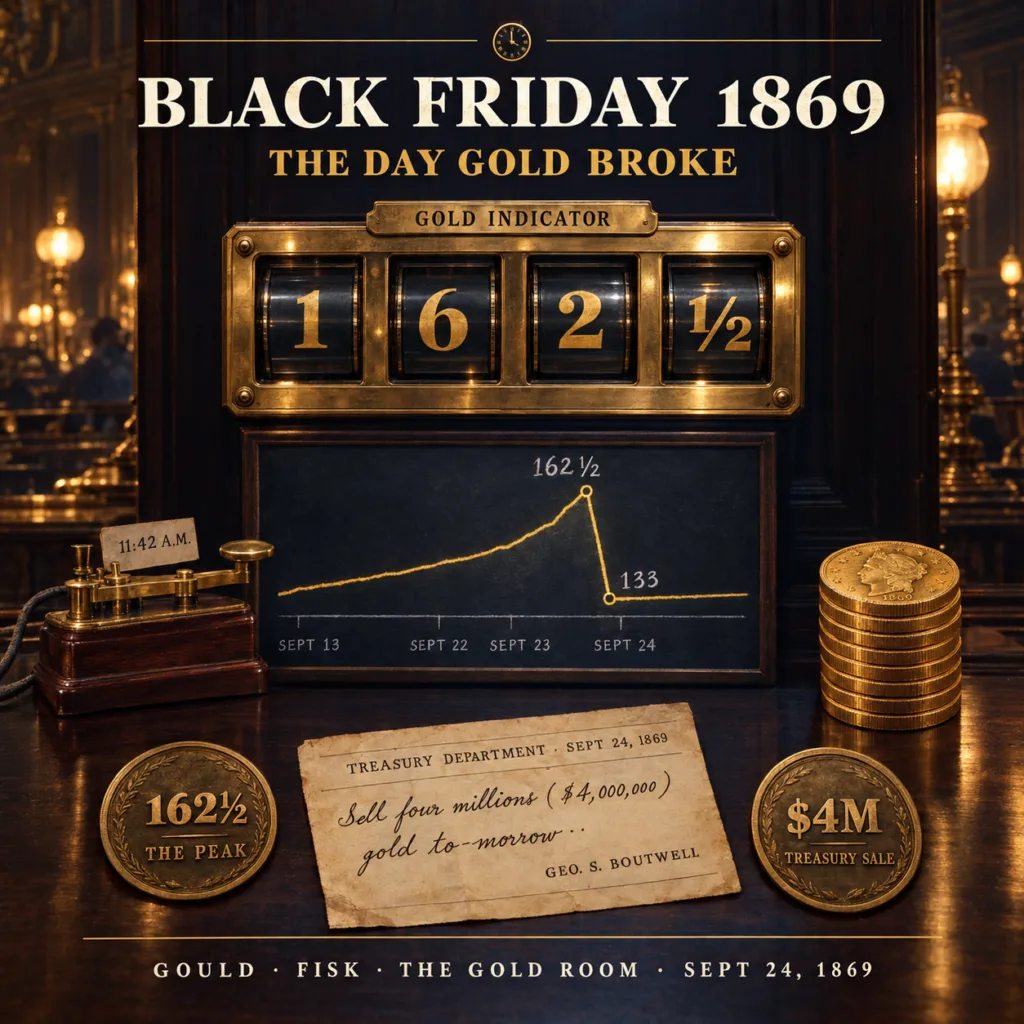
A few minutes before noon on Friday, September 24, 1869, a broker by the little fountain in the middle of New York’s Gold Room bid 160 for any part of five million dollars in gold. Nobody answered. The bid went to 161, then 162. Then a quiet voice said, “Sold one million at 162”, and the boldest market corner in American history began to come apart. Within fifteen minutes gold was at 133. That was Black Friday 1869, the day Jay Gould and Jim Fisk came within a few points of owning the price of gold, and the day the U.S. Treasury took it back with one sentence sent by telegraph.
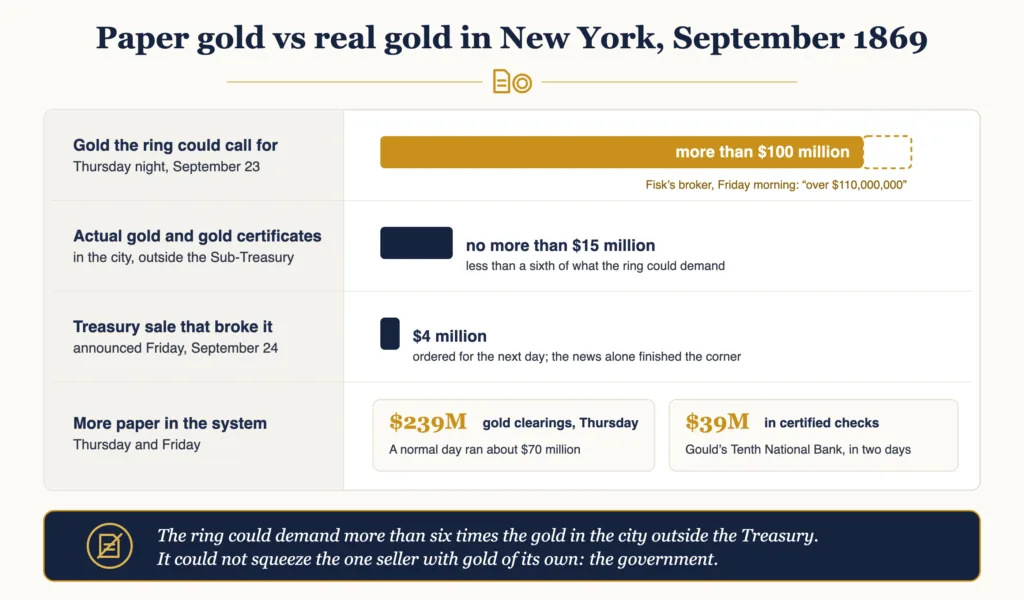
Gould, president of the Erie Railroad, had spent the summer buying gold and cultivating President Ulysses S. Grant’s brother-in-law, betting that Washington would stop selling Treasury gold. In mid-September his vice president, Jim Fisk, joined in, and by Thursday, September 23, they held calls on more than $100 million of gold in a city with no more than $15 million of actual gold and gold certificates outside the government’s vault. On Friday, Treasury Secretary George Boutwell announced a $4 million sale, the price collapsed, and in one witness’s words, half of Wall Street was involved in ruin.
What “gold at 162” meant in 1869
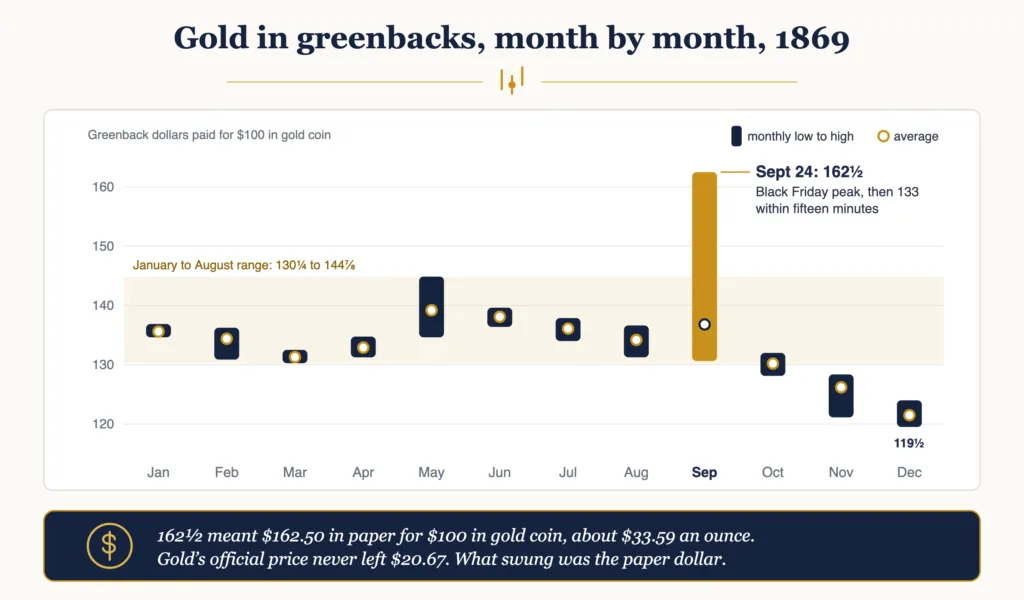
The number on the Gold Room’s board was not a price per ounce. To pay for the Civil War, Congress issued greenbacks, paper dollars that could not be swapped for coin, and as the Library of Congress guide to Black Friday explains, the rate between the two floated from day to day. Gold coin was still required for customs duties and foreign trade. The House committee that investigated the panic put it plainly: for internal trade gold was “an article of merchandise”, but for foreign commerce “it is our only currency”.
So the Gold Room quoted the price of $100 in gold coin in greenbacks. One witness put it in working terms: a man who bought $10,000 of gold wrote a check for $12,000 of currency, with gold near 120 that winter. Gold’s official price never moved. It sat at $20.67 an ounce, a rate that, as the Federal Reserve’s history notes, held until 1933, the year of Executive Order 6102. By that math Black Friday’s recorded high of 162½ put an ounce of gold at about $33.59 in paper money. The Gold Room was trading a running verdict on the greenback, and Gould wanted to write the verdict himself.
The plan: buy the gold, then borrow the President
Gould’s pitch was cleverer than a plain squeeze. On June 15, Grant rode one of Gould and Fisk’s Fall River steamers toward Boston, and over a 9 p.m. supper the two men tried to talk him out of pushing gold down. Grant listened, then, by Gould’s account, said there was “a certain amount of fictitiousness about the prosperity of the country”, and that “the bubble might as well be tapped in one way as another”. Gould testified that the remark “struck across us like a wet blanket”. Back in New York the pair settled on the argument they would press on Washington, in the committee’s summary: “to move the fall crops and secure the foreign market for our grain”, gold had to rise to 145. A higher premium would make American wheat cheaper abroad, more grain would roll east, and plenty of it would ride the Erie.
So the ring worked on the family instead. Abel Rathbone Corbin, a speculator who had married Grant’s sister Jennie, became their window into the White House. Gould bought $1.5 million of gold for Corbin’s account in two lots, without asking for any margin, and on September 6 paid him $25,000, a week’s profit on the smaller lot. From then on, the committee noted, every one-point rise in gold put another $15,000 in Corbin’s pocket.
The pair also cared who would be Assistant Treasurer in New York, the official who carried out the Treasury’s gold sales. After Corbin’s stepson-in-law, Robert Catherwood, declined to be their candidate, they attached themselves to Daniel Butterfield, a Union general who took office on July 1. Gould swore he had bought $1.5 million of gold for Butterfield too. Butterfield denied it under oath, though he admitted receiving a $10,000 check Gould had endorsed to him, which he said had nothing to do with gold.
The week the corner closed
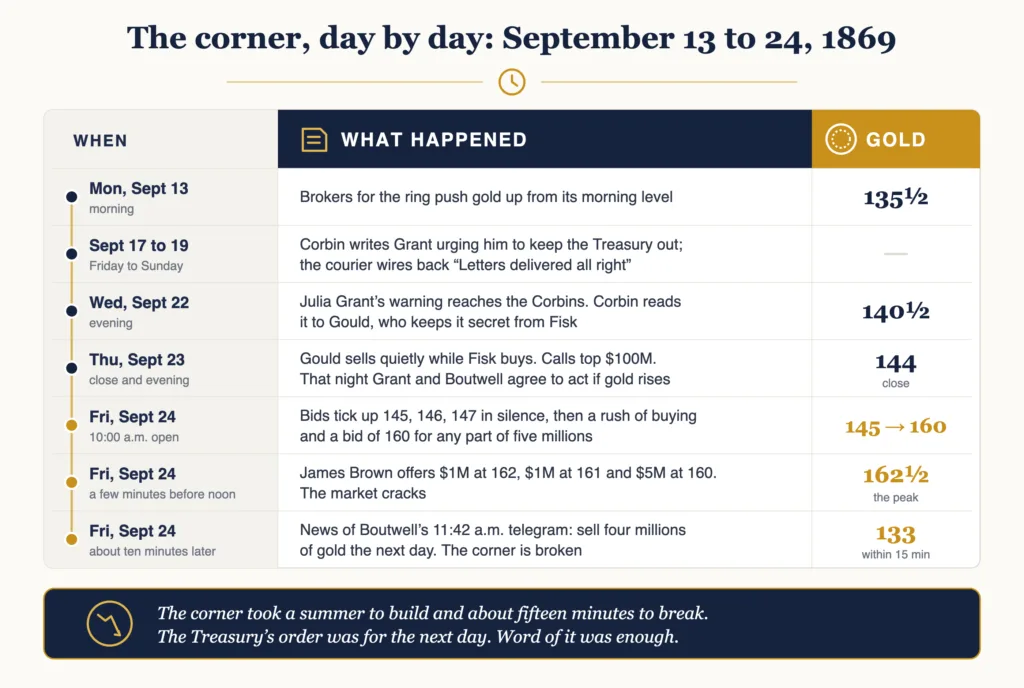
The ring pushed gold from 135½ on the morning of September 13 to 140½ on the evening of Wednesday the 22nd. Grant had written Boutwell on September 12 that “a desperate struggle is now taking place, and each party wants the government to help them out”, and advised changing nothing until it was over. On the evening of the 17th, Gould and Corbin agreed that Corbin should write the President urging him to keep the Treasury out of the market. Fisk’s courier, W. O. Chapin, carried the letter to Washington, Pennsylvania, and wired back “Letters delivered all right”. Fisk took that as the President’s blessing and bought harder. Chapin meant only that the letters had been handed over.
The letter backfired. Along with newspaper talk that Corbin had turned into a big gold bull, it made Grant suspicious, and he had Julia Grant write to her sister-in-law. As Corbin recalled it, she wrote that the President was “greatly distressed” at the rumor that her husband was speculating in Wall Street and hoped he would “instantly disconnect himself”. On September 22 Corbin read it to Gould and said he wanted out. He later testified that Gould offered him $100,000 to stay in the pool.
Gould’s real answer was to sell, quietly. “I was a seller of gold that day”, he testified about Thursday, September 23. “I purchased merely enough to make believe that I was a bull”. Fisk, who knew only that Corbin was nervous, kept buying through his former partner William Belden and offered to bet any part of $50,000 that gold would sell at 200. Gold closed Thursday near 144. The gold clearing house, which normally handled about $70 million a day, handled $239 million. The Tenth National Bank, which Gould controlled, certified $39 million of checks in two days, far more than its cash could cover. That evening in Washington, Grant and Boutwell agreed that if the price went higher, the government would act.
Black Friday 1869 in fifteen minutes
The Gold Room opened at 10 a.m. A newspaper account that broker James B. Hodgskin read into the committee’s record describes bids of 145, 146, 147, 148 and 149 called one after another, “all amid deathlike silence”. At 150 the room broke into a scramble as frightened shorts bought at any price. Clique brokers pulled merchants who had borrowed the ring’s gold into back offices and warned them they would pay 200 the next day unless they settled now. Hodgskin estimated that close to $50 million was sold that way, at 148 to 155.
The committee credited the break to James Brown, a Scottish banker leading the bears. In its account he offered a million at 162, another at 161 and five million at 160, and the market cracked. Brown’s own testimony put his sales, $7 million in all, at 150 to 160. About ten minutes later word arrived that the Treasury would sell.
Soon after 11 a.m. Boutwell called at the White House. Grant suggested selling $5 million, Boutwell had $3 million in mind, and back at his office he settled on $4 million and dictated a telegram to Butterfield, logged as sent at 11:42 a.m. Washington time: “Sell four millions ($4,000,000) gold to-morrow, and buy four millions ($4,000,000) bonds”. It was not even in cipher. Look at the word “to-morrow”. The Treasury was not delivering an ounce on Friday. Brown’s selling cracked the market, and the announcement finished it. Within fifteen minutes gold fell from 160 to 133.
The machinery could not keep up. The committee heard that price indicators in brokers’ offices fell behind the market and that telegraph wires were “melted or burned off” by operators trying to keep pace. Thomas Edison, a young telegrapher who had recently become superintendent of Samuel Laws’s gold reporting company, watched from the top of a Western Union booth as crowds jammed New Street and Broad Street. In his account, from the 1910 biography Edison: His Life and Inventions, a Western Union operator walks over to him: “Shake, Edison, we are O. K. We haven’t got a cent”.
Who paid for Black Friday, and who didn’t
The ring’s first move after the crash was to stop paying. Gould and Fisk repudiated the purchases made through Belden, about $70 million in all, and the committee concluded they had bought Belden’s consent “either before or after the fact”. The New York Fed’s account says Gould paid off Boss Tweed and friendly judges to delay settling trades that went against him, and that stocks fell 20 percent as shorts dumped other securities to cover. The gold clearing house, the committee wrote, was “suffocated under the crushing weight of its transactions”, and its doors were closed. For the first part of October, with the Gold Exchange shut, gold was dealt on the Stock Exchange, according to Wesley Mitchell’s 1908 history. Fisk summed it up for the committee: “It was each man drag out his own corpse”.
Neither Gould nor Fisk spent a day in jail. The House Committee on Banking and Currency, chaired by future president James A. Garfield, reported on March 1, 1870 that the attempts to compromise the President or his family “utterly failed”. Butterfield resigned in October. How much Gould kept has never been settled. The Library of Congress guide cites an estimate of nearly $12 million, and the New York Fed says he escaped with his wealth intact.
The strangest footnote came in 2016, when two Federal Reserve authors on the New York Fed’s blog argued that Gould’s diagnosis was reasonable: tight money had squeezed debtors since the war, and the economy had slipped into recession in June 1869. His remedy just happened to make him rich first.
Could anyone corner gold today?
Not the way Gould tried. His plan needed a market small enough to own and one seller, the Treasury, big enough to break it. Neither holds now. The World Gold Council’s market primer says gold traded a record $361 billion a day on average in 2025, about 3,000 tonnes changing hands daily. Since 2022, federal position limits have capped how many COMEX gold contracts one trader can hold in the delivery month.
Manipulation has not disappeared. It has become faster and smaller. In 2020 JPMorgan paid a record $920 million to settle CFTC charges that its traders spoofed precious metals and Treasury futures from 2008 through 2016. Silver was thin enough in 1980 for the Hunt brothers to try a corner of their own, and in 1968 the London Gold Pool showed that governments cannot hold a price down forever either.
The part of Black Friday 1869 that has aged best is what the ring owned. On Thursday night Gould and Fisk looked like masters of the gold market, and on paper they were: calls, contracts, and certified checks from a bank they controlled. Very little of it was metal. Asked why he had feared a Treasury sale at all, Fisk gave the committee the best line of the whole affair: “O, our phantom gold can’t stand the weight of the real stuff”. When the break came, the promises were repudiated. People holding contracts got lawsuits. People holding coins still had coins, worth less in paper than the day before, but theirs.
The detail I find most telling is Thursday. The man who built the corner stopped trusting it a day before it broke, and he was selling while Fisk was still in the Gold Room offering bets. For anyone holding gold today, the lesson is less about villains than about plumbing. Know whether you own metal or a promise of metal, and know who stands behind the promise, which is the whole question behind allocated vs unallocated storage.