
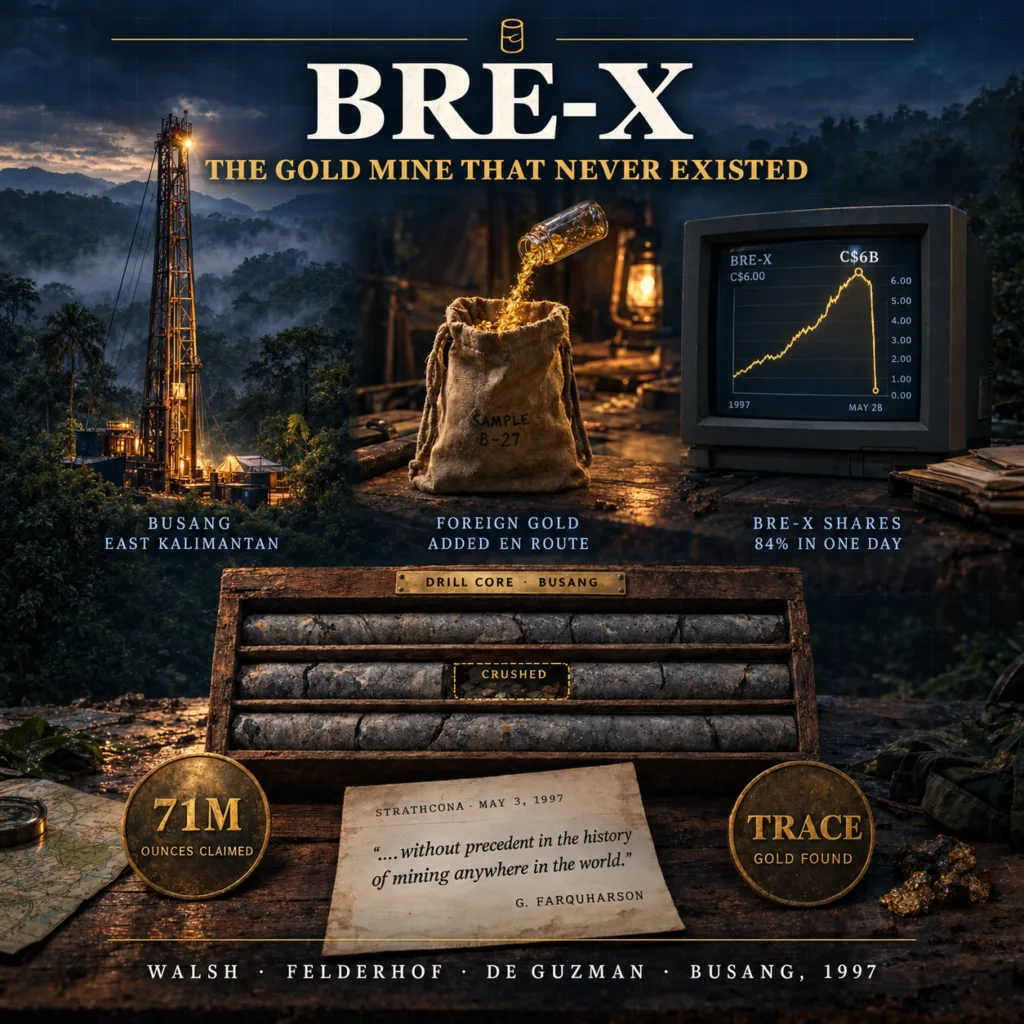
On May 4, 1997, Bre-X Minerals of Calgary released a letter from its own auditor that turned the Bre-X scandal from a suspicion into a fact. Since mid-1995 its drilling at Busang, deep in the Borneo jungle, had fed expectations of one of the largest gold deposits ever found, 71 million ounces by the company’s last count, and the market had once valued it at 6 billion Canadian dollars. Strathcona Mineral Services drilled its own holes and found “only trace amounts of gold.” The tampering with Bre-X’s samples that Strathcona believed had occurred was, Graham Farquharson wrote in the cover letter Bre-X published that day, of a scale, over a period of time and “with a precision that, to our knowledge, is without precedent in the history of mining anywhere in the world.”
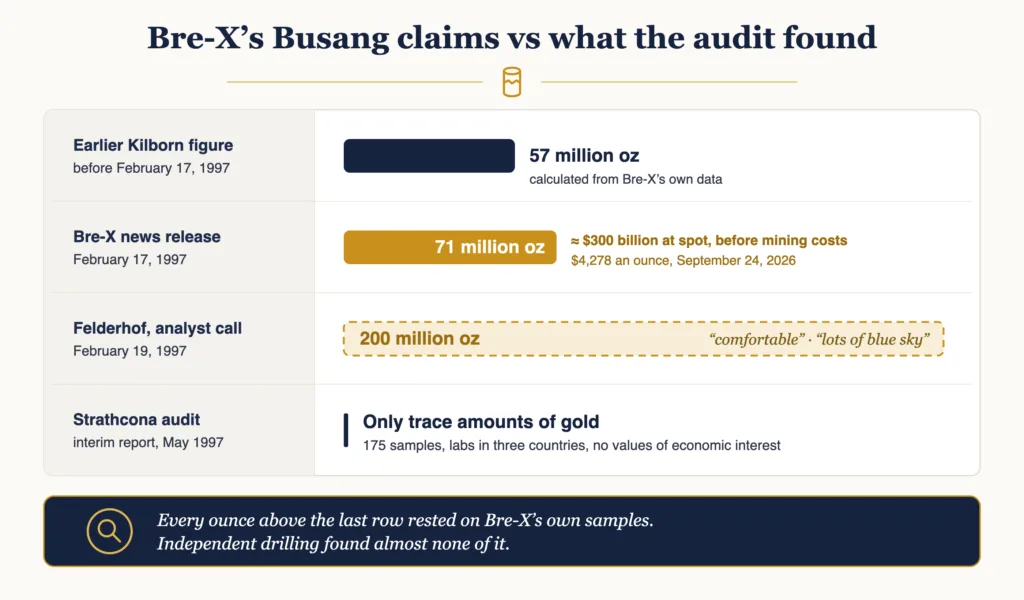
At $4,278 an ounce, where spot gold stood on the morning of September 24, 2026, those 71 million ounces would be worth about $300 billion before a dollar of mining cost. What should bother anyone who owns gold is simpler. The laboratory that tested Bre-X’s samples did its job properly. The fraud happened before the bags reached the lab.
From a Calgary basement to the gold find of the century
David Walsh was bankrupt when it started. In 1993, working from his Calgary basement, according to the Associated Press, he took the advice of John Felderhof, a geologist who had left Halifax for Asia in his twenties, and bought into a property along the Busang River in East Kalimantan, on the Indonesian side of Borneo. The drilling was run by Michael de Guzman, a Filipino geologist who had spent a decade exploring for Manila-based Benguet Corp., with a crew that included Cesar Puspos, who had worked under him at Benguet.
Felderhof said he knew they had something when they drilled line 59 in 1995, three holes 150 meters apart. “That’s when I called David up and said, ‘We’ve got a monster by the tail,'” he told a Maclean’s reporter in February 1997. Bre-X shares climbed from pennies to C$286.50 in May 1996, according to the Nova Scotia Securities Commission. Analysts toured the site with de Guzman that summer, and Lehman Brothers’ Daniel McConvey wrote that if Lehman’s aggressive assumptions held, “in five years Busang may be the largest-producing gold mine in the world.”
Investors took comfort from resource figures calculated by Kilborn Engineering, part of SNC-Lavalin. Kilborn later said its job had been to compile a database built on Bre-X’s own numbers. On February 17, 1997, Walsh raised the Kilborn-based estimate to 71 million ounces from 57 million. Two days later Felderhof told analysts he was “comfortable” with 200 million ounces. There was, he said, “lots of blue sky.”
A deposit big enough to fight over
By late 1996 Busang was a political prize. Major mining houses fought for control, and two of President Suharto’s children, as the AP put it, jockeyed for a stake. The settlement, brokered by timber tycoon Mohamad “Bob” Hasan and struck at Jakarta’s Shangri-La hotel on Valentine’s Day 1997, cut Bre-X’s share to 45 percent from 90 percent. Freeport-McMoRan Copper & Gold took 15 percent and the operator’s job, and Indonesian interests, including the government, took 40 percent, according to Freeport’s SEC filing.
There had already been a warning. In December 1996 Barrick Gold geologists at Busang took small “skeleton” pieces of Bre-X core, and when those were assayed they gave poor gold values, Maclean’s later reported. Samples supplied by Bre-X showed better results, and Barrick was moved off the site before it could drill its own holes. There were quieter flags. The company held no contract of work for the southeast zone, where its best numbers came from, it failed to tell investors when its exploration permit was cancelled, and insiders were selling heavily.
How the Bre-X salting worked
Salting is as old as prospecting. “Desperate prospectors have been salting mines since the beginning of the mining industry,” Freeport chairman Jim Bob Moffett told reporters after the audit. The trick is to add outside gold to a sample so the rock looks richer than it is, a cousin of the schemes in this history of the greatest gold counterfeiters. Busang’s version was run with unusual discipline.
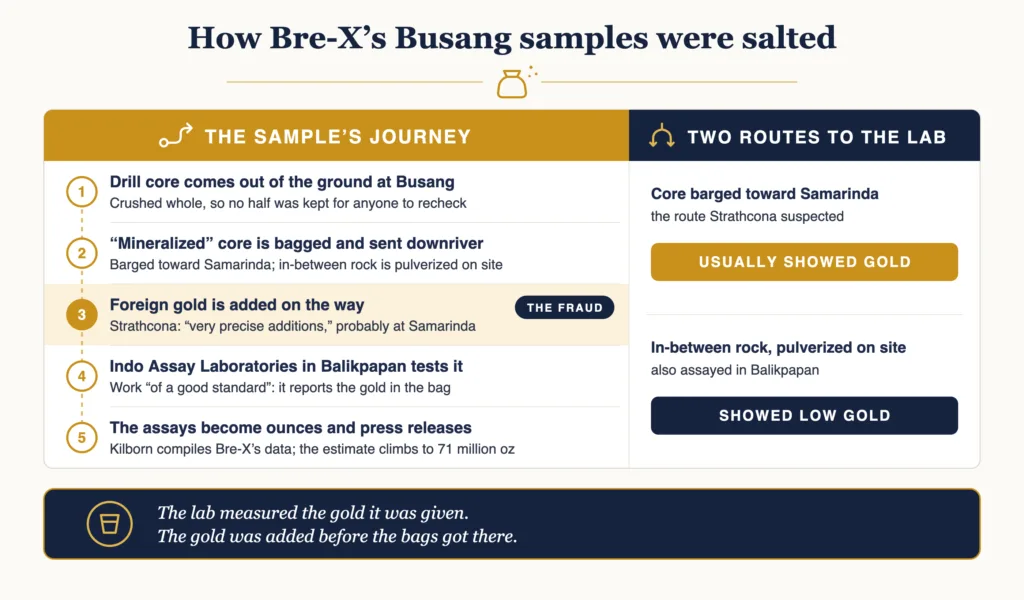
It started with the core. Normal practice is to split each length of drill core, assay one half and keep the other so anyone can test it again. Bre-X crushed whole core instead, as a 2020 peer-reviewed study of Busang notes, and Felderhof’s explanation was that splitting it lost too much of the gold. That left no retained half for outsiders to recheck. Core that Bre-X geologists judged “mineralized” was bagged and sent downriver toward Samarinda. The in-between rock was pulverized at the site, and when an independent lab in Balikpapan assayed it, it showed low gold. The barged core usually showed gold.
Strathcona could not say exactly where it happened. “We can only suggest that somewhere en route, probably at Samarinda, there has been a ‘laboratory’ or facilities established that have allowed very precise additions of the foreign gold,” the report said. The Wall Street Journal quoted a Bre-X employee who claimed to have seen powders mixed with core samples at the company’s warehouse near Samarinda. Gold was close at hand. The 2020 study notes a placer gold operation several kilometers northeast of the property, and the Nova Scotia commission says de Guzman used filings from his wedding ring and flakes bought from local panners. Perhaps a few pounds of gold would have done it, analysts told the AP.
Strathcona also found that Indo Assay Laboratories in Balikpapan had done work “of a good standard, and the gold values reported have reflected the gold in the samples delivered to the laboratory.” The lab measured what it was given. Every assay works that way, from a drill sample to the fire assay a refiner runs on a lot of scrap gold.
Seven holes, a helicopter and an 84 percent drop
Freeport’s team began its due diligence in February 1997 and got nervous fast. “It was clear to me after asking questions for two days that no one had ever done an independent analysis of this project,” Moffett said. Bre-X’s people had controlled it for three years, and no outsider had been allowed to drill. Over three weeks Freeport drilled seven core holes in the Busang II area. The analyses, it told the SEC in a March 26 filing, “indicate insignificant amounts of gold.”
On March 12 Moffett phoned Toronto, where Walsh, Felderhof and de Guzman were moving like royalty through the annual prospectors’ convention, to say there was a problem. De Guzman was sent back to the site and never arrived. On March 19 he fell to his death from a helicopter over the jungle. Indonesian police said they found a note blaming a terminal illness, his family suspected murder, and the body was not recovered for days. A decade later CBC still described his death as mysterious.
When trading resumed on March 27, Bre-X shares, by then split ten for one, fell 84 percent, from C$15.50 to C$2.50, wiping out more than $2 billion in market value, the AP reported. Other small Canadian miners, some with no operations in Indonesia, were battered too. Diadem Resources lost 35 percent over two sessions and Indochina Goldfields 30 percent.
Strathcona’s audit settled it. The firm drilled six closely supervised holes totaling 1,470 meters and sent 175 samples to labs in Australia, Indonesia and Canada. “We very much regret having to express the firm opinion that an economic gold deposit has not been identified in the Southeast Zone of the Busang property, and is unlikely to be,” Farquharson wrote. Walsh said Bre-X was “devastated.” Freeport withdrew on May 5, the Toronto Stock Exchange and Nasdaq delisted the shares, and Bre-X sought bankruptcy protection.
Who paid for the Bre-X scandal
Public pension funds were among the biggest losers. Maclean’s tallied C$100 million for the Ontario Teachers’ Pension Plan, C$70 million for Quebec’s Caisse de dépôt et placement and C$45 million for the Ontario Municipal Employees Retirement Board. Stan Buell, an investor who lost his Bre-X money and went on to found the Small Investor Protection Association, called it “the scam of the century” when he spoke to CBC in 2007.
Nobody went to prison. Walsh died in the Bahamas in June 1998, four days after a massive stroke, having maintained that he too had been duped. The RCMP closed its investigation in 1999 without laying charges. That left Felderhof, who had sold C$84 million of Bre-X stock in 1996, as the only person ever charged. The Ontario Securities Commission accused him of four counts of insider trading and four of authorizing misleading news releases. On July 31, 2007, Justice Peter Hryn acquitted him on all eight, ruling that he reasonably believed in the find. The judge added that the tampering was so sophisticated it would have been hard to uncover.
Hollywood turned the story into Gold, with Matthew McConaughey playing a character based on Walsh, Global News reported.
What changed after Bre-X
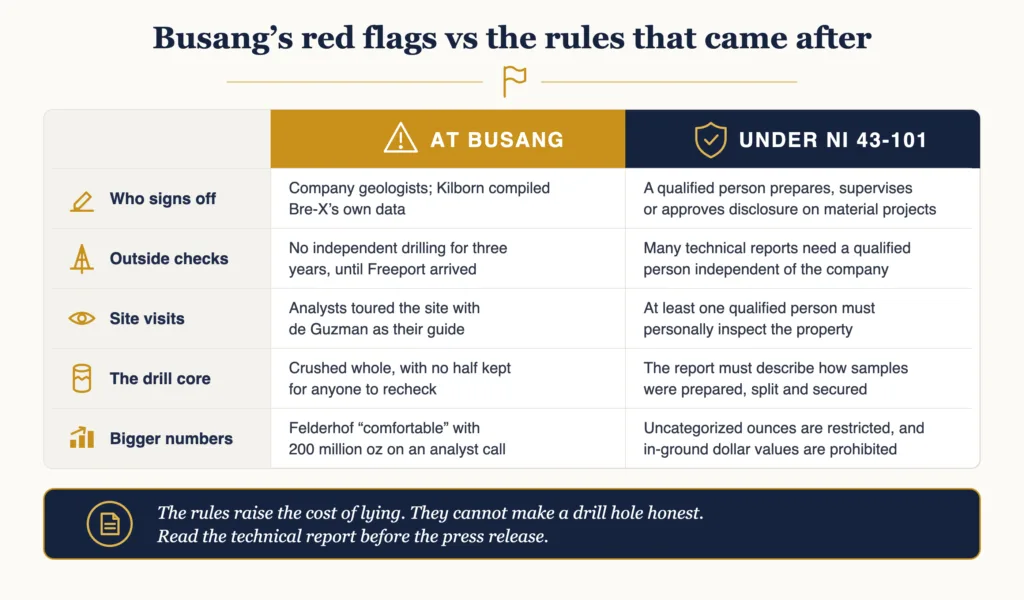
In 1997 the rules left a gap wide enough for Busang. As the 2020 study points out, Bre-X was listed on the Toronto Stock Exchange but “was not required to publicly disclose reports by an independent qualified person on the geology and exploration results on the property.” An Ontario Securities Commission and TSE task force on mining standards reported in January 1999, and National Instrument 43-101, which regulators said is consistent with its recommendations, took effect on February 1, 2001, according to the Alberta Securities Commission. The Nova Scotia commission calls the rule the response to Bre-X.
The rule in force today, last amended in 2023, reads like a list of what went wrong at Busang. Technical disclosure about a material mineral project must be based on work prepared, supervised or approved by a qualified person, an engineer or geoscientist with at least five years of relevant experience who answers to a professional body that can expel members. Disclosure must say whether that person verified the sampling and assay data. Many technical reports need an independent qualified person, at least one qualified person must visit the property, and the technical report form requires a description of how samples were prepared, split and secured.
The SEC adopted a similar qualified-person model, Regulation S-K subpart 1300, in October 2018, backed by a signed technical report summary, and registrants had to comply from fiscal years beginning on or after January 1, 2021.
A qualified person can still be fooled, and a technical report protects only the people who read it. With gold above $4,000, discovery stories sell easily, so keep the Busang questions handy. Has anyone outside the company drilled the property? Is half of the core kept for rechecking? Do check assays come from a second lab? Are insiders selling into the good news?
What Bre-X teaches anyone who owns gold
Bre-X shareholders never owned an ounce. They owned a company whose value rested on assay results, and the results were only as good as the bags. Mining shares can make sense as a leveraged bet on the metal, and the larger royalty and streaming companies spread that bet across many mines. Each is still a claim on someone else’s rock and someone else’s honesty.
Physical gold carries a different kind of risk, and it did not escape 1997. U.S. Geological Survey figures show gold averaging $389 an ounce in 1996 and $332 in 1997, a painful drop for anyone holding coins. But nobody’s coins turned out to be salted. A coin or bar can be weighed and tested, and the serial numbers and chain of custody behind a good bar exist to answer the question Busang raised: who handled this between the source and you?
Neither Freeport nor Strathcona caught the fraud by reading Bre-X’s numbers more carefully. Both drilled their own holes, and Strathcona sent its samples to labs on three continents. A gold buyer can borrow that habit. Buy metal you can test, from people willing to test it in front of you, and treat any number you cannot trace back to its sample as a story.