
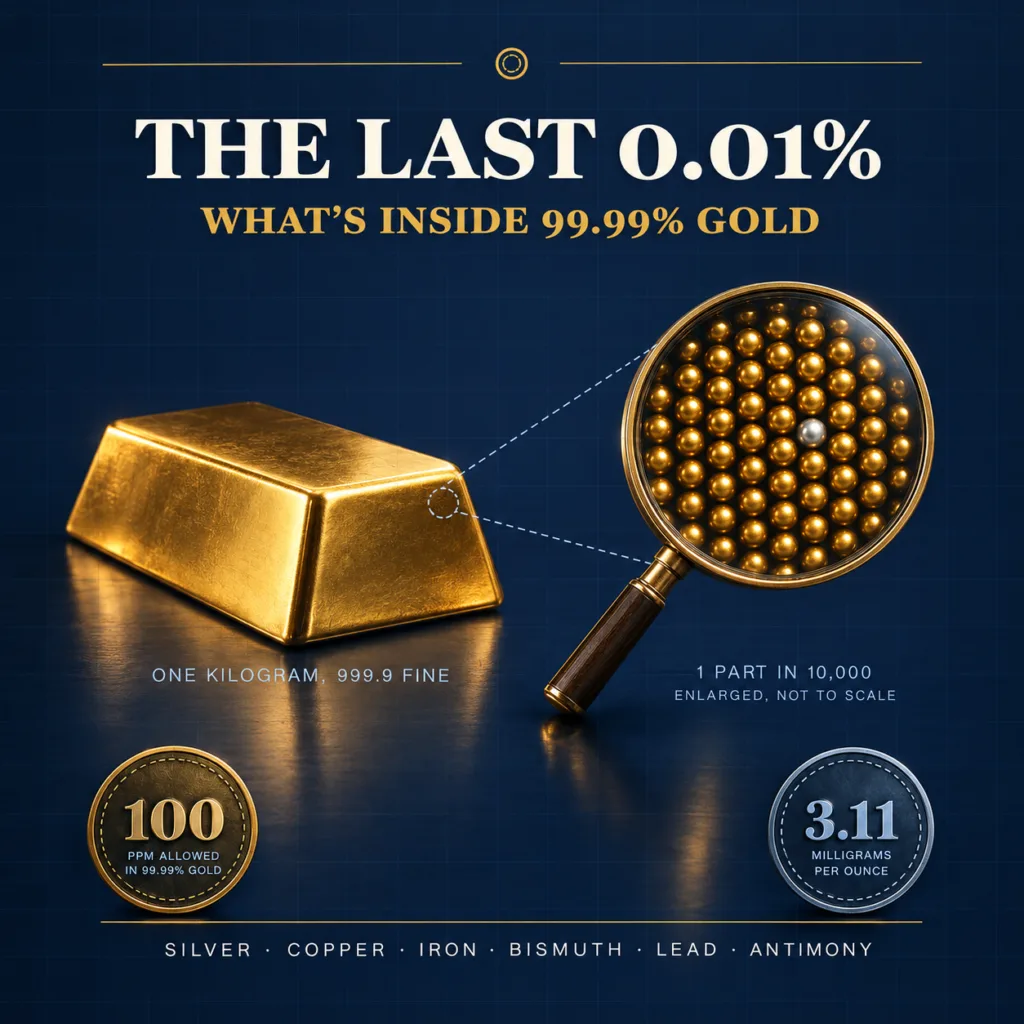
A coin or bar stamped 99.99% gold, also written 999.9 fine or “four nines”, can hold up to 0.01% of something other than gold. That is 100 parts per million, or about 3.11 milligrams in a one-ounce coin. The Perth Mint says the share in its own kilobars includes silver and copper, and the most detailed rule that is free to read, from the Shanghai Gold Exchange, also caps iron, lead, bismuth and antimony one by one. Some of the 0.01% is what refining left behind. Some of it was added on purpose.
Which elements are allowed, and how much of each, depends on whose rulebook you open. Shanghai publishes a limit for six named elements. London publishes no element limits at all and relies on the refiner’s assay. Under Shanghai’s rule the lab never measures the gold directly, either: it measures everything else and subtracts.
How much gold is 0.01% of an ounce?
One hundred parts per million of a troy ounce, which the Royal Mint puts at 31.1035 grams, comes to 3.11 milligrams. In a one-kilogram bar the allowance is a tenth of a gram. With gold bid near $4,151 an ounce on Kitco late on the morning of October 15, 2026 (New York time), the non-gold share of a one-ounce 99.99% coin takes the place of about 42 cents of gold, and the allowance in a kilobar about $13.35.
Nobody buys a coin for the 0.01%, so the people who watch it closely are refiners and the industries that use gold as a material. A refiner selling four nines bars gets nothing for any gold it pours above 99.99%. And in electronics, a few parts per million of the right element are what make gold wire bond the way a chipmaker wants.
Shanghai’s limits for 99.99% gold, element by element
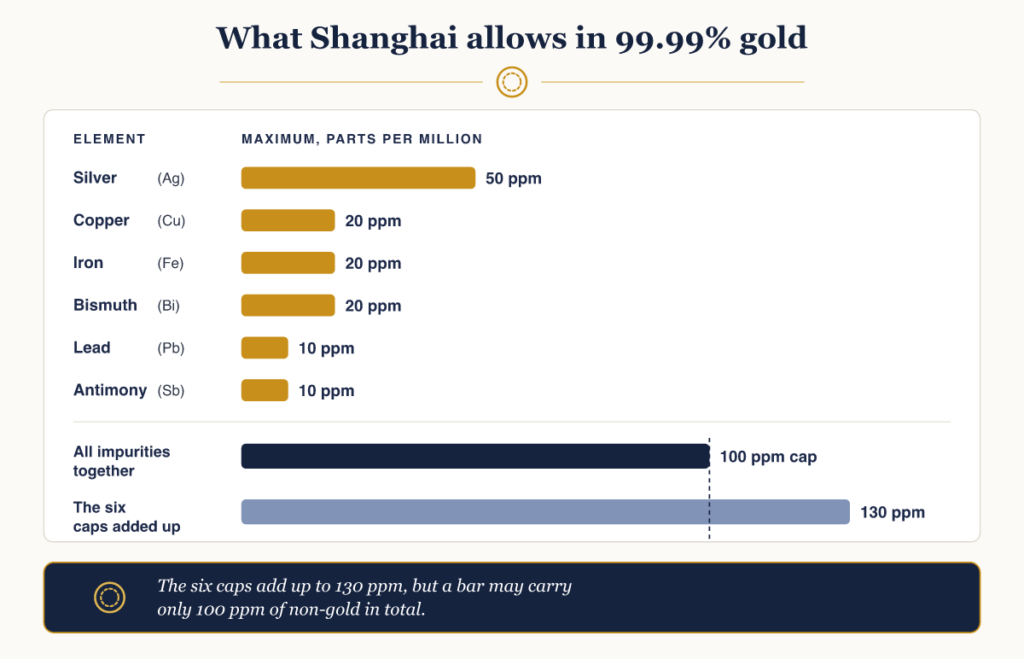
The most detailed freely published rule for 99.99% gold comes from the Shanghai Gold Exchange (SGE). Its standard for gold ingots, SGEB1-2019, caps six elements in Au99.99 metal: silver at 0.005% (50 ppm), copper, iron and bismuth at 0.002% (20 ppm) each, and lead and antimony at 0.001% (10 ppm) each. All impurities together may not exceed 0.01%. A one-kilogram ingot comes in a single grade, Au99.99, and the exchange’s 50 gram and 100 gram bars follow the same table.
Add the six maximums and you get 130 ppm, which is more than the 100 ppm total. A bar has to stay under each element’s ceiling and under the overall cap at the same time, so a refiner running high on silver has less room for everything else. The standard also says the impurities to be measured “include but are not limited to” the six in its table. Because gold content is worked out from whatever impurities are found, a reading of platinum or selenium still counts against the 100 ppm even though neither element has its own line.
Shanghai’s next grade down, Au99.95, allows 0.05% of impurities in total, with up to 0.020% silver and 0.015% copper. That is four times the silver and seven and a half times the copper that Au99.99 permits.
China’s national standard has changed as well. According to the foreword of GB/T 4134-2021, the 2021 edition deleted the limits for palladium, magnesium, chromium, nickel and manganese in Au99.99 and added a 99.90 grade. If you find a list online that caps a dozen or so elements for Chinese four nines gold, check its date, because it may describe the 2015 edition.
Why silver and copper are the usual leftovers
Gold reaches a refinery already mixed with other metals. In a chapter on South Africa’s Rand Refinery, metallurgist K.G. Fisher put the average crude bullion arriving from the mines at 84% gold, 11% silver and 5% base metals. Chlorine refining strips those out in a set order. The iron goes first, then lead and zinc, and only when those three are almost gone do copper and silver start to form chlorides. That stage produced the refinery’s 99.60% monetary bars. Electrolysis took gold to 9999 and also removed the platinum group metals, which Fisher wrote “cannot be removed by chlorination”.
Silver gives trouble in that last step too. Heinrich Wohlwill’s patent, filed in 1909 and granted in 1910, noted that once silver in the gold passed six per cent, the silver chloride forming on the anode had to be removed mechanically, and Fisher describes silver chloride settling into the sludge at the bottom of the cell. We cover both processes in Miller vs Wohlwill: how refiners take gold from 99.5% to 99.99%. The Perth Mint’s 2023 statement describes the end result in its own one-kilogram 99.99% bars: up to 0.01% of non-gold material, “including silver and copper”.
Some of the 0.01% is added on purpose
Refiners can’t pour gold at exactly 99.99%, so each bar comes out with some gold above the line. The Perth Mint calls that extra gold the “gold give-away”, because the customer does not pay for it. To shrink it, refiners add a little non-gold metal, a practice the mint describes as “doping” or “alloying” and calls accepted across the industry.
According to ABC News, the Perth Mint’s process was producing gold of about 99.996%, so it added silver to its bars, and between 2018 and 2021 some of the gold it sold to China failed Shanghai’s silver standard. Silver has the loosest cap in Shanghai’s table, yet it was the element that tripped the mint up.
In September 2021 the mint learned that some of its one-kilogram bars did not meet the SGE rule that the 100 ppm non-gold component contain no more than 50 ppm of silver. The mint says the gold content itself was never short: its bars always held at least 99.99% gold. “This has never been in dispute”, the statement adds. After ABC’s Four Corners aired the story in March 2023, the LBMA opened a review of the mint’s conformance with its Responsible Gold Guidance and closed it in April 2023, saying the credibility of the mint’s assay lab was never in question. The mint stayed on the Good Delivery List.
The statement also gives one of the few public figures on what normal looks like. From December 2021, the Perth Mint says, new processes put its kilobars at an average minimum purity of 99.996%, compared with what it calls an industry standard of approximately 99.992%, and capped the non-gold component at 0.004%. If that industry figure holds, a typical four nines bar carries around 80 ppm of other elements, and Perth now gives away more gold so its bars stay inside Shanghai’s limits.
Electronics take deliberate impurities further. In a patent with a 1979 Japanese priority date, Tanaka reported that the gold bonding wires then in use were “more than 99.9% by weight” gold with residual elements under 100 ppm, and its first claim covers a wire with 2 to 80 ppm of silver, 5 to 80 ppm of germanium, 1 to 20 ppm of calcium, 0.5 to 10 ppm of iron and 0.5 to 30 ppm of magnesium. A Tanaka filing with a 2000 priority date prefers starting gold “purified to at least 99.99 wt%”, adds 1 to 20 ppm of calcium, 1 to 10 ppm of beryllium, or both, alongside other elements, and keeps the total under 100 ppm. These are patent claims, not current product specifications, but they show that in bonding wire the last 0.01% is a recipe.
London sets no element limits for 99.99% gold
London’s bullion market leaves the composition of the last 0.01% to the refiner. A Good Delivery gold bar must be at least 995.0 parts per thousand fine and hold 350 to 430 fine ounces, and the specification lists no limit for any single element. The one-kilogram 9999 kilobar standard that the LBMA and SGE endorse sets a minimum fineness of 999.9 and, in the LBMA’s words, “focuses on the fineness of the gold”.
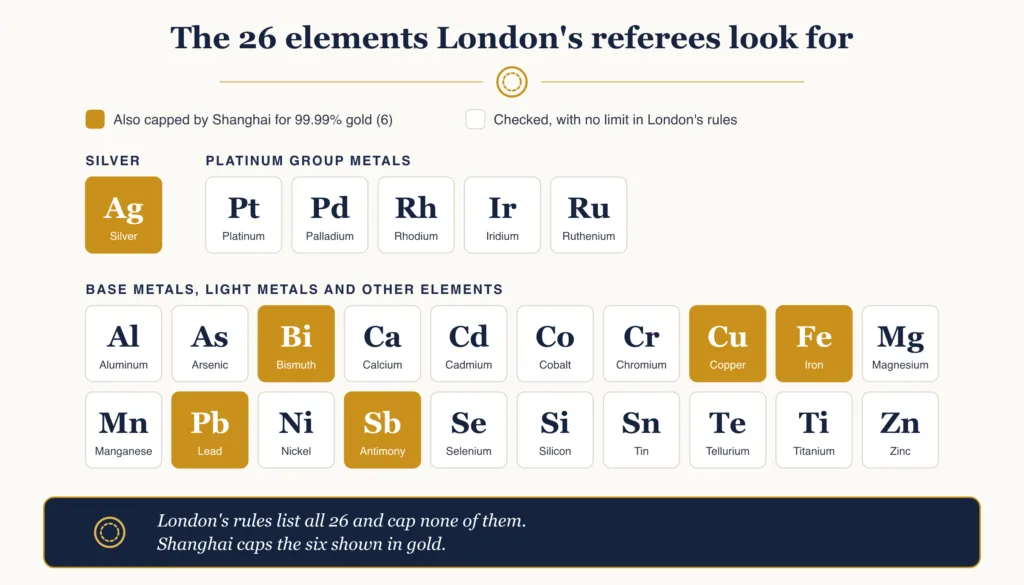
London does say what it looks for. Annex G of the Good Delivery Rules lists 26 elements the LBMA’s referees typically check for in gold: silver, five platinum group metals (platinum, palladium, rhodium, iridium and ruthenium), and aluminium, arsenic, bismuth, calcium, cadmium, cobalt, chromium, copper, iron, magnesium, manganese, lead, nickel, antimony, selenium, silicon, tin, tellurium, titanium and zinc. The LBMA says the list is “not intended to be prescriptive”. Refiners that assay by spectrographic analysis are responsible for identifying every residual element in their bars.
The LBMA’s own calibration gold uses much of that list. Its AuRM4 and AuRM5 reference materials, certified in 2021, carry measured amounts of 20 and 21 trace elements, and the certificate says the composition “reflects the needs expressed by LBMA accredited refiners”. AuRM4, for example, holds 34.7 ppm of bismuth, 33.9 of lead, 33.5 of tellurium, 29.6 of selenium and 20.1 of silver. Add up its certified impurities and it works out to about 99.970% gold, below four nines, which suits a sample built to give instruments a measurable amount of each element.
How labs certify 99.99% gold, often without measuring the gold
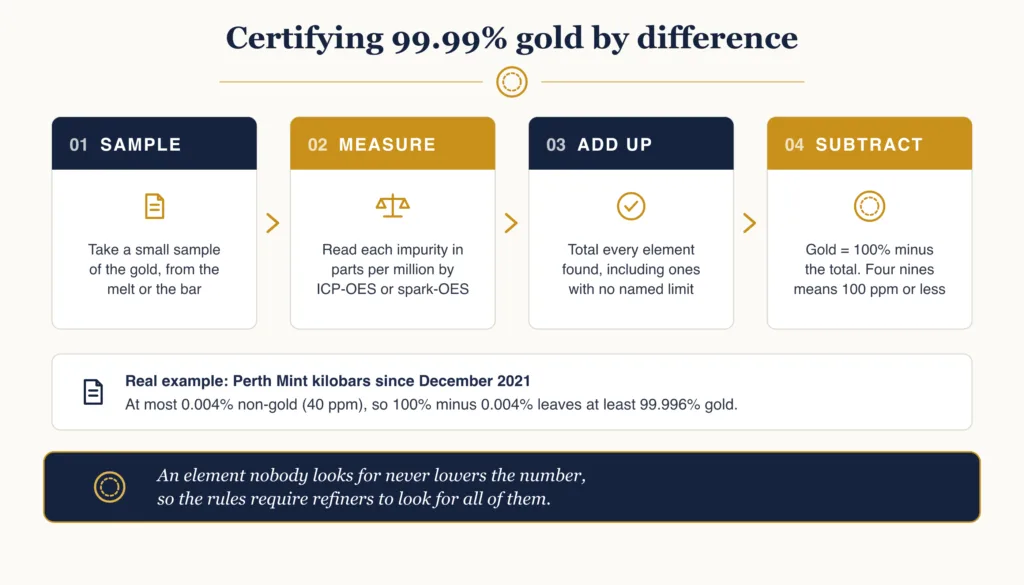
Under Shanghai’s rule, four nines is a calculation. Shanghai’s standard says the gold content of Au99.99 is found by the subtraction method: “100% minus the measured impurity levels”. An international standard for the same approach, ISO 15093, measures the impurities by inductively coupled plasma optical emission spectrometry (ICP-OES) in gold of 999 parts per thousand and above, with extra steps in an annex for 999.9 and higher. ISO has also drafted a spark-OES version, ISO 18214, for a solid sample with a flat surface.
Fire assay, the cupel-and-furnace method we describe in how gold refining works, still anchors most of the purity range in London. LBMA Annex D says every refiner on the gold list must be able to assay from 995.0 to 999.9, most of which can only be assayed accurately by corrected fire assay, while at the top end “spectrographic methods can provide assays of the necessary precision and accuracy”. Even a refiner whose production is all 999.9 gold or finer can opt to be monitored by fire assaying six reference samples of about five grams that the LBMA sends it.
No accepted method reads 99.99% through the surface of a finished bar. The LBMA says there is “currently no definitive non-destructive testing solution” it can endorse, and that the only accurate way to determine a bar’s fineness is destructive testing. The fineness stamp and the refiner’s assay behind it are what carry the four nines, which is why assays and certificates matter on a bar.
What four nines means when you buy a coin or bar
For a coin buyer, 99.99% gold describes the metal more than the value. The U.S. Mint’s American Buffalo coins are “the first .9999 fine 24-karat gold coins ever struck by the United States Mint”, and the Royal Canadian Mint says its Gold Maple Leaf was “the first bullion coin to achieve the heightened standard of 9999 purity”. Both are .9999 coins, unlike 22-karat bullion coins that carry their alloy openly, as we compare in 24k gold coins vs 22k gold coins.
Five nines pushes the allowance down to 10 ppm. The Royal Canadian Mint says it became the world’s first refinery to reach 99.999% purity in 1998 and introduced the first 99.999% bullion coin in 2007. The gap between 99.99% and 99.999% is 90 ppm, about 37 cents of gold per ounce at mid-October 2026 prices. ASTM’s specification for refined gold, B562, tops out at a 99.995 grade, so five nines sits beyond that specification’s highest grade. Whatever extra a five nines coin costs over a four nines one, almost none of it buys additional gold. For the Maple Leaf and its main rival side by side, see our Gold Eagle vs Gold Maple Leaf comparison.
Reading the fine print on four nines
The 99.99% stamp sets a floor for gold and leaves the rest to the refinery and the market it pours for. Bars bound for Shanghai have to keep silver under 50 ppm and five other named elements under their own caps. Bars made to London’s rules face no per-element limits, only the requirement that the assay prove the gold. On the Perth Mint’s figures a typical bar sits around 99.992%, and part of the remaining 80 ppm or so may be silver or copper the refiner added to avoid giving gold away. In a one-ounce coin, the whole 0.01% weighs about three milligrams and takes the place of roughly 42 cents of gold at October 2026 prices.