

So, can you buy gold from a bank? In the United States, the answer is almost always no. Walk into a Chase, a Wells Fargo, or a Bank of America branch and ask the teller for a one ounce gold coin, and you will get a polite blank look and, if you are lucky, directions to a coin shop. American retail banks do not stock bullion, do not sell it, and in most cases will not buy it from you either. The question is completely reasonable. In much of the world, and in most of American history, the bank was exactly where you went for gold. The interesting part is why that stopped being true here, and what it means for where you should actually buy.
It also matters more than usual right now. With gold trading at record levels in 2026, a wave of first time buyers is typing this exact question into Google, walking into branches, and discovering that the institution holding their life savings wants nothing to do with the one asset they came in to buy. That gap between what people expect from a bank and what a bank actually does is worth understanding, because the history behind it explains a lot about how gold is bought and sold in America today.
Banks and gold used to be the same business
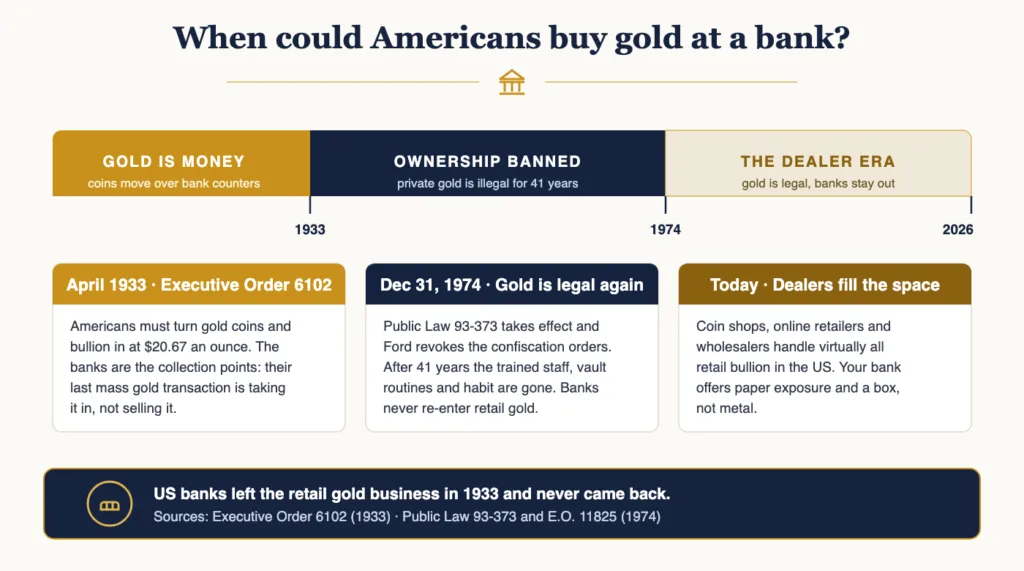
For the first century and a half of American banking, asking whether a bank sold gold would have sounded strange, like asking whether a bakery sold bread. Gold coins were money. Double eagles, eagles, and half eagles moved through bank counters as routine currency, and paper notes were claims on metal sitting in a vault. If you wanted gold, the bank was not one option among several. It was the system itself.
That world ended abruptly in the spring of 1933. Facing bank runs and a currency crisis, President Roosevelt signed Executive Order 6102, which required Americans to turn in their gold coin, bullion, and gold certificates to the Federal Reserve at $20.67 an ounce. Notice the mechanism: the government used the banks to collect the gold. The last mass interaction between American banks and citizens’ gold was the banks taking it in, not handing it out.
Private gold ownership stayed illegal for four decades. It only became legal again when Congress passed Public Law 93-373 and President Ford signed Executive Order 11825 revoking the confiscation orders, effective December 31, 1974. Here is the detail that answers today’s question: when gold became legal again, the banks did not come back. Forty one years is a long time. The tellers who once weighed double eagles were gone, the vault procedures were gone, and an entire industry of coin dealers and, later, online bullion retailers had grown up to fill the space. The banks looked at a low margin, high hassle business someone else now did well, and passed. They have been passing ever since.
Why American banks got out of retail gold, and stayed out
It is tempting to read something conspiratorial into this, and gold forums sometimes do. The boring truth is that selling physical gold is a terrible fit for how a modern American bank makes money. A bank earns its living on the spread between deposits and loans, and on fees. Every product it offers at a branch is designed to feed that engine. A gold coin does the opposite: it pulls a deposit out of the bank and turns it into an asset the bank cannot lend against, earning the bank a one time markup of a few percent at best.
Then come the practical problems, and they are bigger than most people assume. A branch selling bullion needs to hold inventory of a metal that swings in price daily, which means somebody at headquarters has to hedge it. It needs tellers trained to authenticate coins and bars, because the moment a bank sells one fake Krugerrand the reputational damage outruns a decade of margins. It needs insurance, secure logistics, and buyback procedures. Precious metals transactions also carry anti money laundering obligations that compliance departments would rather simply avoid. Any one of these is manageable. Stacked together, for a product that might interest a few customers per branch per month, the business case dies in the first meeting.
There is one more piece. The biggest American banks are actually enormous players in gold. JPMorgan and HSBC run some of the largest precious metals desks on earth, clearing billions of dollars of metal through the London market every day. But that business serves central banks, funds, and refiners, trading in 400 ounce bars. The gap between a London vault moving a pallet of bars and a suburban branch selling you a single coin is not a gap the banks have any interest in bridging. They chose the wholesale end, and they are staying there.
What your bank will offer you instead
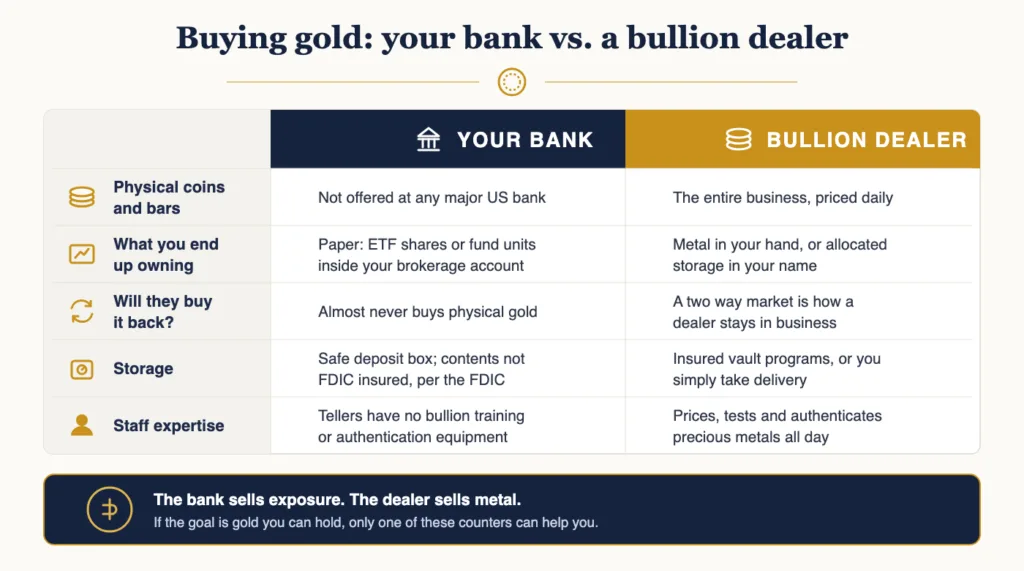
Ask a US bank about gold and, once you get past the teller, the answer is usually some version of paper. The brokerage arm will happily sell you shares of a gold ETF, which track the price but leave you owning a security, not metal. Wealth management clients might be offered gold linked notes or mining funds. These products have real uses, and for some investors they are the right call. Just be clear about what they are: exposure to the price of gold, wrapped in the financial system. If your reason for wanting gold is to hold something outside that system, a fund position inside your brokerage account is close to the opposite of what you came for.
There is also a price dimension the brochure will not mention. An ETF share and a coin in your hand are priced differently, and the difference between the screen price and metal in your hand is the exact subject of our piece on spot price versus physical price, and it is worth understanding before you choose either route.
The other thing a bank will offer you is a box. Safe deposit boxes remain a common way to store coins, and for many people they are a sensible one. But two facts surprise almost everyone. First, the FDIC is explicit that safe deposit box contents are not insured by deposit insurance, and banks generally do not insure them either. If you want the gold in that box covered, you arrange it yourself through your own insurer.
Second, FDIC insurance does not cover gold in any form, anywhere. The $250,000 protection on your checking account exists precisely because a deposit is a loan to the bank. Gold in a box is just your property in their building, protected by the vault door and nothing else. So the one gold service your bank genuinely offers is storage without insurance, for metal it refused to sell you. The irony writes itself.
Can you buy gold from a bank anywhere? Plenty of places, just not here
What makes the American answer stranger is that it is an American answer. Cross a border in almost any direction and the picture changes. In Canada, the big banks run online bullion storefronts where customers buy coins and bars with a few clicks. In Switzerland, UBS will sell you bars from a gram to a kilo, stamped with its own name; UBS branded bars are a recognized brand in their own right. Banks in Singapore sell bullion over the counter, and banks across Asia and the Gulf treat retail gold as a normal product line, because their customers have never stopped treating gold as a normal thing to own. The American arrangement, where the entire retail gold trade lives outside the banking system, is the exception rather than the rule.
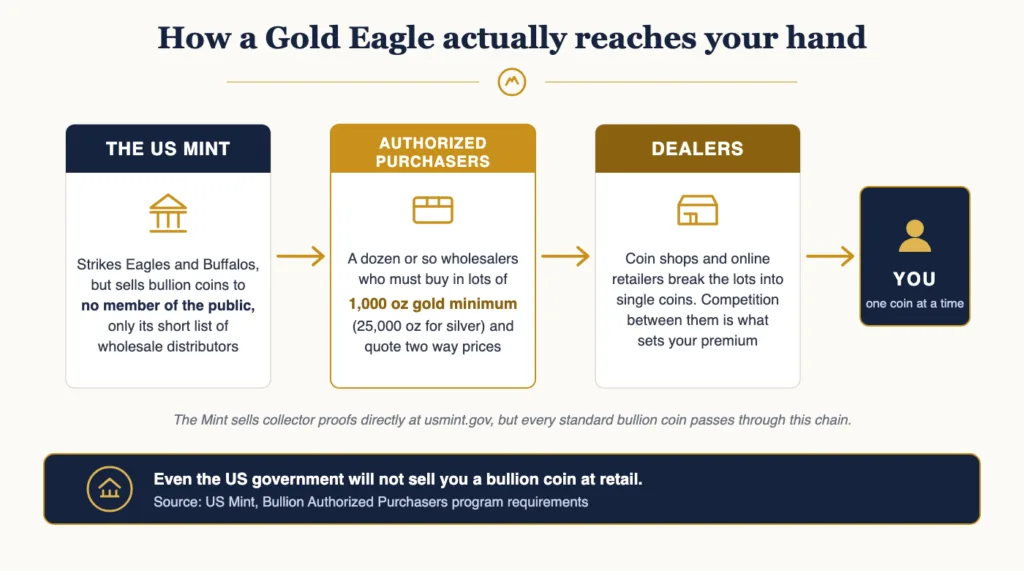
And there is a final American twist. Even the US government will not sell you a bullion coin directly. The US Mint distributes its bullion coins, including the American Gold Eagle, exclusively through a small network of Authorized Purchasers, wholesalers who must buy in minimum lots of 1,000 ounces of gold or 25,000 ounces of silver and commit to making a two way market. Those wholesalers supply the dealers, and the dealers supply you. The Mint does sell proof and collector versions to the public from its website, at collector premiums, but the standard bullion coin in your hand has passed through that wholesale chain every single time. The system was designed this way on purpose: it keeps the Mint out of retail and lets competition between dealers set the markup.
Where Americans actually buy gold now
So the channel that replaced the bank counter is the dealer market: local coin shops, national online retailers, and lately even the occasional warehouse club selling one ounce bars to members. That market is competitive, transparent in ways the old world never was, and entirely navigable once you understand its one universal rule: everyone sells above the spot price, and the difference, the premium, is where all comparison shopping happens. If that concept is new to you, start with our guide to the gold premium trap, because the cheapest advertised price is frequently not the best deal, and the tricks are learnable in an afternoon.
Shopping the dealer market well comes down to a few habits. Compare the all in price for the same product across two or three sellers on the same day, since spreads move. Favor recognizable, liquid products, the Eagles and Maple Leafs and name brand bars, because the easy purchase is also the easy sale later. Check how long a dealer has operated and how they handle buybacks before you care about their price. As an example of what to look for, we publish our bullion buyback prices and buy coins and bars over the counter in New York. None of this is complicated, but it is exactly the homework a first time buyer skips in the excitement of a rising market, which is why we keep a full first time buyer’s checklist for the details, from payment methods to shipping insurance.
Step back and the whole picture is a little funny. Your bank will finance your house, hold your savings, and sell you almost any financial product invented in the last century, but it will not sell you the oldest financial asset there is. That is not a verdict on gold. It is a leftover of 1933, an accident of regulation and margins that pushed an entire market out of the marble lobby and into specialist hands, where it has quietly thrived for fifty years. The bank was never going to be the answer. Knowing that, you can skip the branch visit and go straight to the market that actually wants your business, with a clear idea of how it works.