
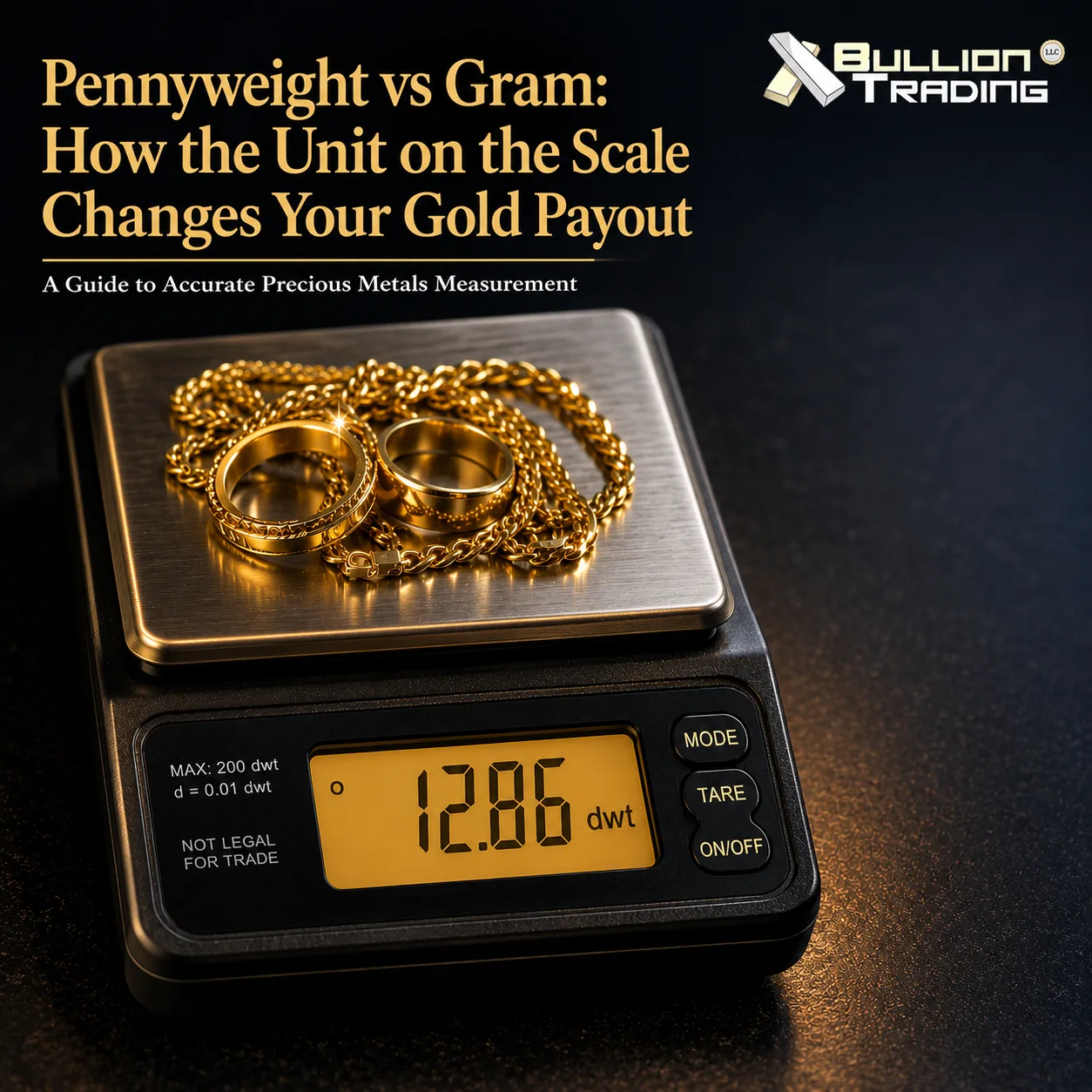

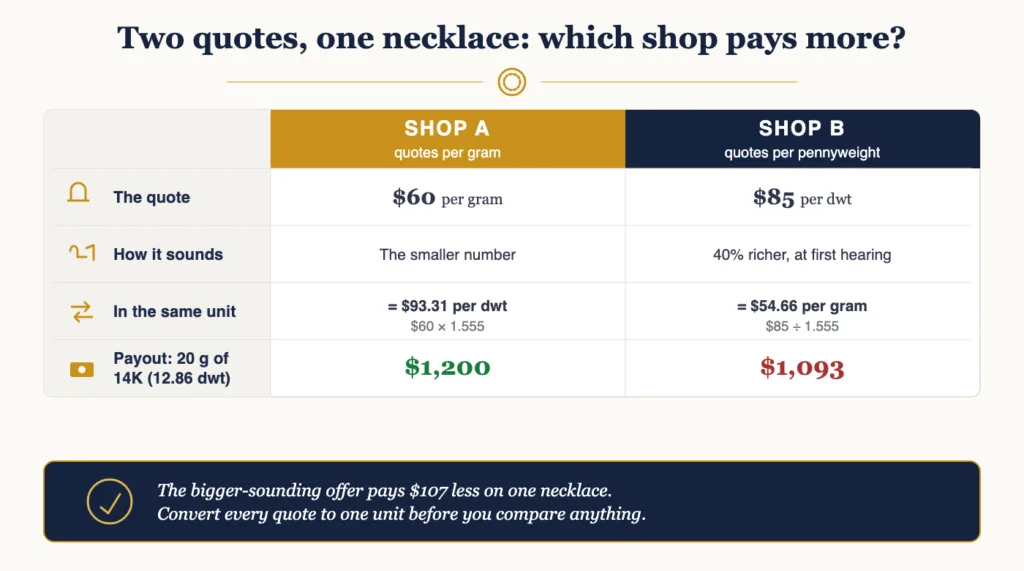
Walk into two gold-buying shops on the same block with the same 14 karat necklace. The first offers you $60. The second offers you $85. Easy choice, right? Not until you hear the rest of each sentence. The first shop said $60 per gram. The second said $85 per pennyweight. And because a pennyweight is 1.555 grams, that louder $85 works out to about $54.66 per gram. The smaller number was the better offer by more than a hundred dollars on a typical necklace. That is the whole pennyweight vs gram problem in one transaction: the unit on the scale changes how big the offer sounds without changing what your gold is worth, and most sellers never think to ask which unit they are being quoted in.
What a pennyweight actually is
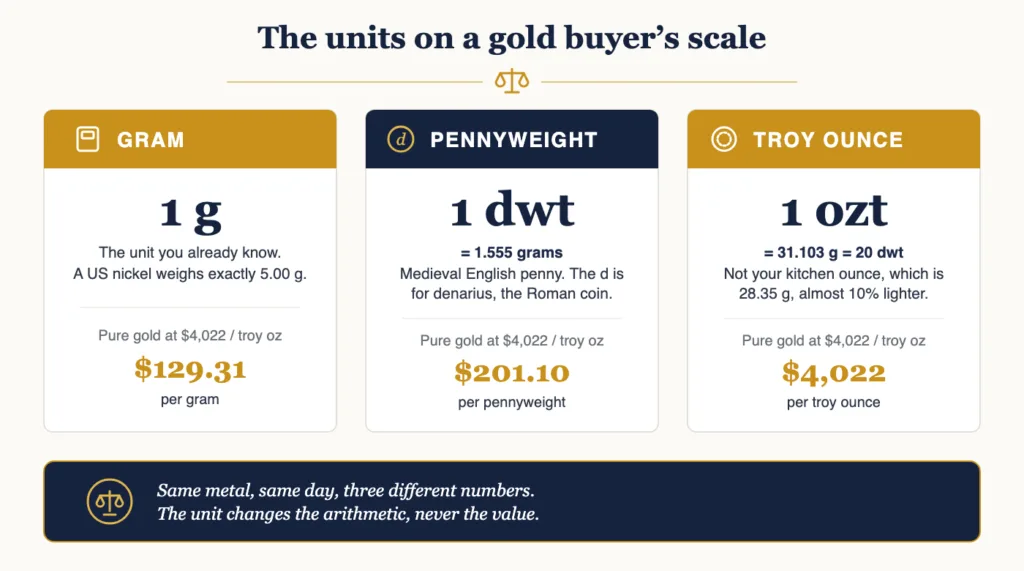
The pennyweight is not an invention of the cash-for-gold business. It is a survivor from the troy weight system, which has been used to weigh gold and silver since the Middle Ages and which takes its name, Britannica notes, from the city of Troyes in France and its great medieval fairs. The unit itself began as the weight of an English silver penny, one twentieth of a troy ounce. The abbreviation, dwt, keeps a Roman souvenir: the d stands for denarius, the coin the English penny descended from.
The ladder is simple once you see it laid out. Twenty-four grains make one pennyweight. Twenty pennyweights make one troy ounce. Twelve troy ounces make one troy pound. The National Institute of Standards and Technology publishes the exact conversions in its reference sheet for precious metal sales: one pennyweight is 1.55517 grams, and one troy ounce is 31.1035 grams.
Notice that last number. A troy ounce is not the ounce on your kitchen scale. The everyday avoirdupois ounce weighs 28.3495 grams, almost ten percent lighter. So the word “ounce” is already ambiguous before anyone gets clever, and the pennyweight sits inside the less familiar of the two systems. Jewelers have priced their work in pennyweights for generations, and inside the trade the unit is harmless. The trouble starts when a unit that professionals use on each other gets pointed at a member of the public who thinks in grams, if they think in weight at all.
Pennyweight vs gram: the same offer in two units
Start with the price of the metal itself. On July 20, 2026, gold traded near $4,022 per troy ounce, which is $129.31 per gram or $201.10 per pennyweight. Those three prices are the same price. Nobody will pay you the full figure for scrap jewelry, since the metal still has to be tested and refined, and the gap between the screen price and what physical metal actually changes hands for is a story of its own, one we walked through in spot price versus physical price. But every honest offer starts from those numbers.
Now add purity. A 14 karat necklace is 14/24 gold, about 58.3 percent, a system we unpacked in our guide to karats, purity marks, and hallmarks. So at $4,022 gold, the pure metal in one gram of 14 karat jewelry is worth about $75.40. A 20 gram necklace holds roughly $1,508 of gold.
Here is where the units go to work. The shop paying $60 per gram is paying you $1,200, which is just under 80 percent of melt value, a respectable rate for scrap. The shop paying $85 per pennyweight is paying $85 for every 1.555 grams. Your 20 gram necklace is 12.86 pennyweights, so the check comes to $1,093. That is 72.5 percent of melt. The offer that sounded 40 percent richer pays $107 less.
Run the conversion in either direction and the fog lifts instantly. Sixty dollars per gram is $93.31 per pennyweight. Eighty-five dollars per pennyweight is $54.66 per gram. Stated in the same unit, no one would hesitate for a second. Stated in different units, most people pick the wrong shop.
Three ways the unit quietly moves money
The first way is the one above: the big-number quote. A per-pennyweight price is always about 55 percent larger than the same price per gram, so a buyer who quotes in pennyweights starts every negotiation sounding generous. Even a dealer who weighs in pennyweights for legitimate legacy reasons benefits from the acoustics. Jewelers who use the unit describe it as trade convention, and the better ones keep both numbers on the table: one shop’s own explainer says it routinely walks clients through the weight in both grams and pennyweights so the math stays visible. Another dealer is blunter about the other kind of shop, writing that some scam gold buyers use pennyweights to confuse customers who have never heard of the unit. The translation is the test. The unit is not the sin. Refusing to convert it is.
The second way is comparison shopping across units. Getting more than one offer on the same day is the single best habit a gold seller has, and mismatched units break it. A seller holding a $62 per gram quote from one shop and a $90 per pennyweight quote from another cannot rank them in their head, and the natural shortcut, bigger number wins, points at the worse deal. The fix costs nothing: every quote gets converted to dollars per gram before it gets compared to anything.
The third way is rounding. A scale that displays whole pennyweights hides more than a scale that displays tenths of a gram, because each invisible decimal is 1.555 grams wide. Round 12.86 pennyweights down to 12 and the seller just donated 0.86 pennyweights, about 1.3 grams of 14 karat gold, roughly $100 at current prices, without either party saying a word. Grams leave less room to hide: a tenth of a gram of 14 karat scrap is about seven and a half dollars. Small print, but it compounds across a drawer of jewelry.
And hovering behind all three is the ounce itself. Sellers who weigh their gold at home on a kitchen scale are weighing in avoirdupois ounces, then comparing against troy-ounce prices, and the ten percent mismatch convinces some of them the dealer’s scale is crooked when it is the only certified instrument in the story.
The scale is regulated. The unit choice is not.
It is worth being precise about where the law protects you here, because the protection is real and it stops exactly one step short of this problem. Every state has adopted NIST Handbook 44, the national rulebook for commercial weighing devices, and NIST’s own guidance is blunt that any scale used to set a price by weight must comply. In practice that means a gold buyer’s scale must be an approved trade class device, certified under the National Type Evaluation Program and subject to inspection. And the inspections are real: Utah’s weights and measures program, for one, conducts unannounced inspections during normal business hours at any business using a commercial scale, gold buyers included.
So the hardware is honest, or at least auditable. What no rule in Handbook 44 requires is that the buyer quote your payout in the unit you understand. A shop can weigh in pennyweights, price in pennyweights, and post per-pennyweight rates in the window, all perfectly legally. The regulations guarantee the number on the display is true. They say nothing about whether the number in the offer is legible to you. That gap should feel familiar. It is the same gap we mapped in what “we pay top dollar” really means: the law polices the measurable facts about your gold and leaves the buyer’s framing of the deal entirely alone. The framing is your job.
Five checks before the scale settles
None of this requires confrontation, a calculator app aside. It requires five small habits at the counter, and a fair buyer will not blink at any of them.
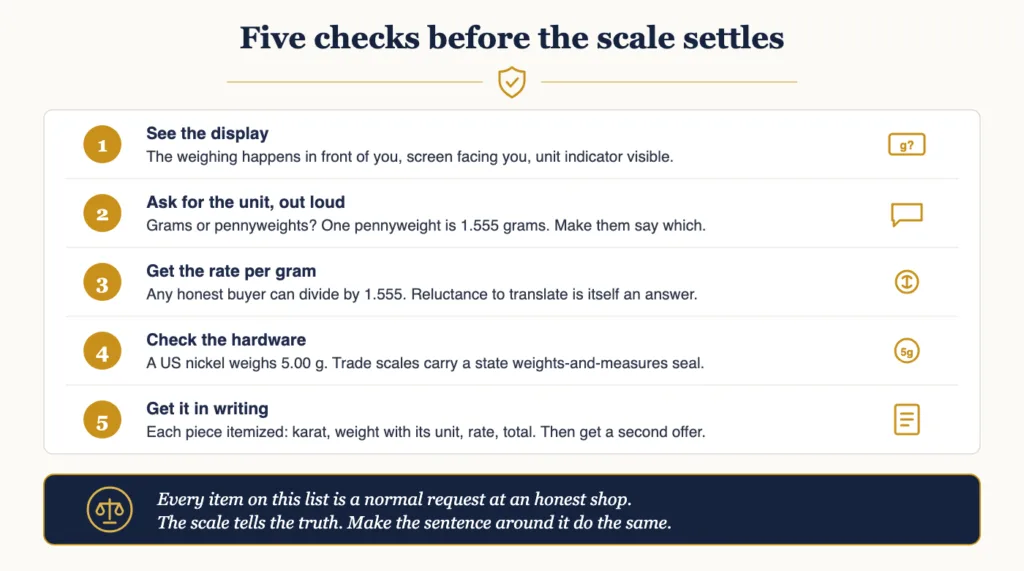
See the display. The weighing should happen in front of you with the screen facing you, and the unit indicator, g or dwt, visible next to the number. A scale you cannot see is an offer you cannot check. Ask for the unit out loud, and ask for the rate per gram even if the shop works in pennyweights. Any buyer can multiply by 1.555, and the ones who make it feel like an unreasonable request have answered a different question for you. If you want to sanity-check the scale itself, a United States nickel weighs 5.00 grams by Mint specification, and a fair shop will happily weigh one.
Then put the arithmetic on paper. An itemized written offer lists each piece, its karat, its weight with the unit named, the rate, and the total. That one sheet of paper converts a friendly verbal number into something you can take across the street, which is exactly why you want it and exactly why a certain kind of buyer hopes you will not ask. Finally, know your own number before you walk in. Weigh your pieces, note the karat stamps, and work out the melt value yourself; our walkthrough on calculating melt value takes about ten minutes to apply. A seller who knows their necklace holds $1,508 of gold hears “$85 per pennyweight” very differently than a seller who is hoping the nice man is being fair.
The only number worth memorizing
You do not need to become fluent in troy weights to sell gold well. You need one conversion and one habit. The conversion is 1.555: multiply a per-gram price by it to get pennyweights, divide a per-pennyweight price by it to get grams. The habit is refusing to compare two offers until they are wearing the same unit.
The pennyweight itself deserves none of the suspicion. It has been weighing precious metal since the Plantagenets, and a dealer who quotes in dwt and converts cheerfully on request is doing nothing wrong at all. The unit only becomes a trick when it is the answer to a question nobody asked, aimed at someone who cannot translate it. Carry the translation with you and the trick has nothing left to stand on. The scale will tell the truth. Make sure the sentence around the number does too.
