
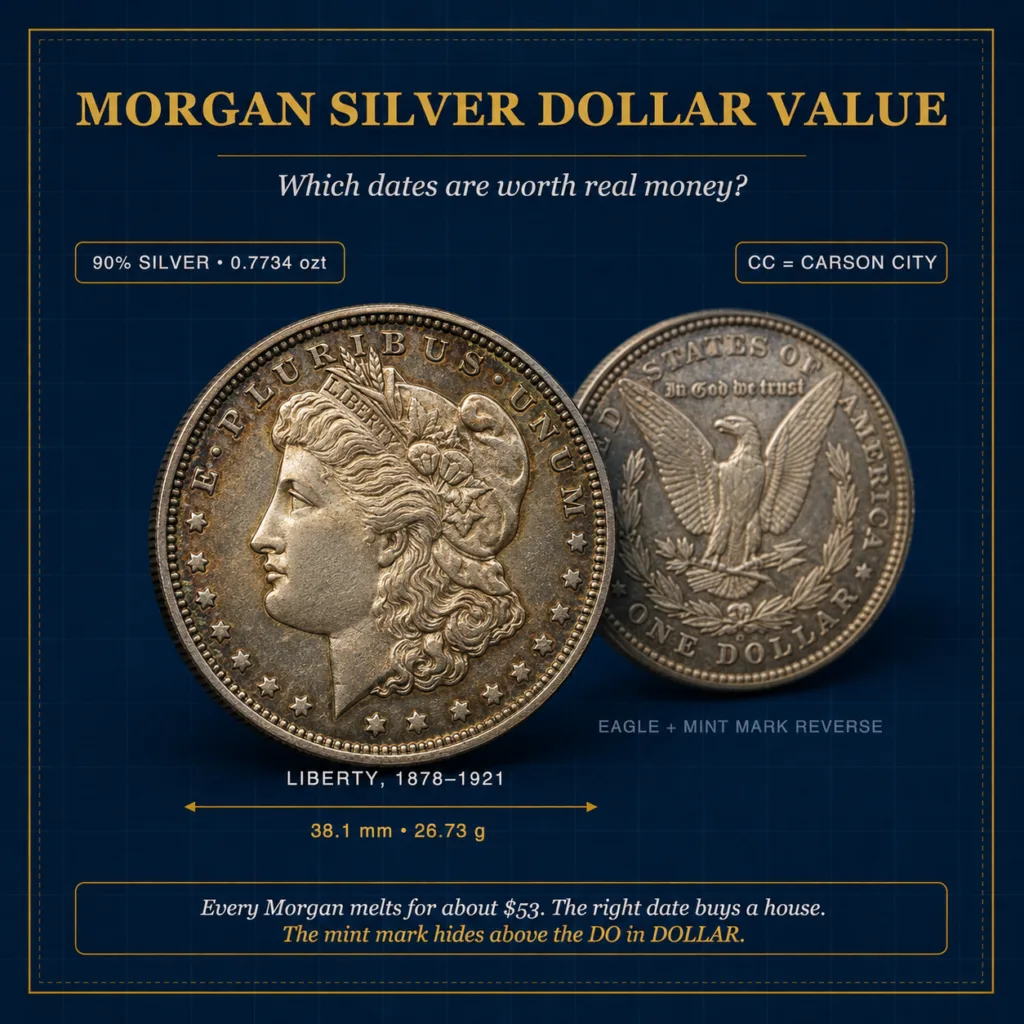
You are holding a big, heavy silver dollar with a woman’s profile on the front and an eagle on the back, and you want a number. Here it is. Every genuine Morgan silver dollar struck between 1878 and 1921 contains 0.7734 troy ounces of silver, and with silver trading near $68 an ounce on August 26, 2026, per Yahoo Finance’s daily silver report, that works out to just under $53 in metal alone. So the honest floor on Morgan silver dollar value is about $53, and a worn common date sells within a few dollars of that.
The ceiling is a different universe. The right date, the right mint mark, and the right condition turn the same 26.73 grams of metal into a coin that sells for thousands, and in a few famous cases for more than a house. The whole game is learning which side of that line your coin sits on, and you can figure most of it out at your kitchen table in five minutes.
The dollar the Comstock Lode built
The Morgan dollar was never really about commerce. Nevada’s Comstock Lode was pouring out silver in the 1870s, the price was sagging, and mining interests wanted a guaranteed buyer. Congress obliged with the Bland-Allison Act in February 1878, which forced the Treasury to purchase millions of ounces of silver every month and strike it into dollars. A young British engraver named George T. Morgan designed the coin, using a Philadelphia schoolteacher, Anna Willess Williams, as the model for Liberty. Five mints struck the series: Philadelphia, New Orleans, San Francisco, Carson City, and, in the final 1921 year only, Denver.
Most Americans did not want a coin this heavy, so hundreds of millions of Morgans sat in Treasury and bank vaults for decades. Then, in 1918, the Pittman Act sent about 270 million of them to the melting pot so the silver could be sold to wartime Britain, a purge that erased roughly four of every ten Morgans ever struck, as CoinWeek’s history of the Pittman Act lays out. That melt is why a series with a 660 million mintage still has genuinely rare dates. Nobody recorded which dates went into the furnaces, so some issues survived in bags of thousands and others nearly vanished. The series took its final bow in 1921 and gave way to the Peace dollar that December.
Morgan silver dollar value starts at the melt floor: about $53
A Morgan weighs 26.73 grams and is 90% silver, which nets out to 0.7734 troy ounces of pure silver. Multiply by the spot price and you have the melt value, the same arithmetic in our guide to calculating the melt value of silver coins. At $68 silver that is $52.59, and Coinflation’s live Morgan melt calculator will run the same math against whatever silver does tomorrow. Worth remembering: silver is up 17% in a single month, so this floor has been climbing under everyone’s feet. A coin your parents could have sold for $25 two years ago now melts for double that.
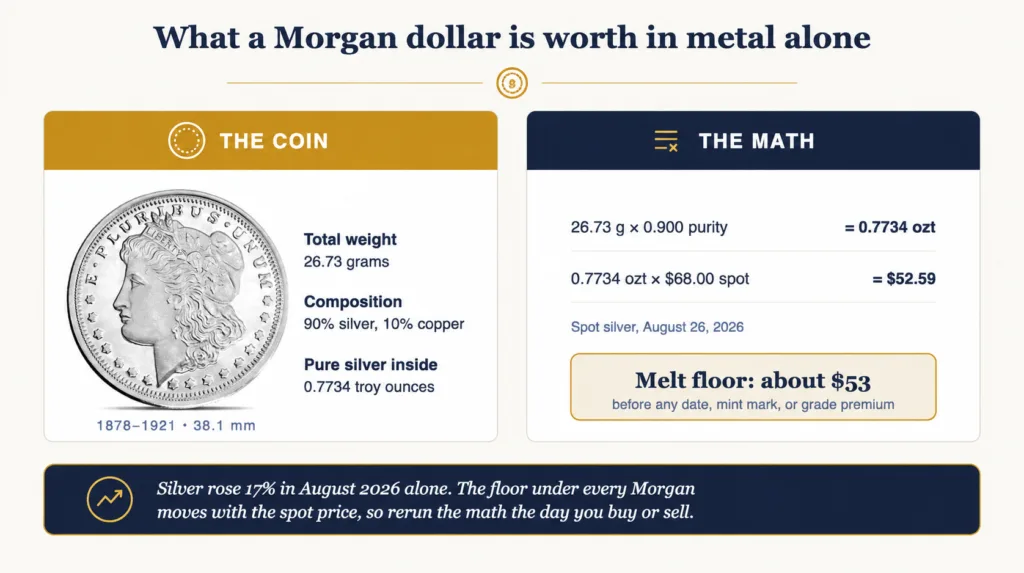
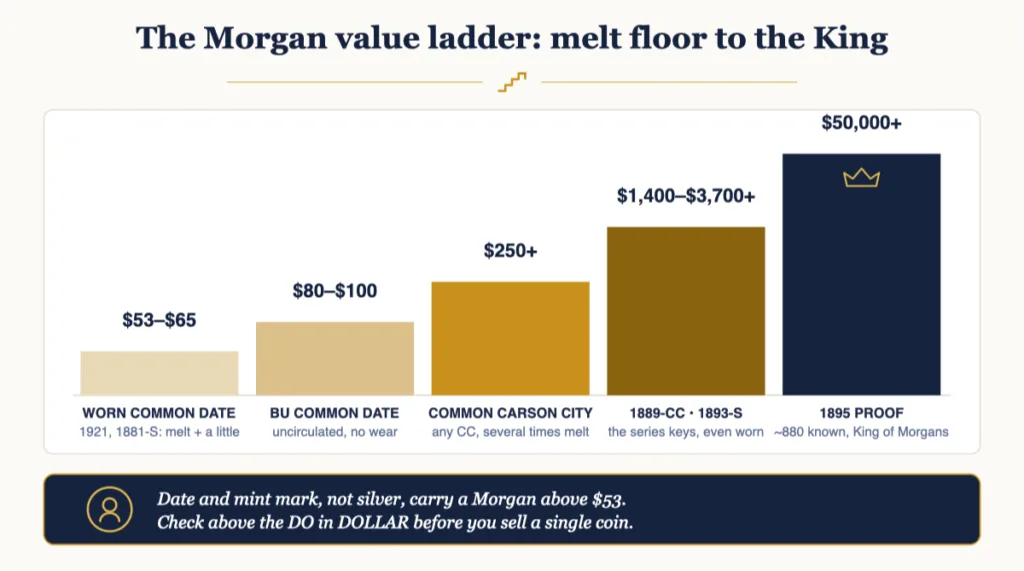
Heavily worn or damaged common dates, what dealers call culls, trade right on this floor, priced like 90% junk silver rather than like collectibles. Nicer circulated common dates bring a modest premium over melt, and an uncirculated common date such as an 1881-S or a 1921 typically retails in the $80 to $100 range. That premium is real but thin, which cuts both ways. If a buyer offers you $30 for a worn Morgan today, they are keeping two-thirds of your metal. If a seller wants $150 for an ordinary circulated 1921 “because it’s over a century old,” age is doing work that rarity is not.
Dates and mint marks that break away from melt
Flip the coin to the reverse and look just above the “DO” in DOLLAR, below the eagle’s wreath. A small letter there tells you which mint struck it: O for New Orleans, S for San Francisco, D for Denver, CC for Carson City, nothing for Philadelphia. Our guide to mint marks on US coins covers the system in detail, and on a Morgan those two millimeters of type can move the price more than anything else on the coin.
Carson City is the mint mark everyone hopes for. The CC facility sat next to the Comstock mines, struck Morgans in small numbers from 1878 to 1893, and closed for good, so every CC dollar carries Old West cachet and a premium of several times melt even for the most common dates. There is a wrinkle worth knowing: in 1964 the Treasury discovered millions of uncirculated CC dollars still sitting in its vaults and sold them to the public through the General Services Administration in the 1970s. A GSA dollar in its original black plastic holder is worth more with the holder intact, so never crack one out.
Then come the coins that stop being silver and start being trophies. The 1889-CC is one of the two great keys of the series, worth several hundred dollars even heavily worn, around $1,900 in Very Fine, and five to six figures uncirculated, per NGC’s 1889-CC price guide. The 1893-S, with the lowest business-strike mintage of the series at roughly 100,000 coins, starts near $3,700 in heavily worn condition and has crossed $350,000 in gem uncirculated.
And the crown is the 1895 from Philadelphia, the “King of the Morgans”: only about 880 proofs are known to exist, and no circulation strike has ever been authenticated, according to PCGS CoinFacts. Examples change hands for $50,000 to well over $100,000 depending on grade. If a raw 1895 turns up in your grandfather’s dresser, assume the date was altered from an 1885 until a grading service says otherwise, because that is the way to bet.
Condition does the rest
Between a common date and a key date sits the third variable: grade. The collector market pays ordinary money for ordinary Morgans and extraordinary money for the best-preserved survivors, and the price curve is not gentle. A common date might bring $60 worn, around $110 uncirculated, a couple hundred dollars in MS65, and four figures by MS67. Reference tables like the PCGS Morgan dollar price guide show that hockey-stick shape on nearly every date in the series. On many dates the jump from MS64 to MS65 alone triples the price, which is why collectors argue about single points of grade the way lawyers argue about commas.
Two practical rules follow from this. First, never clean a Morgan. Not with a polishing cloth, not with baking soda, not “just a little.” Cleaning strips the original surface, and a cleaned coin gets a details grade and a haircut of half or more of its value, permanently. Toned, dark, crusty original coins are worth more than scrubbed shiny ones, which surprises every non-collector alive. Second, if the date and mint mark math above suggests your coin is worth several hundred dollars or more, stop guessing and submit it for professional grading at NGC or PCGS. Authentication matters as much as the grade; the valuable dates in this series have been counterfeited and date-altered for a century.
Three coins that all look like Morgans
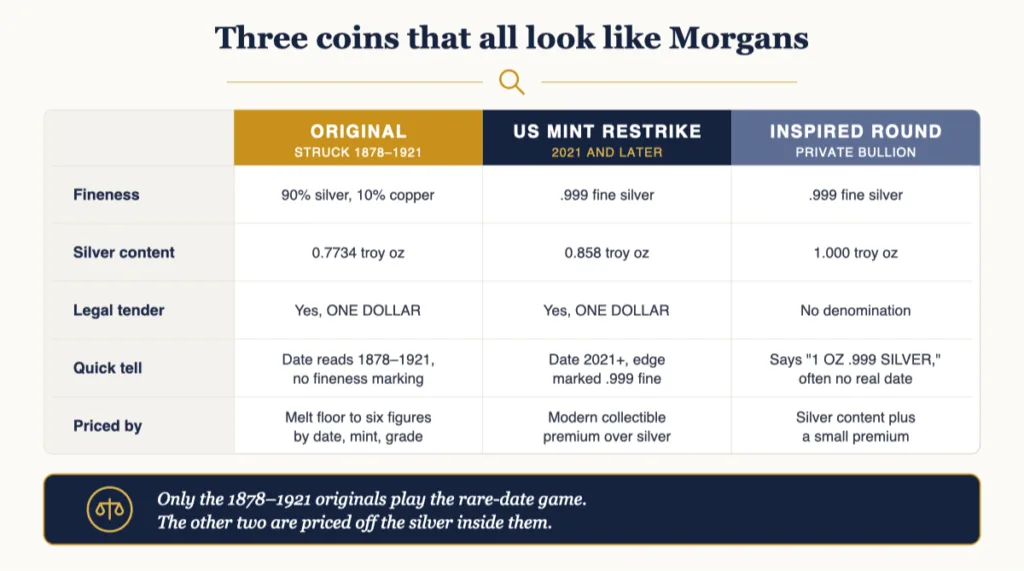
Here is where modern buyers get tripped up, because three very different products now wear George Morgan’s design.
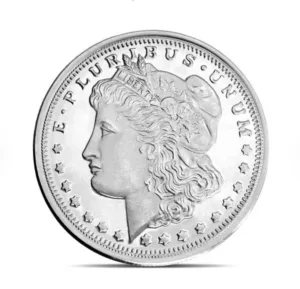
The original is the 1878 to 1921 coin we have been discussing: 90% silver, 0.7734 ounces of it, priced from melt to the moon. The second is the modern US Mint restrike. Since 2021 the Mint has issued new Morgan dollars in .999 fine silver containing 0.858 troy ounces, sold at a premium as collectibles, with details in Coin World’s specifications report. They are attractive coins and they actually hold more silver than the originals, but they are modern products with modern mintages, and a 2021-dated Morgan is not rare. The third is the private silver round “inspired by” the Morgan design: usually a full troy ounce of .999 silver, no date that matters, no ONE DOLLAR denomination, and no legal-tender status. Rounds are honest bullion and often the cheapest way to buy the design, as long as nobody is charging you collector money for them.
The originals and their 1921 successor are still widely traded as bullion-adjacent coins, which is exactly how most common-date survivors change hands today.
Morgan and Peace Silver Dollars
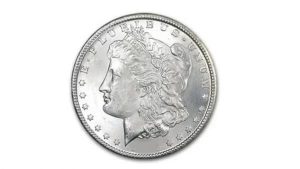

And if you just want the design at the lowest cost per ounce, the private rounds carry more silver per dollar than any dated coin.
Morgan Dollar Inspired Silver Rounds
Five minutes with your coin before you do anything
Sort your Morgans the way a dealer would. Read the date and find the mint mark above the DO in DOLLAR. Anything dated 1921 with no mark or a D or S is almost certainly a common coin worth melt plus a little; the same goes for high-mintage dates like 1881-S or 1884-O in worn condition. Any CC coin goes in the “look closer” pile automatically. So does any 1889-CC, 1893-S, 1894, 1895, or 1903-O, and any coin that looks like it has never been touched, with full frosty luster and no wear on Liberty’s cheek or the eagle’s breast. Weigh a suspicious coin if you can: 26.73 grams, give or take a small tolerance. A common counterfeit is light, and no genuine Morgan is dated 1905 through 1920, because none were struck in those years.
I will leave you with the mistake I see most often, and it is not overpaying for a rarity. It is treating a $53 coin like a $5 coin. People inherit a coffee can of worn Morgans, assume old silver dollars are a novelty, and take the first offer that sounds like more than a dollar. At today’s silver price that can is worth real money on metal content alone, before anyone checks a single date. Run the melt math first, check the dates second, and get a second opinion on anything from Carson City. The floor is $53 and rising; make sure nobody buys your coins as if it were still 1995.